
CHAPTER 5: THE WEIGHT OF THE FOUNDATION
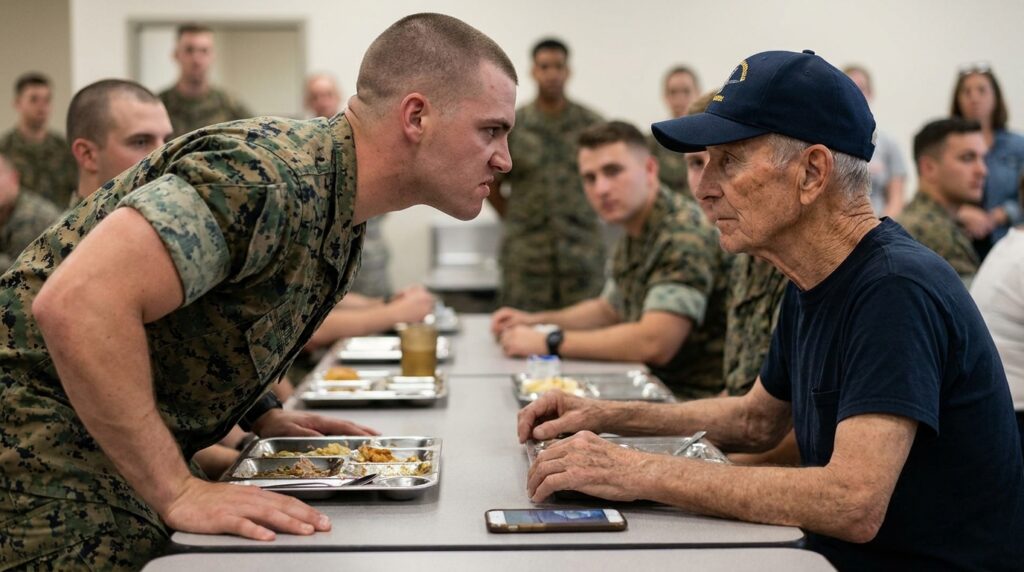
“Now sit down and eat,” I said.
My voice didn’t rise above the persistent hum of the ceiling intake, but it reached the edge of the row with the flat, unnotched weight of a dropped lead plumb. The recruit was still down. His large hand, the skin scraped raw along the outer knuckle where it had grazed the iron seat bracket, was pressed flat against the gray floor sealant. A patch of dark purple fluid was beginning to seep through the white grout line right under his thumb—not blood, but the thick, bitter hydraulic oil that ran through the low-level drainage gates.
He didn’t look up immediately. His broad shoulders remained curved over his ribs, his chest expanding in rapid, uneven jerks that smelled of salt-crusted canvas and dry protein meal. The three junior trainees at his table sat perfectly frozen, their forks suspended like small zinc teeth against the white light of the fluorescent tubes. The entire middle tier of the mess hall had become a dead lane.
“The manual doesn’t include the silt because the people who write the specifications don’t live on the lower tier,” I told the space between his ears. I pulled the navy cap down until the frayed edge of the brim cleared the line of my forehead. The gray laminated plastic card stayed tucked deep behind the wire anchor insignia, its sharp edge pressing against the knuckle of my index finger. “They assume the pressure stays steady because the gauge on the wall has a green light. But the light is just a bulb. It doesn’t clear the lines.”
The recruit slowly pulled his right knee under his hip, his boot leather giving a short, wet grunt as it slid through the purple grease patch. His face was gray now, the small razor scar at the corner of his jaw showing white and rigid against his skin. His arrogance had been redirected, but it hadn’t turned into respect yet; it had settled into the dull, defensive confusion of an animal that has run full-tilt into an iron stanchion.
“You’re done with the table lane, son,” I murmured, my hand returning to the edge of my tray. The black tea in the ceramic mug didn’t move. The mass of the building was too dense to allow local vibrations, but beneath the concrete slab, five yards down through the drainage vents, a heavy, dull thud-clank echoed through the iron piping—the unmistakable sound of an automated valve hunting for a seal that had been eaten away by salt water thirty years back.
Behind the recruit, the old man from the supervisor’s cage didn’t take another step. He stood at the edge of the light tier, his canvas folder clamped under his arm like a scrap of dry timber. He didn’t offer a hand to the kid on the deck. His thumb was busy tracking the notch on his largest brass key, his attention fixed entirely on the floor seam where the purple fluid was widening into a shallow pool.
“The duty officer is already past the second checkpoint,” the old man said from the shadow lane. His teeth were yellowed, his words carrying the flat, dry accent of the old yards down near the river mouth. “He’s got the computerized manifest on his tablet. He thinks the third tier is empty because the logistics register says the door was welded shut during the re-coring in ninety-eight.”
“The re-coring only went down to the zinc line,” I said, without turning my head toward the shadow. I looked at the junior trainees who were slowly beginning to lower their eyes back to their cold trays. “They didn’t replace the backing plates under the foundation bolts. They just painted over the scale.”
The recruit finally found his feet. He rose slowly, his right hand gripping the edge of the laminate table until the plastic groaned under the localized torque. He didn’t look at his squad mates. He stood three inches shorter than he had two minutes ago, his posture compromised by the bruise forming beneath his camouflage blouse where the iron bracket had intercepted his ribs.
“This isn’t an base station,” the kid whispered, his teeth clicking together once from the involuntary chill that follows a sudden loss of kinetic stability. He wiped his greasy palm against his leg, leaving a dark, wide smear across the crisp camouflage pattern. “You’re… you’re not on the roster. I checked the administrative manifest at the gate before the morning shift.”
“The morning shift is for the people who handle the paper,” I told him, my fingers tightening slightly on the ceramic mug. “The people who handle the iron don’t use the gate. We stay with the foundations until the weight shifts.”
A loud, metallic buzz cut through the dead air of the mess hall—the secondary warning horn from the main gatehouse across the quadrangle. It wasn’t the fire alarm; it was the specific, three-beat pattern that signaled a pressure drop in the high-pressure water mains that serviced the fire-suppression grid. To the recruits, it was just a noise that meant the next detail was delayed. To me, it was the sound of the marsh water finding the third seam in the underground ordinance silo right under our boots.
The old man near the supervisor’s cage turned his back to the room, his heavy work shoes clicking against the iron grate of his door runner as he stepped back into the dark. The brass key ring gave one short, final rattle before the latch clicked home, locking the blueprint folder inside the zinc-lined cabinet where the moisture couldn’t touch the paper.
I picked up my tray, my steady hands balancing the weight of the cold tea and the untouched meal remains. The recruit didn’t move out of the lane. He stood there, his chest still heaving slightly, his eyes fixed on the gray plastic corner that was now peaking clearly from the inner seam of my navy cap—a gray marker that didn’t match any security level taught in the current basic cycle.
“Sit down and finish the lard,” I said, stepping past his shoulder into the clear aisle. “You’ve got twenty minutes before the valves go to manual, and you’re going to need the grease on your hands before the afternoon is over.”








