
CHAPTER 4: THE FULCRUM AND THE VECTOR
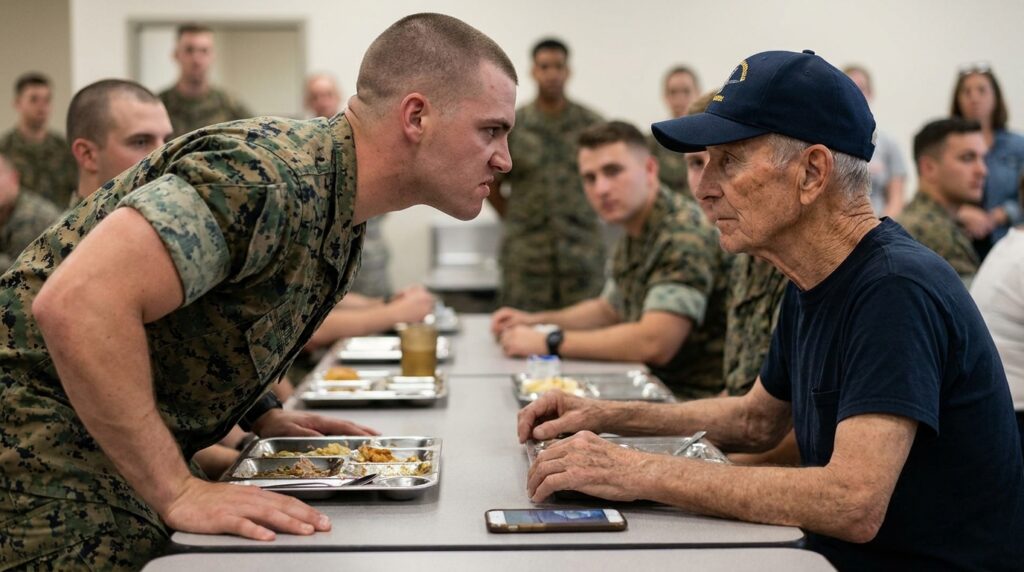
The kid’s fingers reached the steel rim of the tray, his knuckles turning the color of lard under the strain of his leap. He didn’t pull back. He drove his center of mass down, his boots slipping three inches on the gray floor sealant as he tried to pin my forearms between the metal casing and his chest. It was a standard line-force entry, the kind they teach in the physical security course to isolate an uncooperative subject before the lock-irons are applied.
But he had already given away his leverage. By leaning four inches past his baseline, his vertical axis was completely dependent on the resistance of my tabletop.
I didn’t slide my chair back. I rose vertically, using the direct iron framing of the bench seat to lift my hips three inches before his left hand could lock under the lip of the zinc plate. My right hand, still open and dry against the laminate, didn’t fight his fingers. It went under his forearm—exactly two inches behind the wrist bone, where the heavy utility sleeve met the lithium grease stain on his cuff.
The physics of a seventy-eight-year-old skeleton are different from the physics of twenty. You do not use muscle against hydraulics; you use the angle of the pin.
I rotated my palm toward the light tubes, forcing his locked elbow to turn outward by five degrees. It was a minor mechanical adjustment, a single turn of a valve, but it shifted his forward momentum from a direct push into a lateral slide. His boots, already compromised by the salt-crust on the concrete floor, lost their remaining grip. The stiff leather gave a sharp, dry bark against the gray sealant.
The room didn’t move. The hundred pairs of eyes locked onto the row saw the recruit’s chest drop onto the table lane, his broad shoulders overextending as his balance disintegrated. He tried to correct by dropping his right hip into the table frame, but his mass was moving too fast down the vector he had chosen.
I kept my hand behind his wrist, not pulling, simply maintaining the pivot point until his own weight carried him past the edge of the laminate. His shoulder hit the iron bracket of the fiberglass bench with a hollow, metallic boom that sounded like a heavy hatch slamming in an empty hold.
The momentum took him down completely. His knees cleared the floor runner, his camouflage blouse catching on a loose zinc bolt under the table frame before his entire length flattened against the concrete deck. He landed on his side, his hands out to guard his face, his breath exiting his lungs in one short, wet rattle that killed the last remaining echo of the cafeteria chatter.
The silence that followed was different from the waiting quiet of two minutes ago. It was absolute. The mechanical thrum of the ventilator intake seemed to drop an octave, the cold air smelling suddenly of old bilge water and ancient, pressurized grease from the floor drains. Three rows over, a plastic fork slipped out of a junior soldier’s hand, hitting the fiberglass surface with a sound that felt as loud as a starter pistol.
I stood beside the table, my feet anchored to the seam where the concrete plates met the drainage line. My palms were cold, the skin dry, my heart rate steady at seventy beats. I looked down at the recruit. His buzz cut was three inches from my boot heel, his face turned toward the floor, the razor scar on his jaw dark red against his pale skin. He wasn’t bleeding, but his eyes were wide, staring at the grey floor sealant as if trying to calculate the mathematical error that had put him on the deck.
The navy cap had slid three inches during the shift, resting against the ceramic mug. From beneath the faded wire insignia, the edge of an old gray card protruded—a thick, laminated plastic corner showing a serial number printed in black indelible ink that had begun to bleed into the borders. It wasn’t an base pass. It was an old logistics identifier, the gray color reserved for the units that didn’t appear on the morning manifest.
Behind the recruit’s shoulder, the figure in the dark corridor near the supervisor’s cage took two steps forward, entering the fringe of the fluorescent glare. The brass key ring on his belt loop didn’t rattle this time. He held a small, heavy folder under his arm—the canvas binding rotted around the brass eyelets, the paper inside showing the gray edges of forty-year-old blueprint stock. He didn’t look at the kid on the floor. He looked at the watch on my wrist, his thumb tracing the iron latch of his supervisor’s gate.
“The seal on the third tier is down to twelve pounds,” the old man from the cage said. His voice was lower than mine, the words sliding across the dead space of the room like a heavy cable scraping over a fairlead. “They’ve been running the digital pumps since seven, but the lines are full of silt from the marsh drains. The kid didn’t read the manual.”
I reached down and picked up the navy cap, my thumb covering the gray card before the trainees at the nearest bench could identify the serial prefix. The wire insignia felt cold under my hand, the gray-green crust rough against my skin.
“They don’t print the manuals for silt,” I told him, looking down at the recruit who was slowly beginning to bring his hands under his chest to push his mass off the floor. His movements were slow now, his hydraulics leaking air. “They think the iron stays clean if you keep the grease off the shirt.”








