
CHAPTER 2: THE INTERACTION LANE
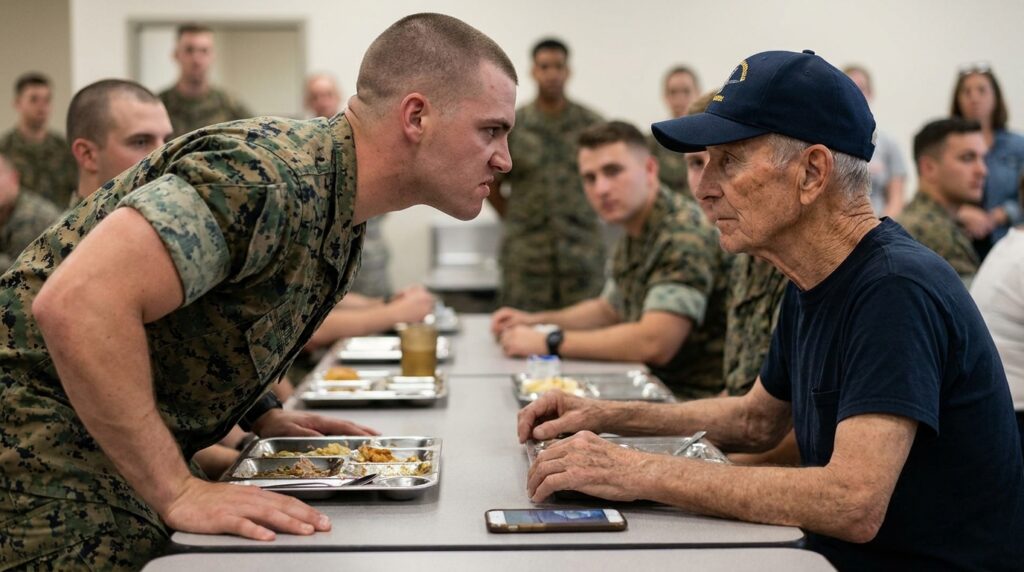
The silence in the mess hall was not a clean thing. It was thick with the smell of scorched lard from the galley vents and the damp, metallic tang of gray floor sealant that had been scrubbed raw by generations of green-stripping pads. My right thumb remained on the notched crown of the silver watch. Sixty seconds to the minute. The click inside the casing was a vibration I felt in the bone of my wrist rather than a sound, a faint, rhythmic drag that told me the mainspring was pitting.
The recruit’s hand didn’t move from the laminate surface. Up close, the white glare of the fluorescent tubes caught a smear of industrial lithium grease on the seam of his right sleeve cuff—a fresh mark, the specific heavy lubricant they used on the old hydraulic tracks down in the low-level supply channels. It was an unforced error. A trainee on this base should have been handling dry graphite or synthetic spray, not the old lard-thick compounds meant for obsolete iron.
“You’re crowding the tray, son,” I said. My voice didn’t carry past the third row of fiberglass benches, but in the dead air, it had the dry, abrasive quality of coarse emery paper sliding over a rusted plate. “The grease on your cuff is going to ruin the finish on that utility shirt.”
The kid’s fingers twitched, but his palm stayed anchored. His chest expanded, the stiff, unwashed cotton of his camouflage blouse rasping against his undershirt with a sound like dry grass under a boot. He didn’t look down at his sleeve. He couldn’t. To break eye contact now would be a failure of his own internal friction, a loss of the momentum he had spent three loud comments building across the aisle.
“I don’t care about the shirt,” the recruit whispered. The skin around his nostrils had turned a sharp, bloodless white. He shifted his weight again, his right boot heel grinding into a salt-pitted pockmark in the concrete floor. The leather groaned under the torque. “And I don’t take suggestions from people who are just waiting around for the afternoon bus. You didn’t answer the question.”
Behind him, the room had settled into a hard, competitive stillness. The junior soldiers at his table had stopped their forks completely. One of them, a kid with grease under his fingernails and an unbuttoned collar, slowly lowered his plastic mug until it hit the tray with a dull, hollow click. Nobody reached for their pockets. Nobody moved their feet. In an American mess hall under an unwritten rank structure, a challenge like this was an operational sequence that had to run its course until something broke or someone with silver on their collar stepped through the fire doors.
I kept my eyes on the small white razor scar at the corner of his jaw. The tissue was slightly raised, an imperfect heal that showed he had a habit of turning his head too fast while the blade was moving. He was relying on the mass of his shoulders—the raw, gym-built bulk that didn’t take into account the natural pivot points of a human frame when it’s anchored to a slick floor.
“The question,” I told him, keeping my arms loose against the cold steel rim of the tray, “was about proof. But you haven’t established the baseline yet. You’re leaning forward four inches past your boots. If the deck rolls five degrees to the port side right now, you’re on your face without me touching a finger to your shirt.”
A low rustle passed through the benches behind him—a micro-shift of boots against steel runners. Someone in the back cleared their throat, the sound sharp and short, like a dry stick snapping in winter.
The recruit’s face darkened, the pink skin under his buzz cut turning the color of raw brick. His fingers curled, his nails scraping a gray streak into the worn laminate pattern between our trays. “There aren’t any ships here, old man. This is dry dirt. This is the present day.”
“The dirt is never dry under a concrete slab,” I murmured. My hand slid one inch to the right, my fingers lightly touching the edge of the navy cap. The green-gray wire thread of the insignia felt rough under my skin, like frozen sand. “The water tables under these old coast batteries always find the seams. You can smell the rust in the floor drains if you know how to breathe through your nose.”
He didn’t take the warning. His shoulder dropped three inches, his center of gravity shifting deeper into the table lane as his elbow locked out. He was preparing to press his palm into the center of my tray, a classic service-entry flex meant to push an older man’s spine back against the bench support. It was a simple, mechanical calculation based on the assumption that seventy-eight years of age meant thirty percent less structural resistance in the lumbar vertebrae.
I watched the lithium grease mark on his sleeve move another half-inch closer to my cold tea. In the dark gap by the supervisor’s cage, the face from nineteen years ago didn’t move. The old man standing there just reached up and unhitched a brass key ring from his belt loop, the metallic rattle small but distinct across the dead space of the room. The sound was a trigger I didn’t need, but it confirmed the architecture. The lane was locked.








