
CHAPTER 6: THE DISCREPANCY IN THE MANIFEST
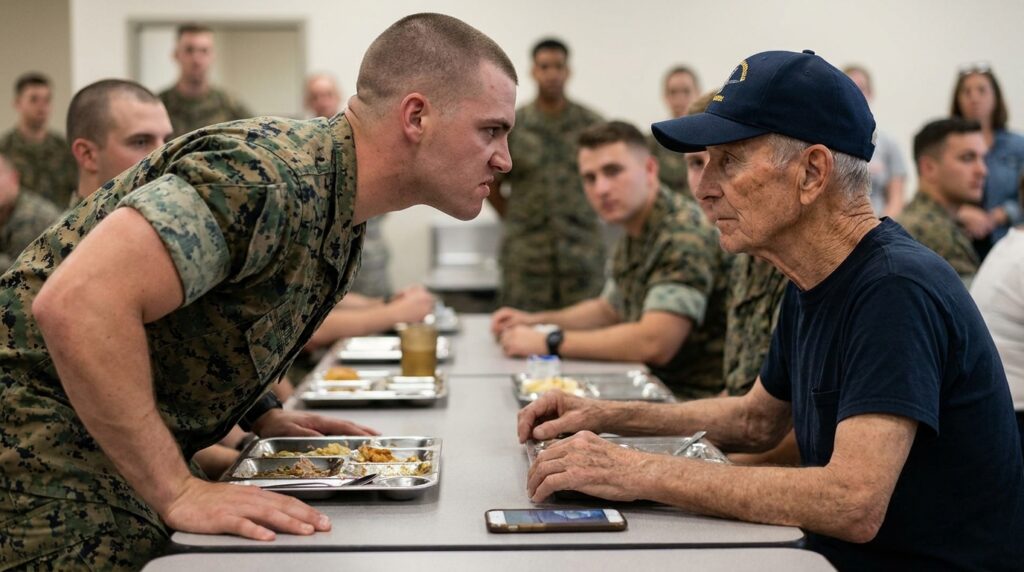
The grease on my boots left a thin, iridescent film across the steel floor plate of the dish-return alcove. I set the tray into the structural slot, the zinc surface scraping against the plastic rim with a short, high-pitched screech that cut cleanly through the lingering silence of the middle aisle. Behind me, the recruit hadn’t returned to his bench. His shadow stayed fixed against the white glare of the middle row, his broad shoulders slightly dropped, his posture holding the precise imbalance of a mechanical component whose casing has been warped by an unexpected load.
The fire doors at the north end of the hall swung open with a heavy, pressurized hiss. A master warrant officer entered, his utility blouse stiff with starch, the black leather of his clipboard holder tucked firmly into the pocket formed by his left elbow. His name tape read VANCE. He didn’t look at the trainees. He didn’t look at the purple hydraulic fluid slowly widening its perimeter along the center grout line. His eyes were fixed entirely on the small supervisor’s cage near the scullery doors, his boots striking the concrete with a quick, rhythmic cadence that stopped exactly six inches from my shoulder.
“The main line is down four pounds, sir,” Vance said. His voice was low, clipped, using the non-commissioned officer’s cadence that assumes the room is always listening for an operational error. He didn’t address me by name, but his eyes dropped to the navy cap in my left hand, tracking the green-gray thread of the insignia until his jawline tightened. “The automated system at the station gatehouse says the valve is locked out at the manual station. We’ve got an administrative discrepancy on the logistics tablet.”
The recruit took two steps toward the alcove, his boots squeaking against the wet gray sealant. His face was still pale from the structural drop, but the sight of the master warrant’s starch seemed to activate his residual training line. He straightened his spine, his hands pinning themselves against his seams, though his left side still hitched slightly from the contact with the table bracket.
“Sir,” the recruit barked, his voice cracking slightly before it caught the institutional frequency. “The civilian was… he was clearing the lane without an updated base pass. I attempted to enforce the administrative perimeter as per the morning briefing.”
Vance didn’t turn his head to look at the kid. He kept his clipboard flat against his ribs, his thumb lifting the heavy iron spring of the retaining clip by an eighth of an inch. “Stand down, trainee. Your detail hasn’t been signed off by the machine shop supervisor. You’re out of your assigned division.”
“But the card, sir,” the recruit pressed, his insecure pride forcing him to push past the warrant’s verbal boundary—an error that usually resulted in extra duty hours at the wash racks. “He’s got a gray ledger card in the cap liner. It’s an expired serial. It doesn’t match the current database.”
Vance finally shifted his gaze, his gray eyes locking onto the recruit’s face with the flat, unyielding weight of an anvil dropping into sand. “I said stand down, son. The database only covers the hardware that requires electricity to turn. If you’ve got grease on your shirt, you belong in the lower maintenance bay, not interpreting the manifests in the dining tier.”
The low clank-clank sounded again from the dark corridor behind the supervisor’s cage—sharper now, the metallic impact carrying the high-frequency ring of steel hitting cold water. The purple fluid in the grout lines was no longer stagnant; it was pulsing in small, rhythmic surges that indicated the return lines from the underground silo were backing up against the primary floor drains. The smell of old iron and sulfur was beginning to rise through the copper vents, heavy enough to turn the air inside the alcove cold and thick.
I reached into the cap liner, my fingers catching the smooth, heavy corner of the gray laminated card. I didn’t hand it to Vance. I merely held it flat against the zinc edge of the dish-return slot, letting the white fluorescent light hit the faded black indelible numbers stamped across the center: SYS-04-DECOM.
Vance looked down at the prefix. The starch in his collar seemed to hold his head perfectly rigid, but I felt the micro-shift in his weight as his boot heels cleared the wet grease patch on the plate. He didn’t touch the clipboard. His right hand came up slowly, the movement unhurried but exact, his fingers forming a stiff, level line against the brim of his utility cap. A formal salute inside a base cafeteria—a direct violation of the standard regulatory handbook, but a mandatory structural correction according to the older unwritten manual of the tier yards.
“The gatehouse didn’t receive the clearance log from the lower silo,” Vance said, his hand remaining fixed at his brow while the three rows of junior trainees behind him slowly began to slide off their fiberglass benches to see who owned the name on the gray plastic. “The duty officer thought the decommissioning manifest was completed in ninety-eight.”
“The paper was completed,” I told him, my voice flat against the hiss of the fire doors as they began to close behind us. “The iron is still down there. And it’s hunting for a ground.”
The recruit’s hands slowly slipped from his seams, his jaw dropping an inch as he watched the master warrant hold the salute against the background noise of the clattering dish slots. The white razor scar on his jaw looked thin and sharp against his skin, a small mechanical mark that had no value inside a room where the foundations were beginning to leak.








