CHAPTER 8: THE HEAVY TOLL
The earth under the front left tire didn’t just drop—it vanished.
The primary asphalt pad sheared with a sound like a small caliber rifle shot, a clean vertical break that sent a spiderweb of hot black fractures tracing across the remaining apron. The seven-ton dump truck hung for one protracted, agonizing heartbeat on its heavy steel crossmembers before the hydraulic oil reservoirs ruptured under the twist. A twin stream of red fluid hissed out onto the scalding iron brake drums, filling the narrow space between the houses with a thick, choking cloud of vaporized grease.
Arthur lunged forward, not away. His heavy work boots ground into the shifting, liquefied silt as he grabbed the side-mounted control lever of the gravel bed. He didn’t lock it; he threw his entire skeletal weight against the manual emergency release pin. The internal locking dogs, caked with old corrosion and gray lime dust, screamed as they slipped, then fired open with an explosive metallic ring.
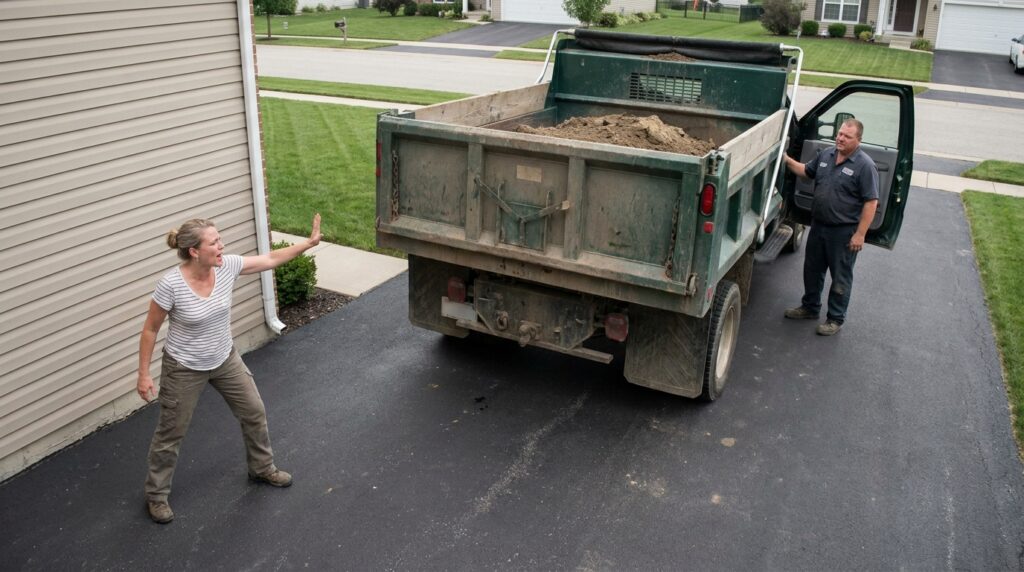
The dump body shot skyward with a high-pitched hydraulic squeal. Twenty thousand pounds of crushed limestone gravel slid from the tailgate in one continuous, thundering sheet, pouring directly into the gaping cavern where the high-pressure geyser had unearthed the foundation. The weight of the stone didn’t just fill the hole—it acted as a massive structural ballast, hitting the fractured copper main and the broken brass T-junction with a crushing, suffocating force that instantly strangled the geyser down to a low, muddy boil.
The silence that followed was heavy, wet, and absolute.
The diesel engine had choked out when the frame twisted, its cooling fan spinning down into a clicking stop. The pale gray light of the July noon caught the fine mineral mist that settled over everything—the truck, the ruined driveway, the gathering cluster of neighbors who stood perfectly frozen at the edge of the yellowing sod.
Arthur stayed down, his hands resting on the raw iron handle of his wrench, his breath coming in hot, shallow rattles through his teeth. His face was gray with limestone dust, his knuckles bleeding into the wet sand that clung to his canvas work pants. He looked down into the crater. The bright copper pipe was buried now, crushed flat beneath three tons of public aggregate, but the rusted iron head of the original county survey pin remained visible at the absolute perimeter, unyielding, a silent witness to the true boundary line.
The woman hadn’t moved from the corner of her garage wall. The wet spray had washed away the starch in her floral shirt, leaving it plastered against her ribs like a second skin. Her sunglasses had slipped slightly down her nose, revealing her eyes for the first time—not the cold, calculated disks of a neighborhood tyrant, but two bloodshot, exhausted hollows that looked at the pile of stone with the numb, hollow stare of someone who had spent twenty years defending an empty vault.
“It’s over, ma’am,” Arthur said. His voice was low, flat, carrying the immense physical exhaustion of a man who had spent his entire life working the dirty margins of a city that didn’t care about his history. He didn’t lift the wrench. He didn’t point his finger. “The loop is dead. The pressure’s gone. The district will have an excavation crew out here with concrete cutters before the shift change.”
She looked at him, then past his shoulder to where George and the other residents stood. None of them spoke. None of them pulled out their phones to take another picture. The collective realization was a quiet, suffocating pressure that seemed to flatten the entire cul-de-sac. They weren’t just neighbors anymore; they were an unindicted group who had signed the fake books and accepted the cheap, unmetered flow from a ghost board because it kept their private balance sheets clean.
Miller stepped into the space between the truck’s listing bumper and the foundation, his digital tablet tucked under his arm like a piece of useless timber. He didn’t look at his schematics. He looked at the white carbon paper map that Arthur had pulled from the lawn—the handwritten ledger of the illegal taps.
“The state attorney’s office is going to require the full registration books, ma’am,” Miller said, his administrative voice sounding thin and small against the vast, ruined architecture of the driveway line. “For every house on this branch. We have to trace where the infrastructure bypasses terminate.”
The woman reached up, her fingers trembling slightly as she pushed her sunglasses back up the bridge of her nose, restoring the flat gray mask that had hidden her face for decades. She drew her shoulders back, her chin lifting into one final, tragic performance of the sovereign gatekeeper.
“The books are inside,” she said, her voice dropping into a clear, rhythmic cadence that sounded exactly like a board meeting adjournment. “They’ve been ready since ninety-four. My husband kept them in alphabetical order by parcel number.”
She turned and walked back toward the screen door, her wet work pants making a heavy, scraping sound against the concrete porch steps. The door clicked shut behind her with a soft, hollow rattle that marked the absolute end of the empire she had forged out of paper and secrets.
Arthur stood up slowly, his spine popping with a series of sharp, painful clicks as he straightened his back. He didn’t follow her. He walked to the back of the dump truck, his calloused hands catching the cold steel gate to steady his balance as the heavy frame settled into the gravel base. The job was done. The line was closed. He reached down and picked up his heavy aluminum permit case from the grass, shaking the wet sand from the metal edges before latching it shut with a quiet, dull snap.