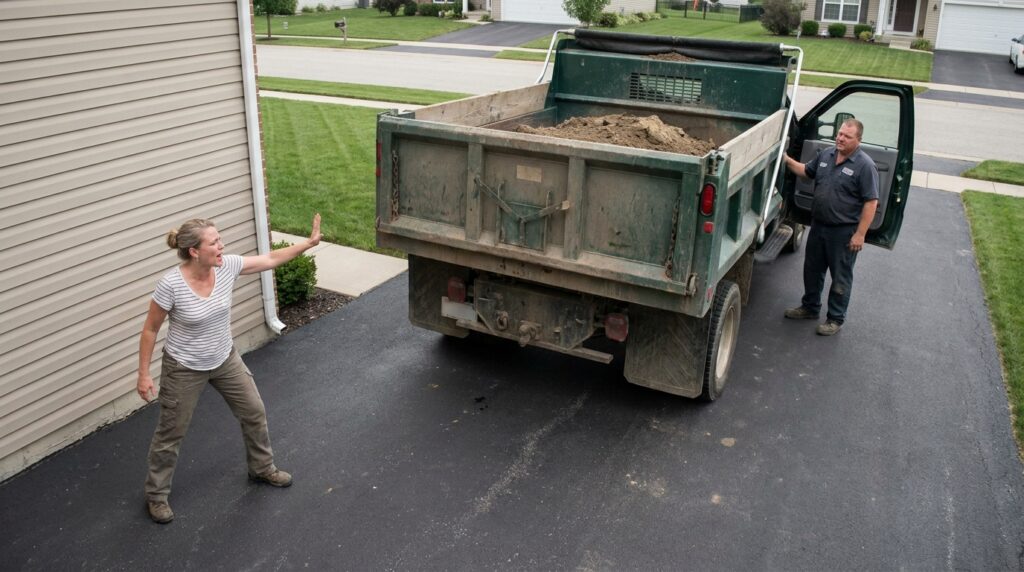
CHAPTER 3: THE STRANGE OVERRIDE
The steel deck plates beneath Arthur’s boots shook as the hydraulic line bellowed. It was a sharp, high-pitched screech—the sound of valves being forced against an internal mechanical lock.
He lunged past the front fender, the grease-slicked steel of the dump body scraping his shoulder as he rounded the chassis. His hand went instantly to the secondary control housing mounted behind the cab, a heavy cast-iron box rusted shut at the hinge pins. The auxiliary lever was down, pinned into the raise position by a wedge of weathered pine wood.
Arthur jammed the heel of his palm against the wood, splintering the dry pine until the grain tore into his skin. The iron lever slammed back into neutral with a heavy, wet thunk, and the high-pressure groan subsided into the standard, rhythmic rattling of the diesel.
“Get away from that side panel,” he said without turning around.
The woman hadn’t run. She stood near the rear duals, her breath coming in shallow, ragged gaps that whistled through her nose. The plastic clipboard was tucked tight under her left arm, but her right hand was tucked into her pocket, her thumb hooked over a small, brass-plated key ring that didn’t belong to any standard residential deadbolt.
“This vehicle is an unpermitted hazard,” she said, though the words lacked the structural force of her initial bureaucratic performance. Her gaze flicked toward the house corner, where the damp, iridescent smear on the foundation concrete patch seemed to grow darker under the rising sun. “The pressure from your equipment is cracking the subterranean retention walls. If you discharge that load here, the structural damage will be total.”
Arthur wiped his blood-flecked palm against his work pants, leaving a dark streak across the canvas. He looked down at the auxiliary lever. The cast-iron housing had fresh scratch marks around the lock cylinder—bright, unoxidized silver cuts in the old green enamel. Someone had spent time trying to pick the maintenance plate open before he even put the truck in reverse.
“The only thing down there is a standard sixteen-inch reinforced concrete pipe for storm runoff,” Arthur said, his voice dropping into a flat, investigative register. He stepped closer to the edge of the driveway, his eyes tracking the line of the utility flags. “Unless somebody put something into the easement that isn’t on the county plat.”
“Everything in this subdivision is built according to the master plan,” she said, her head jerking back toward the street. “We don’t allow modifications. We don’t allow deviations. That’s why we have the guidelines.”
Arthur looked at her hands. The black pipe dope on her wrist had begun to dry, cracking into tiny, charcoal-colored fissures that highlighted the tension in her tendons. He knew the look of an operator holding onto a losing hand. In twenty years of clearing lines, he’d seen men stand over illegal septic bypasses with shotguns, and he’d seen municipal clerks alter books to hide thousands of gallons of unmetered water. This wasn’t about a neighborhood weight limit. This was about what happens when the ground gets turned over.
“Let’s see the handbook,” Arthur said, extending a calloused hand toward the clipboard.
She drew back instantly, her shoulders dropping into a hard, protective posture that mirrored the defensive architecture of her house. “The documents are proprietary to the association members. You have no legal standing to inspect them.”
“If you’re using them to halt a county crew on a registered utility corridor, they’re part of the record,” Arthur replied. He didn’t wait for her to hand them over; he stepped into her space, his heavy frame blocking the pale daylight until she was forced to lean against the cold siding of her own garage.
He didn’t grab the papers, but he looked down at the exposed page under the wire clip. The text wasn’t printed on standard legal stock. The heading at the top of the sheet didn’t have the official seal of the county registrar or the corporate tracking number required for an active homeowners’ association. It was a photocopied template from an office supply store, the dates in the margins filled in with a heavy black felt-tip pen that looked less than forty-eight hours old.
The low murmur of an opening garage door across the cul-de-sac broke the silence. A neighbor in a gray undershirt stepped out onto the driveway two doors down, a plastic trash bin in his hands, his eyes locked on the massive dump truck pinned against the split-level facade.
The woman noticed him instantly. Her jaw tightened, the pale skin around her lips turning a stark, bloodless white. She adjusted the clipboard, flipping the top page over with a rapid, defensive movement that completely hid the template from view.
“We have an agreement in this valley,” she muttered, her eyes remaining fixed on the neighbor across the street. “We keep the costs low. We handle our own infrastructure. We don’t need the city coming in with meters and tax assessments for things that were settled twenty years ago.”
Arthur didn’t answer. He looked back down at the damp patch by the foundation, then at the auxiliary pump box on his truck. The scratches on the lock cylinder weren’t from a screwdriver. They were the exact width of a commercial water key—the kind used to turn the underground gate valves on the main county line.