CHAPTER 6: THE TRUE SURVEY BOUNDARY
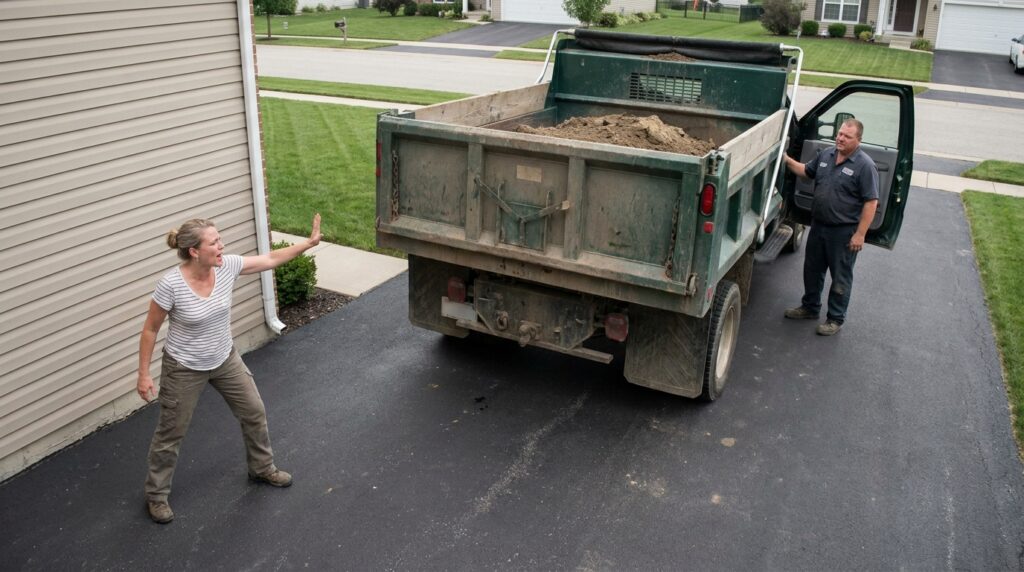
The high-frequency whine from behind the foundation wall grew so sharp that it cut through the thick exhaust smoke like a bone saw. Then came the vibration—not from the dump truck’s engine block, but a deep, subterranean judder that rose directly through the soles of Arthur’s boots.
The wet clay at the bottom of the trench began to slough away, sliding off the copper sleeve as a fresh surge of water bubbled up around the brass T-junction. The pressure was mounting. The small, weeping drip had turned into a steady, rhythmic pulsing that pushed gray sand out from beneath the concrete driveway’s edge.
“Arthur, get back from the edge,” Miller barked, his eyes locked on the digital display of his field tablet. The screen was flashing a sequence of amber alert bars. “The main line pressure for this entire cul-de-sac loop just dropped twelve pounds in thirty seconds. Whatever that booster pump is pulling, it’s back-feeding into the auxiliary distribution manifold.”
Arthur didn’t pull back. He dropped to his knees at the very margin of the asphalt, his fingers plunging into the cold, grease-slicked mud to grope for the base of the copper riser. The friction of the raw stone aggregate scraped his knuckles, but his hand found the cold iron casing of the primary shut-off valve buried six inches beneath the illegal tap. It was a standard municipal curb-stop, but the iron operating nut was completely rounded off, rusted into an unyielding lump by twenty years of subterranean moisture.
“The stop-cock is seized, Miller,” Arthur called out, his voice straining against the wet, sucking sound of the waterlogged clay. “If that pump keeps pulling against a dry main, it’s going to collapse the lateral line under the street.”
The woman didn’t move from her position by the garage door frame. Her hands remained wedged deep inside the pockets of her work pants, her shoulders raised against the pale, desaturated glare of the morning sky. She looked down at the rising water with a look that wasn’t panic—it was a cold, fatalistic validation.
“It won’t run dry,” she said, her voice thin but remarkably clear across the mechanical din. “It hasn’t run dry since ninety-four. The line goes straight to the old high-ridge reservoir tank behind the orchard. The county abandoned the storage facility, but the pressure head remains. It belongs to this land.”
Miller looked up from his tablet, his brow furrowed into a sharp, unyielding line. “The high-ridge tank was drained and decoupled from the grid five years ago, ma’am. There shouldn’t be any head-pressure in that direction unless someone bypassed the primary isolation gate by the utility sub-station.”
Arthur froze, his hands still submerged in the freezing mud. He tracked the direction of the copper pipe with his mind’s eye, mapping it against the three-page blue-line schematic he’d pulled from his cab. The diagram didn’t show a dead-end lateral; it showed a loop that cut behind the residential fences, terminating near the old orchard easement. If that loop had been illegally bridged to an abandoned, unmetered reservoir line, the entire development wasn’t just drawing free water—they were sitting on top of an unmonitored high-pressure loop that bypassed every safety relief valve in the county network.
Across the asphalt curb, George and the other gathering neighbors were no longer just watching from a distance. They had advanced to the very edge of the lawn strip, their heavy boots trampling the yellowing sod. One of them held a phone up, the plastic lens capturing the steady eruption of gray silt from beneath the driveway.
“What do you mean, an illegal loop?” George called out, his voice sharp with a property owner’s immediate calculation of liability. “She’s been collecting seventy-five dollars a month from every house on this street for infrastructure maintenance since the corporate charter renewal in twenty-one. She told us the fees were going directly to the county water district to keep our local rates capped.”
The woman turned her head toward him, her sunglasses reflecting the pale amber light of the supervisor’s truck. “The county would have doubled your baseline usage fee the moment they took over the local lines, George. I saved you thirty thousand dollars in municipal assessments over the last ten years. You signed the proxies. You wanted the costs kept down.”
“We signed the proxies for the association, not a private utility heist,” George spat back, taking another step forward before Miller raised a flat, orange-vested arm to stop him.
“Stay off the driveway, folks,” Miller warned, his voice tight. “The sub-base is washing out under the asphalt. Arthur, pull out of there now. The weight of the rear wheels is going to drop the whole chassis into the trench if that sand keeps shifting.”
Arthur reached for his heavy steel utility wrench, jamming the long handle under the truck’s rear leaf spring to use as a temporary lever against the slipping mud. The iron tool creaked under the immense strain, the cold metal slipping against the grease-slicked casing of the axle. He could feel the physical failure coming—the subtle, sickening tilt of seven tons of steel as the underlying earth turned to liquid grout. He had the legal right, the permits, and the blueprints, but the material reality of the old infrastructure didn’t care about the chain of command. It was breaking beneath them anyway.
He looked across the yard toward the patio chair. The wind had caught the clipboard again, lifting the top pages completely. Beneath the forged bylaws and the expired charter lay a third document, printed on old carbon paper with a faded purple ink signature that matched the name of the supervisor who had run this district three decades ago.
It wasn’t a deed or a utility permit. It was a handwritten map of the neighborhood valve network, annotated with small, meticulous numbers that detailed exactly how many turns of a key it took to isolate the cul-de-sac from the county meters without tripping the main office alarms.
The booster pump inside the crawlspace suddenly gave a wet, metallic screech as the intake lines filled with thick, gray silt, the sudden resistance sending a violent hydraulic shockwave backward through the exposed brass T-junction.