CHAPTER 4: THE SUBTERRANEAN TAP
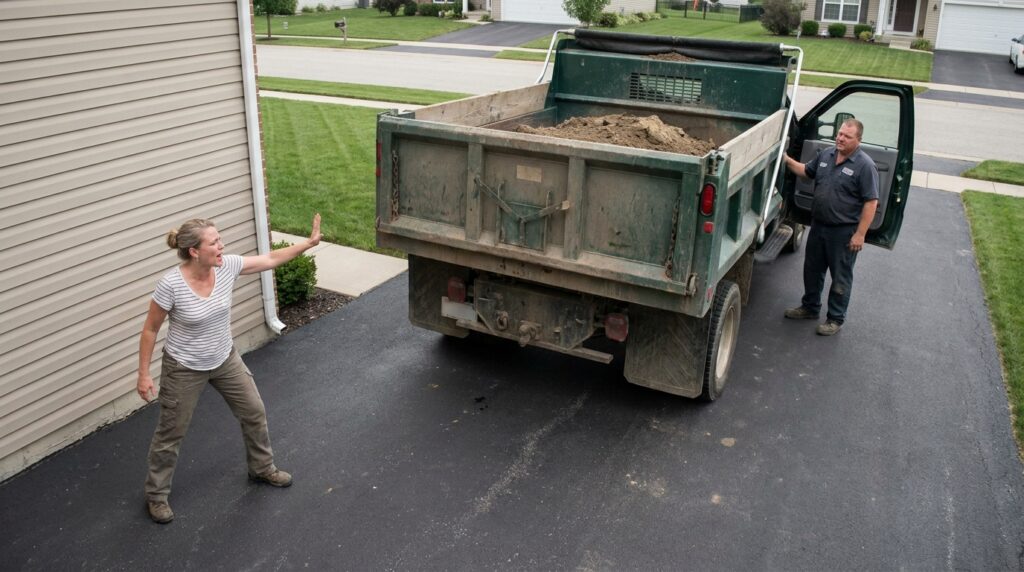
The spade hit something that wasn’t bedrock. It was a dull, heavy thud that vibrated straight up the hickory handle and shook Arthur’s shoulders.
He leaned his weight into the iron tread of the shovel, scraping back a thick layer of damp decorative mulch and gray river gravel. The soil beneath was completely saturated, consistency of thick black grease, smelling strongly of stale iron and old, pressurized water that had spent years in total darkness. With his boot, he cleared the remaining loose silt until the flat blade of the spade hit a solid, light-colored ridge.
It was the edge of the unauthorized concrete patch he’d noticed from the cab. Only it wasn’t four inches thick like a standard residential walkway. The pour went deep, plunging straight down into the structural easement line like a heavy pillar.
“I told you to step away from that foundation line,” her voice came from behind him, colder now, the bureaucratic pitch completely gone. She was standing at the edge of the garage door frame, her fingers clawing into the weathered trim. The clipboard was gone, discarded on a plastic patio chair by the porch steps. “You’re tracking mud across the lot. You have no authorization to excavate private landscaping.”
Arthur didn’t look up. He reached into his back pocket, pulling out a heavy, double-jointed steel utility wrench—the sixteen-inch model with the teeth worn smooth from two decades of working municipal gate valves. He knelt in the grease-slicked mud, the knee of his work pants soaking through instantly with a cold, foul-smelling moisture.
“The county right-of-way covers everything up to fourteen inches from your crawlspace vent, ma’am,” Arthur said, his tone flat, even, operating purely on the logic of maintenance codes. “This isn’t landscaping. This is an obstruction of a priority drainage channel.”
He jammed the nose of the iron wrench down into the narrow gap between the raw foundation stone and the fresh concrete pour. He leaned his entire weight against the handle, using the heavy steel chassis of the dump truck’s rear tire as an anchor for his boot. The concrete gave a low, wet groan, the hairline fractures along the seam widening until a thick chunk of aggregate broke free with a sharp crack.
A sudden, sharp hiss of escaping air whistled through the newly opened seam.
Arthur froze. That wasn’t a sound a storm culvert made. Storm drainage lines were gravity-fed, open-ended systems; they didn’t hold head-pressure unless the lower basin was entirely submerged, and there hadn’t been a drop of rain in three weeks.
He reached into the hole, his fingers brushing past rough gravel until they met a cold, unyielding cylindrical surface. It wasn’t the ribbed, gray plastic of a modern code-compliant line, nor was it the thick, pitted iron of the old county main. It was a bright, clean six-inch copper sleeve, wrapped in heavy commercial-grade insulation that had been sliced open with a utility knife.
Tapped directly into the top of that copper sleeve was a heavy brass T-junction valve. The valve was weeping from the packing nut, a steady, rhythmic drip of crystal-clear water that was pooling in the loose dirt beneath the foundation before draining directly into the lower culvert line.
“The county main runs fifty feet out under the curb,” Arthur muttered, his thumb tracing the clean, uncorroded edge of the brass fitting. He looked up at her through the gray daylight, his eyes narrowed against the glare. “But this tap comes straight out from under your crawlspace. This is a high-pressure commercial bypass line, ma’am. It’s drawing straight off the primary water infrastructure before it ever hits the neighborhood meter bank.”
The woman didn’t answer. Her face had gone completely rigid, her hands dropping to her sides, the fingers twitching against the canvas of her work pants. Across the street, the neighbor with the trash bin had stopped at the edge of his driveway, two more residents from down the cul-de-sac joining him on the curb, their eyes locked on the deep trench Arthur was uncovering.
“My husband was a senior inspector for the district for thirty years,” she whispered, her voice barely carrying over the low, rhythmic rattle of the idling diesel engine. She didn’t look at Arthur; she looked down at the bright brass fitting gleaming in the black mud. “He knew how this valley was piped. He knew what they were charging people for water that runs right through our own hills. He said the county had no right to meter the natural flow.”
Arthur stood up slowly, the iron utility wrench dangling from his hand, its weight pulling his shoulder down. He looked from the illegal water tap back to the corner of the house, where the dark, oily smear on the vinyl siding was now fully explained—it wasn’t engine oil, it was the residue of graphite pipe dope used to seal a high-pressure, non-regulated connection.
The decoy was perfect. She had used the authority of the HOA handbook to scare away any private contractors or county workers who came near the easement line for over a decade, claiming weight violations and structural concerns to prevent anyone from setting up an excavation team near the hidden tap. It was a flawless infrastructure heist, hidden beneath the mask of a fanatical neighborhood enforcer.
But as Arthur’s eyes drifted toward the old plastic clipboard lying on the patio chair, he noticed the bottom sheet of paper had flipped over in the morning breeze.
The document underneath wasn’t an HOA notice or a township regulation. It was a final, certified termination order from the state department of corporations, dated August 2021, bearing a heavy red stamp across the center page: CHARTER FORFEITED – NON-COMPLIANCE.
Before Arthur could move toward the chair, a sharp, prolonged air-brake hiss erupted from the main road at the entrance of the cul-de-sac. A white county supervisor vehicle with high-visibility chevron decals on the tailgate rounded the corner, its amber light bar turning silently against the gray July sky.