CHAPTER 1: THE DRIVEWAY LINE
The steering wheel felt like cold grit under Arthur’s palms. He didn’t cut the ignition. When you’ve spent twenty-two years working infrastructure for the county, you learn to let seven tons of steel do the talking before you ever open your mouth. The asphalt of the driveway was old, webbed with hairline fractures that leaked small tufts of crabgrass near the margins, but it was solid enough to hold the weight of the gravel bed. He shifted the stick into neutral, the hydraulic fluid giving a low, wet sigh through the chassis.
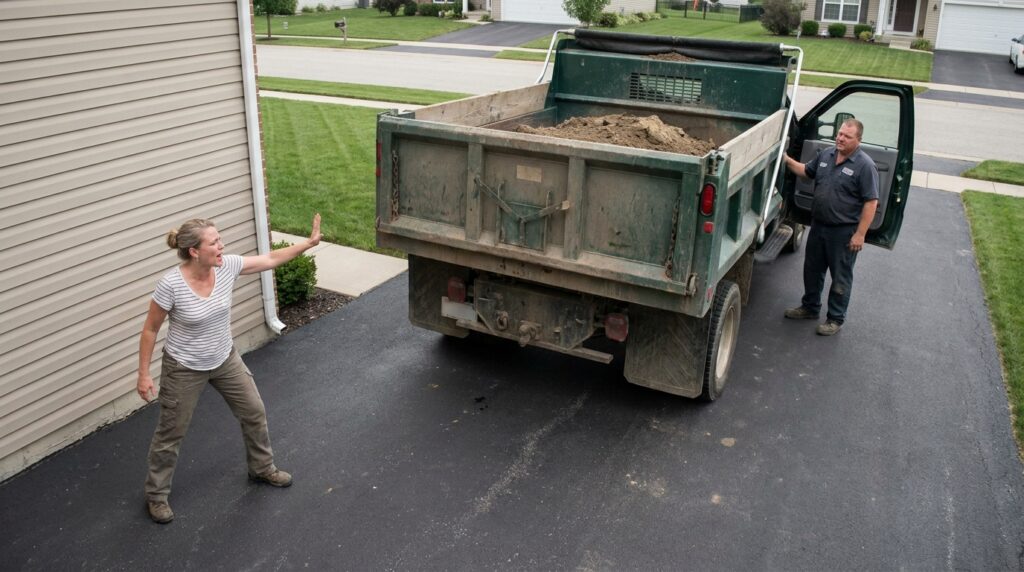
Through the salt-filmed windshield, she appeared before the truck had even fully settled on its springs. She didn’t walk out of the split-level house; she erupted from the screen door, her work pants rustling against the overgrown clover of the lawn strip. Her light hair was pulled back into a knot so tight it seemed to pull the skin at her temples into sharp, defensive angles. In her left hand, tucked under an arm like a shield, was a heavy plastic clipboard.
Arthur didn’t move. He watched her through the side mirror as she stepped off the grass and directly into the path of the front left tire. She planted herself there, her feet wide, an open palm thrust forward against the radiator grill as if she could halt forty thousand pounds of industrial momentum with her skeleton alone.
“This is my property,” her voice cut through the rhythmic thrum of the diesel, thin and sharp as a utility blade. “You don’t get to do whatever you want.”
Arthur reached down, his fingers catching the worn brass ring of his key ring. The heavy set of keys clinked against his belt loop as he cracked the heavy steel door of the cab. He didn’t drop down into the driveway; he stayed on the running board, using the elevation to look over the hood. The air out here was thick with the smell of sun-baked pine needles and the faint, bitter tang of leaking coolant from a job three miles back.
“We’re on the job order, ma’am,” he said. His voice was low, flat, entirely stripped of the cadence of an argument. It was the tone he used for city inspectors and busted water mains. “We’re not damaging anything. We’re clearing the drainage line.”
“That still doesn’t make this okay,” she snapped, her head giving a single, rigid jerk to the left. Her fingers tightened on the edge of the clipboard until the plastic groaned. “The HOA has a weight limit for private lanes. You’re cracking the base structure. I want this vehicle moved out to the county curb right now.”
Arthur looked down at the asphalt between them. Right there, where the gray driveway met the yellowing sod of the lawn, a small orange flag fluttered on a wire stem. Just three inches behind it, barely visible under a clump of unraked leaves, the dull square head of an old iron survey pin sat frozen in the earth. He knew what the blueprints in his cab said—the thirty-foot right-of-way didn’t care about neighborhood weight limits or manicured borders.
But as his eyes tracked the line from the iron pin toward the corner of the house, he noticed something else. A dark, oily smudge was weeping out from beneath the vinyl siding, right where the main foundation met the driveway’s edge, dripping onto a fresh, unauthorized patch of concrete that hadn’t been poured by any county crew.