CHAPTER 2: THE GUIDELINE BOUNDARY
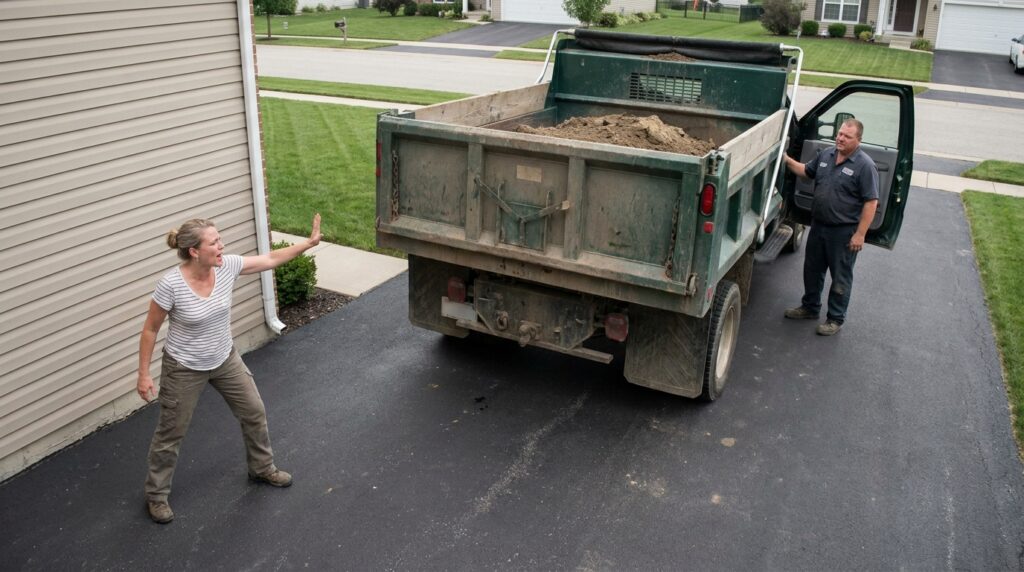
“You have exactly thirty seconds to cut that engine before I call the township towing inspector,” she said.
The words came out clipped, rattling against the steady, metallic thrum of the seven-ton dump truck. She held the plastic clipboard high against her chest, a shield of white paper over a faded floral print. The pages underneath the heavy wire clip were dog-eared, yellowing at the edges with the distinct texture of outdated bylaws that had been thumbed through too many times in dark rooms.
Arthur didn’t shift his weight from the running board. The steel plate beneath his work boots vibrated with the deep, mechanical pulse of the idling diesel. He looked down at her—at the strict, pale line of her jaw and the small, twitching muscle just beneath her left eye. Up close, the striped short-sleeve top she wore looked stiff, starch-burnt and smelling faintly of cheap laundry detergent and old floor wax.
“Township doesn’t tow county trucks on a registered job order, ma’am,” Arthur said. He kept his hands flat on the top edge of the cab door, the rough, salt-crusted paint scraping against his calluses. “We’re clearing the drainage culvert at the base of the slope. If we don’t drop the stone today, the next heavy rain is going to compromise the foundation line on three of these lots.”
“There is no registered easement on this parcel,” she shot back, her voice tightening as she took a half-step closer to the massive front tire. The rubber was caked with dry, gray mud from the yard three miles north, and she looked at the debris as if it were a personal insult. She tapped her index finger against the clipboard. “Section four, paragraph B of the community guidelines explicitly forbids commercial vehicles exceeding three tons from staging within forty feet of a residential facade. I signed the notice myself.”
Arthur turned his head slightly, his gaze tracking past the sharp angle of her shoulder to the corner of the split-level house. The sun was clearing the tree line now, casting a flat, desaturated glare across the concrete driveway. The light wasn’t warm; it was the pale, dusty gray of an early July morning in a subdivision built on old gravel pits.
There it was again—the dark, damp stain weeping through the seam where the gray vinyl siding met the foundation.
In the dry heat of the last three weeks, that patch of ground should have been bone-white. Instead, the soil at the very edge of the fresh concrete patch looked loose, waterlogged, and covered by a thin skin of iridescent oil. A tiny, metallic glint caught his eye near the base of the siding—a brass clean-out plug, half-buried under a layer of decorative mulch that had been violently kicked aside. It was standard commercial-grade plumbing, the kind the county used for main water line taps, completely out of place on a standard residential lateral.
“Who poured that section by the corner wall?” Arthur asked, his voice dropping into a quiet, pragmatic rhythm.
Her finger stopped tapping the clipboard. For less than a second, her posture didn’t just stiffen—it locked. The muscles in her throat pulled taut, her chin lifting just enough to make the thin, light hair at her temples shake.
“That is none of your concern,” she said, her voice dropping an octave into a forced, defensive hiss. “That is private maintenance. If your crew touches that concrete, or if that truck so much as leaks a drop of oil onto this asphalt, I will have the HOA board file an emergency injunction before noon.”
Arthur looked back at the iron survey pin in the grass. The orange flag wire was rusted at the base where it entered the soil, vibrating slightly from the secondary shockwaves of the truck’s engine. He knew every line on the county transit map by heart. This wasn’t a standard residential driveway boundary; it was a designated triple-utility corridor established in 1994 before these houses were even framed. The county didn’t just have an easement here—they owned the dirt six feet down.
He reached into the cab, his fingers wrapping around the cold, zinc-plated handle of his aluminum permit case. He pulled it free, the metal corner clipping the door frame with a sharp, resonant tink.
“I’m not here to debate the handbook with you, ma’am,” Arthur said, stepping down onto the asphalt. The soles of his boots made a gritty, grinding sound against the loose stones. He unlatched the case, pulling out a three-page, blue-line schematic stamped by the county registrar’s office. “This is the structural schematic for the drainage right-of-way. Your property line stops exactly fourteen inches to the left of that foundation vent. This truck is parked in the public zone.”
She didn’t look at the paper. Her eyes remained fixed on Arthur’s face, two flat disks of hardened gray behind her sunglasses. She didn’t retreat an inch as he approached the front fender. Instead, she reached out with her right hand, her fingers catching the lip of the truck’s heavy steel bumper, her knuckles turning white against the grime.
“You think because you have a stamp on a piece of paper from the city building you can just tear up twenty years of peace?” she whispered. The calm, bureaucratic mask was beginning to fray at the edges, revealing a strange, desperate panic that didn’t match the scale of a simple gravel delivery. “You people don’t live here. You don’t pay the assessments. You don’t see what happens when the water starts coming up through the floorboards.”
Arthur stopped. The phrase water coming up through the floorboards wasn’t in any maintenance log for this sector. The drainage culvert was purely for surface runoff from the upper ridge—unless something else was discharging into the system from behind the walls.
He looked down at her hand on the bumper. Just beneath her cuff, her wrist was smeared with a fresh streak of black, graphite-heavy pipe dope—the specific chemical sealant used to lock high-pressure water valves.
Before he could speak, the heavy diesel engine behind the grill gave a sudden, hard cough. The RPMs dropped dangerously low as a thick plume of black exhaust belched from the vertical stack, settling over the driveway like wet charcoal. From the back of the truck, the low, rhythmic clatter of a secondary hydraulic pump began to whine—someone was trying to override the bed controls from the auxiliary panel.