CHAPTER 5: THE GATHERING SILENCE
“Arthur, tell me you haven’t started tearing up an established lateral without a secondary surveyor present,” a voice called out.
The driver’s door of the white Ford utility truck clicked shut with a dull metallic slam. Miller, the regional district supervisor, stepped off the gravel shoulder and onto the worn mouth of the asphalt driveway. His high-visibility orange vest was crisp, unstained by grease or pipe dope, rustling softly against his starched uniform shirt as he walked. He carried a heavy, ruggedized field tablet under his arm, its screen casting a flat, bluish reflection against his chin.
Arthur didn’t drop the iron utility wrench. He stood up slowly from the trench, the wet mud on his work pants growing heavy and cold against his shins. “The lateral isn’t where the district maps put it, Miller. And it’s not a gravity-fed storm pipe either.”
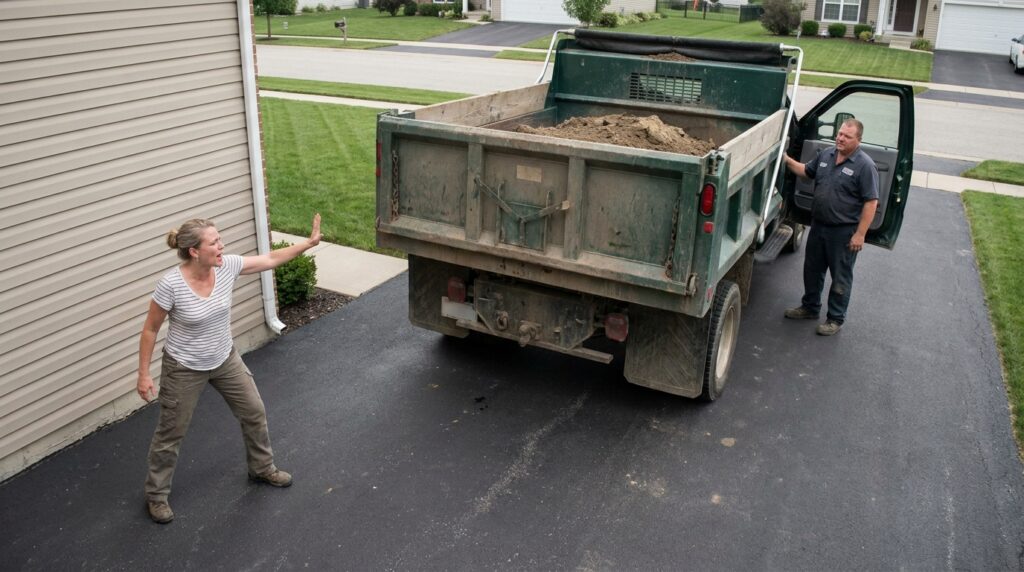
The woman shifted her position, her back coming off the garage wall. She took two steps toward the supervisor, her hands sliding smoothly back into the pockets of her work pants, her posture recovering a fraction of its previous rigid authority.
“Your employee has exceeded the scope of the county work order,” she said to Miller, her tone reverting instantly to the sharp, practiced cadence of a board president managing a vendor. “He has actively vandalized a private drainage easement, cracked an unmanaged concrete walkway, and harassed a property owner using an outdated utility schematic. I expect this truck off the lane immediately, and I will be filing a formal complaint with the county administration before the noon recess.”
Miller stopped, his eyes flicking from the woman to Arthur, then down to the deep, waterlogged trench where the clean copper sleeve and the weeping brass T-junction valve sat exposed in the black earth. He didn’t answer her right away. He tapped the screen of his tablet, his thumb moving through the county GIS layers with a rhythmic, dry click.
“Ma’am, our records show this utility corridor has been zoned for open infrastructure maintenance since the original plot subdivision in ninety-four,” Miller said, his voice carrying the professional neutrality of a bureaucrat who had spent twenty years reading land disputes. “But Arthur’s right about the pipe. The district doesn’t lay six-inch copper for neighborhood storm runoff. That looks like a primary feed line.”
Across the street, the neighbor with the trash bin had crossed the asphalt curb, stepping onto the opposite shoulder of the cul-de-sac. Two more residents—a man in an aviation cap and an older woman holding a garden hose—moved closer to the driveway’s edge, their voices a low, gravelly murmur that died out the moment Miller looked up.
“What’s going on with the water line, Miller?” the man in the cap called out. “She told us last month the county was planning to hike the district infrastructure surcharge by fifteen percent to repair the lower basin. Is that what they’re doing down there?”
The woman turned on her heel, her jaw locking as she glared at the gathering neighbors. “The association affairs are private, George. Return to your lot. This is a technical matter between the board and the municipal department.”
Arthur took a step away from the truck fender, his boots making a heavy, suctioned sound as he pulled them out of the wet silt. He didn’t join the argument. His eyes were still fixed on the plastic patio chair by the porch steps, where the morning wind was tugging at the loose pages of the clipboard. The bottom sheet—the one with the red state department stamp declaring the charter forfeited—was vibrating against the plastic backing.
He looked back at the woman. Her face remained covered by the flat gray lenses of her sunglasses, but the skin around her throat was mottled with red, blotchy patches of sudden, unmanageable adrenaline. She wasn’t just defending her yard; she was gatekeeping the entire block’s access to the conversation.
“Miller,” Arthur said quietly, pointing the tip of the iron wrench toward the house corner. “Take a look at the pressure reading on the district main map for this branch. If this is a direct tap before the cul-de-sac manifold, it’s not just her house that’s tied into it.”
Miller frowned, his thumb pausing on the tablet casing. He walked to the edge of the trench, kneeling down near the exposed brass nut where the clear water was pulsing into the mud. He leaned close, the ambient odor of old calcified silt and chemical pipe dope hitting him.
“This is drawing a steady five gallons a minute right now,” Miller muttered, his face darkening as he tracked the direction of the copper sleeve where it disappeared beneath the foundation wall. “And the pressure regulator isn’t standard county issue. This is an industrial bypass valve.”
He stood up, his eyes meeting the woman’s face with a hard, unyielding intensity that shattered the remaining pretense of a routine neighborhood dispute.
“Ma’am,” Miller said, his voice dropping the polite administrative cadence entirely. “Who installed this junction? Because if this line runs back to the main trunk line under the hill, someone’s been diverting unmetered county water into this private loop for a long, long time.”
The woman didn’t flinch. She drew her shoulders back, her fingers tightening inside her pockets until the canvas seams groaned.
“The county built the reservoir on our family’s old pasture lot in seventy-eight,” she whispered, her voice sharp and rattling like dry gravel. “They paid two hundred dollars an acre and promised this development would have free access to the high ridge flow forever. Then the registration laws changed. The county broke the agreement. My husband didn’t steal anything. He just kept the valve open.”
Arthur watched her, the weight of the story settling into the small space between them. It was a perfect, multi-decade retribution arc, hidden beneath a forged HOA handbook and a clipboard. But as he looked past her toward the garage, he heard a low, metallic click from inside the house—the distinct sound of an automatic booster pump kicking on behind the foundation wall, its high-frequency hum vibrating through the very asphalt beneath his feet.
The truck’s diesel engine gave another violent, choked sputter, the exhaust stack emitting a thick cloud of unburnt fuel that obscured the driveway in a gray, chemical fog.