CHAPTER 9: THE LITMUS MARGIN
“Don’t let that run hit the storm grate,” the man in the bright yellow slicker yelled. He didn’t look at Arthur or Mrs. Gable; his boots were jammed deep into the newly carved trench running through the center of the ruined driveway apron. He held a three-foot fiberglass sampling rod with a set of plastic test strips clipped to the tip, the small paper squares instantly turning a deep, unnatural plum color as they touched the milky froth. “It’s testing over nine on the pH scale. That’s straight bentonite slurry from the deep boring rigs. It’ll cure like grout inside the lower neighborhood pipe main if we don’t treat it before it drops.”
Arthur stood on the narrow lip of his remaining sod, his fingers tight against the cold brass water key inside his pocket. The rain had settled into a fine, freezing drizzle that turned the gray slurry in his yard into a dull, iridescent mirror. Two more county vehicles—heavy white utility trucks with DEPARTMENT OF ENVIRONMENTAL PROTECTION stamped across their tailgate panels—had backed onto the grass three houses down, their warning beepers pulsing a flat, percussive rhythm through the overcast air.
“The storm grate is already full, inspector,” Arthur said. His voice was quiet, rhythmic, holding the level cadence of an inspector checking an oversized bore. He pointed with the toe of his wet shoe toward the iron bars of the intake at the corner of his lot. “The water’s been backing up through the brickwork since six this morning. The sub-base under the concrete apron is completely gone. If your crew drops a vacuum line down there right now, the suction is going to pull the rest of the sidewalk into the hole.”
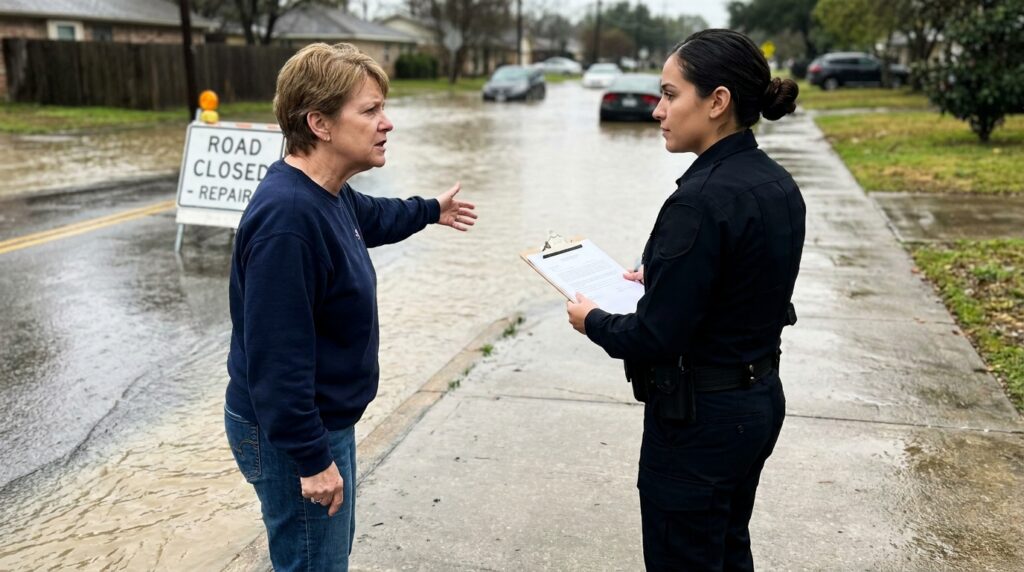
Officer Miller didn’t look back from the hood of her cruiser. She had a field report sheet clamped under her thumb on the aluminum clipboard, her pen scratching gray graphite lines across the wet paper. Beside her, the worker from Public Works was using a handheld grease gun to pump red sealant into the sheared valve box, his knuckles covered in a mixture of dark grease and cold mud.
“Mrs. Gable,” Miller said, her eyes tracking the movement of a large, dark sedan that had just stopped at the top of the hill near the logistics park gates. The vehicle’s headlights were on, cutting two pale yellow tubes through the desaturated mist. “The man who gave you that letter—the one who paid for the limestone blocks—did he leave a corporate contact number, or did he tell you to route all complaints through the regional drainage clerk?”
The older woman didn’t move her arms from her sides. The white sneakers were completely invisible now, buried beneath four inches of dense, gray limestone paste that had washed out from the core of her retaining wall. Her short, light-brown hair was flat against her forehead, soaked by the drizzle, her uncovered eyes staring at the white PVC sleeve that lay exposed in the mud like a broken bone.
“He said the clerk would handle the billing,” she whispered. Her voice carried no performative unearned authority now; it was simply the dry sound of a resident who had found the absolute limit of her property value. “He said if we noticed any settling in the driveway, we were to call the number on the back of the card. He told us it was a private account. He said it was faster than waiting on a borough council appropriation.”
The inspector in the yellow slicker let out a short, sharp whistle, pulling the sampling rod out of the muck with a wet, sucking sound. “The regional drainage clerk hasn’t had an active account since the county restructured the sewer authority in 2022,” he said, walking toward Miller’s cruiser with his boots heavy with gray clay. He held up the tip of the rod, where the plum-colored paper was already beginning to dry into a hard, brittle crust. “This code belongs to a private shell corporation registered out of Delaware—Oakridge Utilities LLC. They aren’t a public utility, Officer. They’re a private sub-contractor hired by the logistics development to handle their heavy industrial dewatering.”
Arthur watched the dark sedan at the top of the ridge road. The driver-side door opened, and a man in a dark grey trench coat stepped out onto the wet asphalt, his hand instantly coming up to hold an umbrella against the drizzle. He didn’t come down the hill toward the police cruiser; he simply stood near the concrete perimeter wall of the logistics warehouse, watching the yellow strobe lights of the public works trucks slice through the fog.
“They didn’t give her an account, Officer,” Arthur said, his hand finally coming out of his hoodie pocket to reveal the wire-looped corporate tag he had pulled from the crater. The plastic was slick, smelling of raw diesel and industrial surfactant. “They gave her a dead end. They knew the county wouldn’t check a private residential retaining wall for an industrial bypass until the warehouse footings were poured and the state EPA had signed off on the primary basin maps. They just needed the line to hold until the inspections cleared.”
Miller took the tag from Arthur’s hand, her thumb tracing the stamped red numbers on its face before sliding it beneath the heavy metal clip of her board. She looked up the slope toward the man with the umbrella, her jaw setting into a hard, professional line that matched the grey slate of the sky.
“Arthur,” she said, her voice dropping into the quiet, tactical register she used when the boundaries of the situation shifted beyond the municipal codebook. “Keep your line clear. I’m pulling the county property clerk out of bed. We’re going to find out whose names are on that Delaware registration before the logistics park shifts their drilling crews to the northern ridge.”
The water in the driveway didn’t stop, but its flow was slowing, the thick gray silt beginning to settle into a heavy, unyielding pavement of mud that sealed the legal surveyor’s pin completely beneath the surface of the clay.