CHAPTER 10: THE LIABILITY DEMARCATION
The heavy staple gun snapped against the wooden fence post with a dry, metallic report that made the floating paper copies in the ditch ripple. The county code enforcement officer, a man wearing a stiff canvas jacket that smelled of stale tobacco and wet mud, didn’t look back at Mrs. Gable as he smoothed down the fluorescent orange placard. The neon ink seemed to bleed into the gray drizzle, its bold block lettering screaming against the weathered pine: ORDER TO ABATE: ILLEGAL SURFACE ALTERATION & HAZARDOUS DISCHARGE.
“You have seventy-two hours to clear the right-of-way, ma’am,” the inspector said. He didn’t raise his voice; he carried the flat indifference of an official who had hung the same card on a hundred unpermitted sheds and retaining walls across the borough. He slid his steel rule back into his thigh pocket, the metal clicking against his brass snap. “If the DPW crew has to bring the backhoe back to clear these stones out of the channel, the township will attach the machine hours directly to your tax duplicate. That’s five hundred an hour, starting from the perimeter fence.”
Arthur stayed inside his boundary line, his boots sinking an inch into the cold, clay-choked grass near his mailbox. The water level had dropped slightly, but the ground was left coated in an unyielding, oily crust of gray bentonite slurry that had begun to skin over like wet cement. He looked down at the orange card, then up toward the ridge road. The dark sedan was gone, but a new set of tire tracks—deep, dual-wheeled ruts from a commercial utility rig—had been cut fresh into the mud right outside the logistics park’s chain-link gate.
“The masonry isn’t the primary blockage anymore, inspector,” Arthur said. His hands were tucked deep into his sweatshirt pocket, his fingertips resting against the smooth, worn handle of his trowel. “The wall is just where the pipe cracked under the head pressure. If she pulls these blocks down without a trench box supporting the shoulder, the whole utility bank is going to slide into my lower driveway. The gas main tracer line is completely exposed under the third course.”
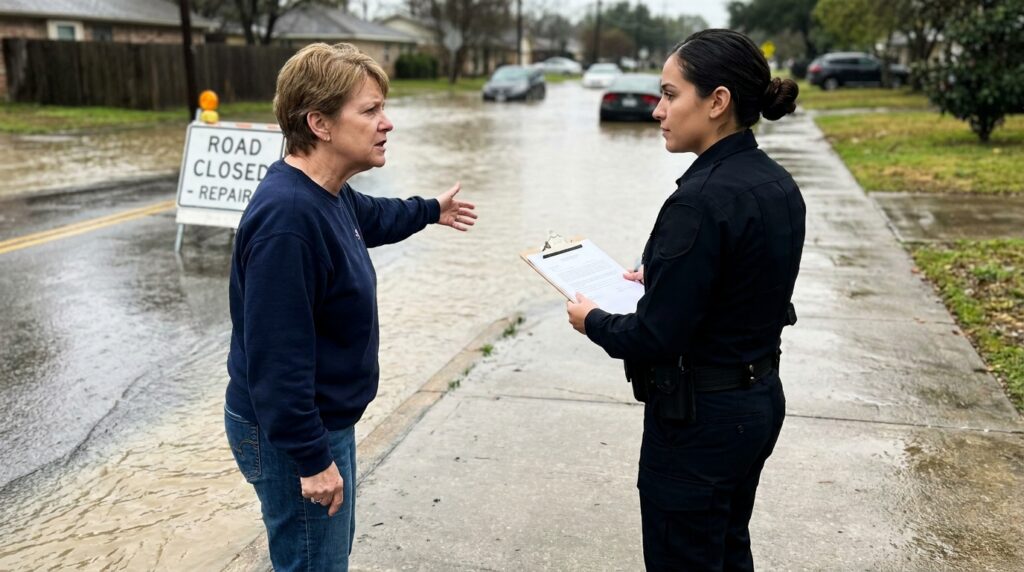
Officer Miller didn’t argue. She stood near the open driver’s door of her cruiser, her radio microphone held flat against her collar bone as she watched two white trucks with corporate logos slow down at the intersection below the avenue. The trucks didn’t turn onto Crestview; they parked across the entrance to the cul-de-sac, their hazard lights blinking a rhythmic, silent orange against the wet brick faces of the lower houses.
“They aren’t sending a repair crew, Arthur,” Miller said, her voice dropping into that low, transactional register that bypassed the public record. She didn’t look at Mrs. Gable, who was now sitting on the bottom step of her porch, her face gray, her fingers slowly unweaving a loose thread from the cuff of her wet sweatshirt. “The legal department for Oakridge Infrastructure just filed an emergency injunction with the county clerk. They’re claiming the four-inch line under the wall is an authorized municipal discharge extension under a 2018 county infrastructure variance. They’re trying to lock the street file before the building supervisor signs the structural damage assessment.”
“The variance doesn’t list Crestview,” Arthur said. He stepped closer to the orange placard, his eyes tracking the fine print at the bottom of the township enforcement code. “The maps the public works driver had on his hood showed the termination code ending behind the commercial yard. If they had a valid variance for this block, they wouldn’t have used a private Delaware shell to sign the masonry contract with her husband.”
Mrs. Gable lifted her head. Her pale eyes were bloodshot from the cold drizzle, her voice coming out as a flat, dry rattle that barely reached the fence line. “The man from the development board didn’t mention a variance, Arthur. He just said the county was modifying the easement and we had to sign the maintenance release or face a civil citation for the foundation runoff. My husband was too sick to go down to the borough hall to check the books. We thought it was the city.”
The code inspector didn’t pause his work to offer an assessment. He took a heavy yellow wax crayon from his pocket and drew a thick, diagonal cross directly over the center of Mrs. Gable’s limestone blocks, marking the stones for structural removal like a condemned wall in an old rail yard.
“The city didn’t sign for this clay, ma’am,” the inspector said, gesturing with his thumb toward the thick, milky crust coating Arthur’s grass. “This is industrial dewatering waste, and the county drainage main isn’t rated for it. If that corporate rig up on the ridge road starts their second-phase boring before this channel is cleared, this entire block’s lateral system is going to back up into the kitchen sinks.”
Arthur looked down at the small yellow utility tag he still held between his thumb and forefinger. The wire loop was rusted, but the stamped corporate serial number was perfectly intact, a physical link to a ledger that didn’t exist on the inspector’s clipboard. The decoy of the neighborly dispute had been washed away by the gray silt, but the real line was still buried sixty inches deep in the clay, and the corporate trucks at the end of the street were waiting for the clock to run down.