CHAPTER 8: THE STROBE BOUNDARY
The concrete apron didn’t settle; it dissolved from the bottom up as the high-pressure industrial line tore the rest of the gravel packing out from beneath the curb. A twelve-foot section of the public walkway sloped sharply into the pit, the aggregate face snapping off in clean blocks that slid through the white mud like grease.
Arthur held his ground on the high rim of his porch step, his boots unmoving on the aggregate concrete. He didn’t look back at his house. His right hand was locked around the brass water key in his pocket, his knuckles white against the metal joints. The yellow strobe lights from the public works truck spun across his chest, casting wide, rhythmic bars of amber light through the cold mist that smelled of limestone slurry and diesel wash.
“The gate isn’t holding,” the worker shouted. He had both hands flat against the crossbar of the five-foot steel T-wrench, his shoulder blades wedged hard against the side of the truck bed for leverage. The iron shaft was twisting, a narrow spiral of gray scale popping off the metal as the internal valve discs fought the column of industrial runoff from the ridge road. “The pressure isn’t coming from our main. It’s coming from the corporate feeder. The valve is bypassed up at the perimeter line.”
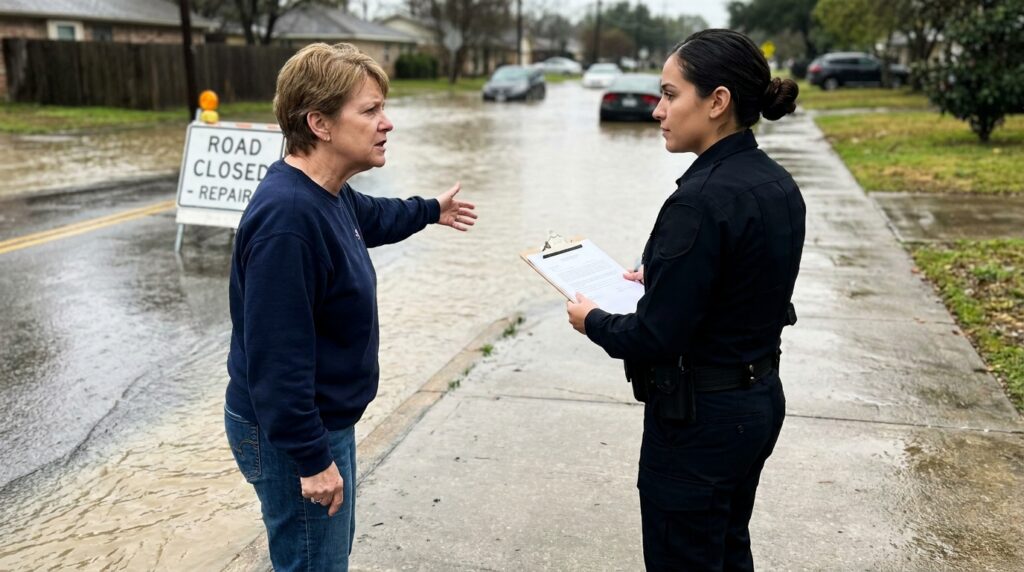
Officer Miller didn’t move away from the hood of her cruiser, even as the first spray of milky slurry began to skin over the rolled blueprints. She reached down, her gloved fingers picking up the small yellow plastic utility tag Arthur had pulled from the crater. The metal wire loop on the tag was cold, dripping a gray film of fine silt across her sleeve. She turned it over under her flashlight, tracing the stamped numbers with her thumbnail.
“This code isn’t on the township log,” Miller said. Her voice didn’t rise above the chug of the truck engine; it remained low, percussive, carrying the weight of a professional who had just found a deliberate alteration on a legal map. She looked across the broken pavement at the older woman standing on the grass. “Mrs. Gable, the man who brought you the stabilization letter after your husband’s funeral—he didn’t work for the county. The regional board doesn’t use these stamps. This is a private commercial routing code.”
Mrs. Gable didn’t speak. She stood perfectly still on the remaining strip of sod, her sneakers buried to the eyelets in the thick, gray slush that pumped out from the base of her limestone wall. The plastic folder she had held like a shield was completely empty now, its white permit sheets scattered face-down across the flooded ditch, their ink running into gray streaks against the mud. Her face looked like old lard under the amber strobe glare, the lines around her mouth dry and hard despite the rain.
“They said it was part of the easement,” she whispered, her voice barely lifting over the hiss of the water through the broken asphalt. “They said if we didn’t let them drop the stones and run the relief sleeve, the borough would declare the lower cellar a public hazard. We didn’t have the funds to pour a new foundation wall, Arthur. They paid for the masonry. They said it was just a backup line for the storm basin.”
Arthur looked up the hill toward the ridge road. The grey concrete forms of the logistics warehouses were completely hidden by the overcast mist, but the volume coming down the slope told him everything his levels hadn’t. The private development hadn’t just tapped into the block’s drainage to hide their silt; they had systematically lowered the core culvert bed by two feet to drain the footings of their multi-million dollar storage bays, converting the entire lower suburban street into a sacrificial overflow basin without changing a single public record.
“They didn’t give you an easement, Mrs. Gable,” Arthur said. He stepped down into the shallow water at his lawn edge, his boots crunching against the loose gravel that had washed up from the sub-base. His voice was flat, empty of any triumph, holding only the cold clarity of a checked measurement. “They gave you their industrial waste liability. Your husband signed a non-disclosure agreement disguised as a code variance, and they used your wall to hide the intersection from the county inspectors.”
Miller unhooked her radio from her shoulder, her thumb slamming the lateral button down with a hard, plastic click that overrode the dispatcher’s incoming code list. “Unit Two to Supervisor. Confirm the emergency environmental dispatch. I have a corporate utility tag matching Oakridge Infrastructure. The unpermitted line is actively discharging industrial drilling slurry through a private residential easement at 414 Crestview. The street sub-base is compromised, and the curb line has failed. I need the county road inspector and the building supervisor on site with a full stop-work order for the ridge road development.”
The worker with the T-wrench gave one final, desperate push against the crossbar, his boots slipping on the slick mud as the internal brass fittings of the street box sheared off with a sharp, iron pop. The handle spun free in his hands, and a fresh column of gray, sulfurous water erupted from the valve box opening, throwing a two-foot plume of gravel and rust flakes into the air.
The water didn’t rise further; it began to clear out a new channel through the center of Arthur’s ruined driveway, carving a deep, ragged trench through the clay toward the lower cul-de-sac. The physical confrontation at the property line was over, the limestone wall completely separated from the bank, but the real line—the one laid out in red ink on the plastic-coated blueprint—was still screaming deep under the asphalt, and the ridge basin hadn’t even reached its peak.