CHAPTER 5: THE BLUEPRINT DEVIATION
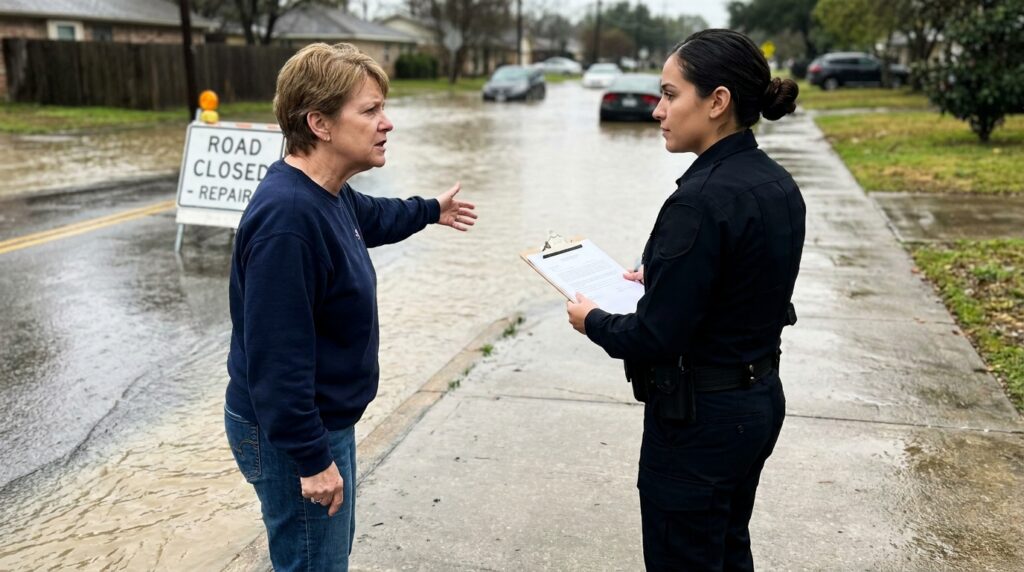
The municipal truck didn’t clear the deep water at the curb lane. It settled sixty feet away, its massive, steel-belted tires grinding into the saturated gravel shoulder with a heavy, wet crunch that sent twin plumes of grey silt into Arthur’s lower lawn. The yellow strobe lights on the cab roof continued to slice through the overcast mist, casting rhythmic, pale amber bars across the clapboard siding of the houses and the wet leather of Officer Miller’s uniform belt.
A man in a stained orange high-visibility vest stepped down from the cab, his heavy work boots splashing instantly into four inches of muddy runoff. He didn’t look at Mrs. Gable or the folder she held pinned to her hip; his attention was locked on a rolled roll of large-format engineering paper he carried under his arm like a length of pipe. The paper was coated in clear plastic sheeting, beads of rainwater running off its surface as he approached the curb line.
“Unit Two,” the worker said, nodding once toward Miller. His voice was raw, scratched clean by twenty years of idling diesel engines and subterranean exhaust. He dropped the heavy roll onto the wet hood of the cruiser, the plastic wrapper making a sharp, wet crinkle against the metal. “I’m Miller’s dispatcher’s contact from Public Works. We ran the pressure readings from the lower cul-de-sac gate. The main block isn’t down here. The pressure is coming straight down from the ridge basin. Every meter of six-inch line between here and the ridge road is backing up under five atmospheres of head.”
Officer Miller stepped back from the stone wall, her boots leaving deep, muddy sockets in the lawn edge. She leaned over the cruiser hood, her fingers tracing the faded blue grid lines of the municipal drainage map the worker unrolled. “The resident claims this four-inch PVC bypass was installed as an overflow concession during the 2018 ridge road land acquisition,” she said, her voice dropping into a hard, procedural register.
The worker let out a short, wet laugh that smelled faintly of cheap tobacco and cold coffee. “The 2018 easement didn’t include an outlet on Crestview, Officer. The maps show the overflow route terminating four hundred yards east in the retention ditch behind the lumber yard.” He slapped his broad, grease-darkened palm against the center of the sheet, where a thick, newly stamped red line cut across the old lot markers. “Look at the grading signature. This isn’t a residential relief line. Someone altered the primary culvert invert level six months ago. They lowered the concrete bed by twenty-four inches up at the ridge road junction box.”
Arthur moved to the edge of the hood, his hands still tucked inside the wet pockets of his hoodie, the cold brass of the water key pressing into his palm. He looked down at the red ink on the blueprint. The line didn’t curve around the property boundaries; it cut straight across the corner marker he had dug out with his trowel. It crossed directly beneath Mrs. Gable’s limestone retaining wall, but it didn’t stop at her basement. It continued down the slope, its trajectory lined up exactly with the subterranean void he had been measuring under his own garage floor.
“They didn’t alter it for the street,” Arthur said, his eyes tracking the red line back up the ridge to the massive grey outline of the logistics park. “They lowered the bed to drain the footings of the commercial warehouses. If the water stayed in the ridge basin, the warehouse bays would have flooded during the first frost last November. The county didn’t give her husband a concession. They used her line to protect the commercial development’s liability.”
Mrs. Gable didn’t step forward to look at the map. She stood alone on the wet sidewalk, her fingers trembling against the soft corners of her fake HOA documents. The amber glare from the utility truck’s strobe lights flashed across her face, catching the deep, tense lines around her mouth that looked like cracks in old clay. Her sunglasses had slipped down her nose, revealing pale, wet eyes that stared blindly at the yellow grease marks Miller had scrawled across her wall.
“They said it was legal,” she whispered, her voice dropping beneath the steady, rhythmic chug of the utility truck’s idling diesel. “The man from the development board came to the house after the funeral. He said if we let them stabilize the retaining wall with the limestone blocks, they’d guarantee the basement wouldn’t shift. He had a county seal on the letter, Officer. He said it was part of the infrastructure expansion.”
The worker from Public Works didn’t look at her. He pulled a heavy, rusted iron T-wrench from the bed of his truck, the metric threads of the tool screeching as he set the handle against his thigh. “The development board doesn’t sign for the Department of Public Works, ma’am,” he said, turning his back to the wall as he walked toward the buried utility box near Arthur’s fence line. “And whatever they buried under this stone is currently structural failure territory. The pressure from that ridge bypass just blew the packing out of the main gate valve. The water isn’t just coming out between your stones anymore. It’s lifting the asphalt three feet out from the curb.”
Arthur looked toward his driveway apron. The dark, wet surface of the asphalt was bowing upward, a long, spiderweb fracture opening in the center of the pavement like a mouth. From between the cracks, a clean, high-velocity stream of sulfur-smelling water began to hiss, throwing up tiny, sharp shards of aggregate stone against the undercarriage of the police cruiser. The baseline truth remained locked behind the ridge road maps, but the ground beneath their feet had already begun to fail.