CHAPTER 1: THE WATER PATTERN
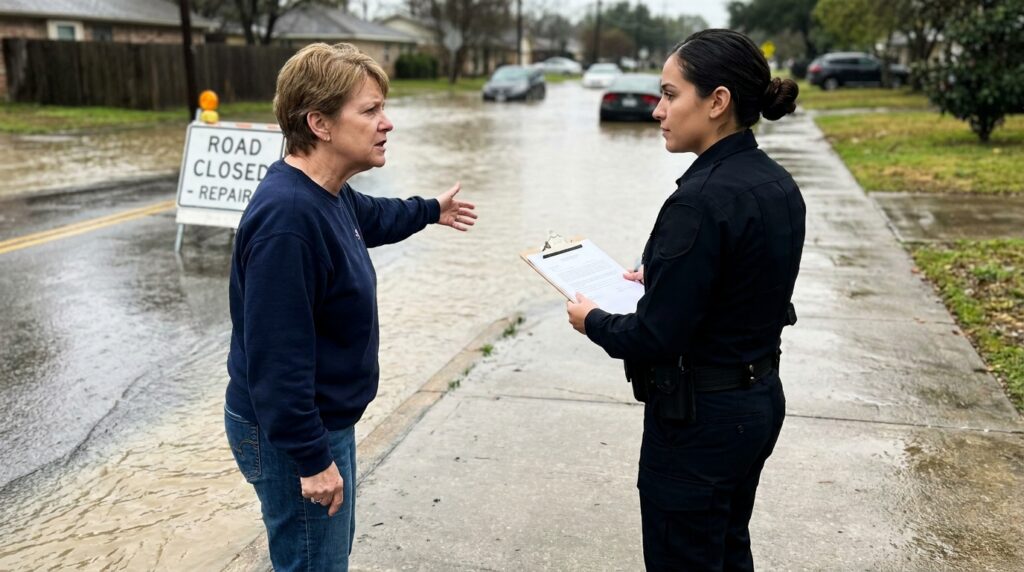
“You keep leaving me flooded out, fix this today,” the woman said. Her hand sliced downward through the damp morning air, her fingers rigid against the backdrop of grey, churning gutter water. She didn’t look at the man standing twenty feet away on the porch; her focus remained pinned to the silver badge on the officer’s chest. The fabric of her navy sweatshirt was stiff with salt from older sweat, the shoulders bunched tight like wire-wrapped insulation.
Arthur didn’t answer. He stayed near the rusted iron support post of his awning, his hands buried deep inside the front pocket of a salt-stained grey hoodie. The wool was heavy with mist. Beneath his boots, the concrete of his porch felt cold, a solid slab of unyielding, aggregate stone that had settled two inches to the left since 1994. He could smell the particular scent of the asphalt out here—wet oil, rotting pine needles, and the sulfurous tang of a backup in the lower culvert.
The officer, a woman named Miller whose dark hair was pulled into a flat, regulatory knot behind her ears, didn’t move her feet from the clean rise of the sidewalk. She held a heavy aluminum clipboard against her ribs. The metal was scratched, dull silver showing through grease-smudged corners where years of thumbs had worn down the factory finish. She looked at the water. It was four inches deep now, a wide, tea-colored mirror that transformed the suburban curb into a slick canal. Floating chunks of brown lawn thatch and crushed plastic soda bottles revolved slowly in the eddies near Arthur’s mailbox.
“The water isn’t coming from his grass, Mrs. Gable,” Miller said. Her voice had the flat, percussive rhythm of someone who spent forty hours a week reading municipal penal codes aloud to people who hadn’t slept. She turned a page on the clipboard. The paper made a dry, fibrous snap in the damp air. “The call came in as an unpermitted obstruction. I have to look at the easement first.”
“Look at it?” Mrs. Gable stepped off the curb. The heel of her white sneaker came down into two inches of muddy runoff, the water instantly sucking at the mesh toe box. She didn’t flinch. Her sunglasses, dark and rectangular, caught the reflection of the grey sky like two pieces of slag glass. “There’s nothing to look at but his drain. He stuffed it. He’s been stuffing it with lawn clippings since May. Look at the silt on his driveway. That’s state-line runoff.”
Arthur watched a drop of rain roll down the rusted edge of the utility box near the ditch. A single iron surveyor’s pin, buried six inches below the sod three feet to his left, was completely submerged now. He knew exactly where it was. He had dug it out with an old trowel three weeks after moving in, scraping away the clay until his fingers hit the cold, square head of the stake. The county map said that pin was law. Everything else—the arguments, the calls to code enforcement, the way Mrs. Gable stood at the edge of her lawn at 6:00 AM with a digital camera—was just noise.
Miller didn’t look up from the paper. “He hasn’t mowed in three weeks, Mrs. Gable. The silt is coming down from the ridge road.” She shifted her weight, the leather of her utility belt creaking like an old saddle. With the toe of her heavy regulatory boot, she reached out and nudged a loose piece of grey limestone that sat at the very edge of the water line. The stone didn’t belong to the street; it had a clean, machine-cut face, identical to the three hundred other blocks forming the low, unpermitted retaining wall that bordered Mrs. Gable’s driveway. When her boot tip touched it, the stone shifted, and a dark bubble of trapped grease and black mud burped up from beneath the surface, revealing a line of blue utility tape that had been sliced through by a shovel.