CHAPTER 6: THE RUSTED CROSSOVER
The first slab of asphalt didn’t split cleanly; it sheared with a sound like a wet pine log cracking under an axe. A six-foot ribbon of black driveway surface bowed upward by three inches, its internal steel mesh humming under the sudden tension of the water bursting through from the sub-base. The jet that erupted wasn’t a slow pool anymore; it was a high-velocity fan of grey silt and ground limestone that struck the driver-side door of the police cruiser with the rhythmic rattle of buckshot.
Arthur didn’t run back to his porch. He took two fast paces backward, his boots sliding through the loose, wet sod at his fence line until his spine hit the rusted galvanized post of his mailbox corner. His hand was out of his pocket now, the brass water key gripped between his fingers like an iron knuckle. “The pressure isn’t relieving through her wall anymore,” he yelled over the sound of the geyser. He pointed down at the expanding fracture where the blacktop met the concrete gutter. “The wall didn’t fail. The entire easement channel beneath her stones has collapsed into the gas main trench.”
Officer Miller was already moving, her heavy regulatory boots splashing through the widening pool as she grabbed the worker from Public Works by the sleeve of his high-visibility vest. She dragged him away from the cruiser’s hood just as a second fracture tore through the pavement, spitting out a fist-sized chunk of old aggregate stone that chipped the vehicle’s windshield. “Get your valves down,” she said, her voice cutting through the hiss of the spray with the cold authority of an engine brake. “Shut the avenue gate.”
“The avenue gate won’t stop the ridge basin,” the worker shouted back, his boots slipping on the slick slurry as he scrambled toward the rear utility bed of his truck. He yanked a five-foot steel T-wrench out from beneath a pile of wet sandbags, the heavy tool ringing as it hit the truck’s iron tailgate. “The ridge basin is six hundred thousand gallons of concrete runoff. If I drop the gate at the bottom of the hill, the head pressure will just blow the residential meters out of the cellars three doors up. We have to isolate the high-pressure diversion at the ridge road boundary line.”
Arthur watched the water pattern shift again. The spray hitting the cruiser was losing its dark, muddy color, turning into a thick, milky froth that smelled violently of industrial laundry detergent and raw diesel. He knew that smell. It was the surfactant used by the boring crews up at the logistics park to keep the drilling heads from binding in the deep shale. It wasn’t county water. It wasn’t stormwater. It was the direct waste output of the upper ridge development, routed through a pipe that wasn’t supposed to exist, under an agreement that had been signed in a kitchen.
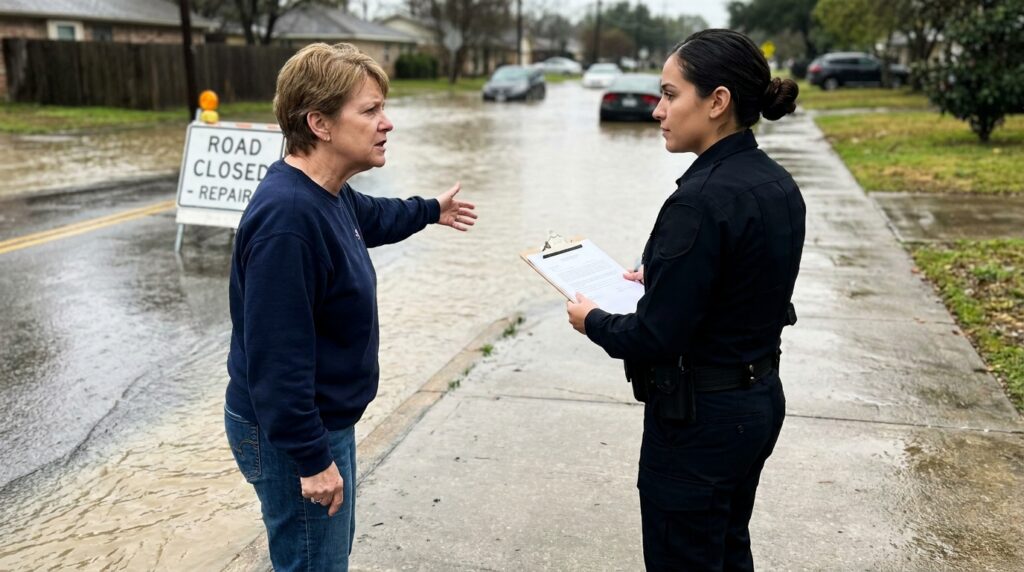
He looked across the shifting line of the property border. Mrs. Gable hadn’t moved from her position on the wet sidewalk. The water from the new fracture was swirling around her ankles, her white sneakers completely hidden beneath a three-inch layer of grey slurry. Her clipboard had fallen into the grass, the fake HOA violations and laminated permit copies floating face-down in the muddy pool like dead leaves. She was staring at the base of her limestone wall, where the three courses of machine-cut stone were slowly tilting forward, the joints opening wide enough to show the bright red ink of the metric stamps on the white plastic pipe behind them.
“The survey markers are right next to your boots, Officer,” Arthur said, his voice dropping into a flat, steady register as he stepped back toward Miller. He wasn’t looking for a victory; he was checking the tolerances of the failure. He pointed at the square iron stake that was now visible again, its rusted head exposed as the rushing water washed away the top four inches of clay. “The pin hasn’t moved an eighth of an inch. Her wall moved six inches to the left when the sub-base cleared out. That means her private masonry is legally occupying the county’s primary utility trench.”
Miller didn’t answer him. She had her shoulder mic unclipped, her thumb grinding into the plastic button as she backed toward the dry grass of Arthur’s lawn. “Unit Two to Supervisor. We have a structural breach on the main easement. The road surface is undermined. Inform the gas company they have an exposed tracer line at 414 Crestview, and tell the shift supervisor I need the county road inspector here now. This isn’t a code dispute anymore. The commercial basin line has bypassed the public main.”
The worker with the T-wrench didn’t wait for the inspector. He drove the square foot of the iron tool down through the muddy water, hunting for the valve box lid beneath the surface of the gutter. When the iron hit the cast-iron rim of the box, it made a dull, heavy clink that traveled up the shaft into his arms. He began to lean his weight against the crossbar, his boots straining for traction against the slick asphalt as the gears inside the street box groaned against forty years of rust.
Arthur stood perfectly still, his eyes fixed on the red ink of the blueprint that still lay on the cruiser’s hood, its edges curling under the spray. The red line didn’t just stop at his property; it had a secondary notation—a metric coordinate that matched the depth of the municipal water main he used to fill his house. The decoy of Mrs. Gable’s illegal sump line had broken apart under the pressure, but the real infrastructure was still screaming deep inside the stone ridge, and the water was still coming down.