CHAPTER 2: SULPHUR AND METRIC THREADS
“That tape wasn’t there when the surveyor staked it in November,” Mrs. Gable said. Her voice didn’t rise in pitch; it simply hardened, a flat piece of cold-rolled iron snapping against the low thrum of the idling cruiser. She took another half-step into the gutter pool, the oily water now swirling grey foam around the white rubber rim of her sneaker. “He put that down himself. He’s been digging out there after dark, Officer. Ask him about the shovel marks behind my shed.”
Arthur didn’t shift his shoulders from the iron post. He reached down into the pocket of his hoodie, his fingers finding the small, notched brass key to his water meter box. It was cool and greasy against his palm, a simple mechanical tool that knew nothing about property lines or municipal easements. “The gas company laid that tracer line three years ago, Mrs. Gable,” he said, his voice flat, rhythmic, holding the low, steady cadence of a man who spent his days measuring tolerances on a lathe. “They ran it six inches inside the public right-of-way. Your wall is sitting four inches over the mark.”
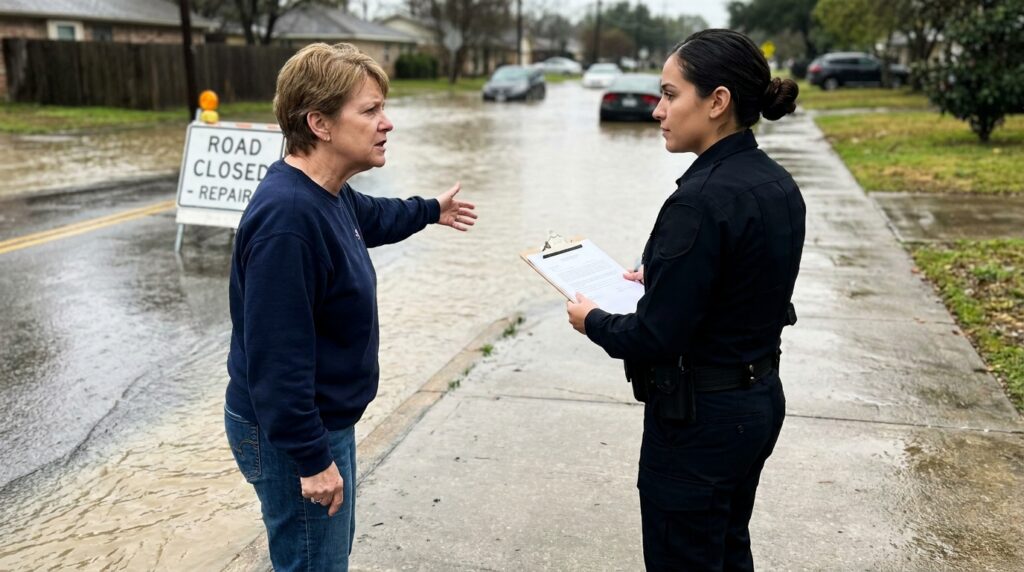
Officer Miller didn’t look back at him. She remained balanced on the balls of her heavy black boots, her fingers hook-linked into the top edge of the aluminum clipboard. The grey morning light caught the fine sheen of diesel exhaust mist on the cruiser’s fender behind her. Slowly, with a deliberate, unhurried precision that came from five years of responding to identical suburban boundary skirmishes, she drew a yellow plastic grease pencil from her pocket. She didn’t write on the paper. Instead, she leaned down, the leather of her uniform belt groaning under the weight of her radio and cuffs, and made a single, thick yellow mark across the face of the limestone block she had nudged.
“Nobody’s citing anyone for excavation yet,” Miller said, her breath forming a brief, pale cloud in the damp air. She stood up, her eyes narrowing as she looked up the long, desaturated slope of the asphalt toward the ridge road. A quarter-mile up, where the tree line ended, the massive concrete retaining structures of the new logistics park sat like grey teeth against the sky. The water coming down the hill wasn’t clear rainwater anymore; it carried the thin, iridescent rainbow sheen of heavy machinery grease and industrial silt. “But this stone is sitting directly over a junction box that isn’t on my first-phase sheet. Mrs. Gable, did you hire the crew that poured the concrete footings for this driveway apron?”
“My husband did. Before the estate cleared,” the older woman replied instantly. Her chin came up, the stiff collar of her navy sweatshirt chafing against her jawline. Her fingers twitched against the plastic folder she held, the corners of the fake HOA notices inside soft and grey from the humidity. “We had the permit from the borough. It’s grandfathered. If there’s a box under there, it’s been there since the township put the original culverts in during the seventies.”
Arthur stepped down off the first concrete riser of his porch. His boots hit the wet grass with a soft, wet crunch. The ground here was oversaturated, the clay beneath the sod turned to a cold, slick paste that squeezed up through the eyelets of his leather work shoes. He walked toward the boundary line, keeping his eyes fixed on the yellow grease mark on the stone. He wasn’t looking at Mrs. Gable; he was looking at the way the water pattern changed when it hit that specific block. The runoff didn’t just pool; it spun in a tight, clockwise siphon, disappearing into the dark space between two improperly bedded stones with a distinct, hollow gurgle that sounded like a dry throat swallowing.
“That’s not an old municipal box,” Arthur said, stopping three feet from Officer Miller’s shoulder. He smelled the wet wool of his own sleeve, the sharp salt of the street runoff, and the burnt-oil stink of the cruiser’s catalytic converter. He pointed down at the base of the limestone where the sliced blue tape trailed off into the silt. “That’s a newly laid four-inch PVC sleeve. You can hear the vacuum from here. She didn’t block the drain, Officer. She harnessed it.”
Mrs. Gable’s shoulders stiffened, her jaw locking into a rigid, defensive square. “That’s a lie. We repaired the retaining wall after the frost heave last winter. That’s standard fieldstone reinforcement. You have no right to come off your property line to inspect my masonry.”
Miller didn’t intervene. She stepped back one pace, her boots splashing through the shallow edge of the flood, and let her hand drop naturally toward the side of her utility belt where the heavy black casing of her flashlight sat. She wasn’t reaching for a weapon; she was reaching for an extension of her eyes. She clicked the switch, the high-intensity LED beam cutting through the grey morning glare to strike the dark gap between the stones. The white light reflected off something smooth, clean, and unmistakably synthetic—the white, unweathered curve of a schedule-40 PVC pipe, its metric stamp still visible in bright red ink against the plastic.
“Arthur,” Officer Miller said without turning her head, her voice dropping into a quiet, tactical register that excluded the woman across the line. “Go back to your porch.”
“Officer—” Mrs. Gable started, her clipboard coming up like a shield.
“I said stay back, Mrs. Gable,” Miller interrupted, her tone flat, absolute, and completely devoid of the neighborly patience she had carried five minutes ago. She reached for her shoulder mic, her thumb clicking the lateral button with a sharp, plastic snap. “Dispatch, this is Unit Two. Have the shift supervisor contact Public Works. I need a locator crew at 414 Crestview, and notify the code enforcement officer on call. We have an unrecorded water diversion into the county right-of-way, and I’ve got a damaged tracer line on the gas main.”
The water kept rising, its cold, muddy edge now creeping over the lip of Arthur’s lower driveway, but the rhythm of the street had changed. The silence that followed the radio call was heavy, broken only by the distant, rhythmic clank of a diesel engine shifting gears further up the ridge road.