CHAPTER 3: THE WEIGHT OF LANDSCAPE
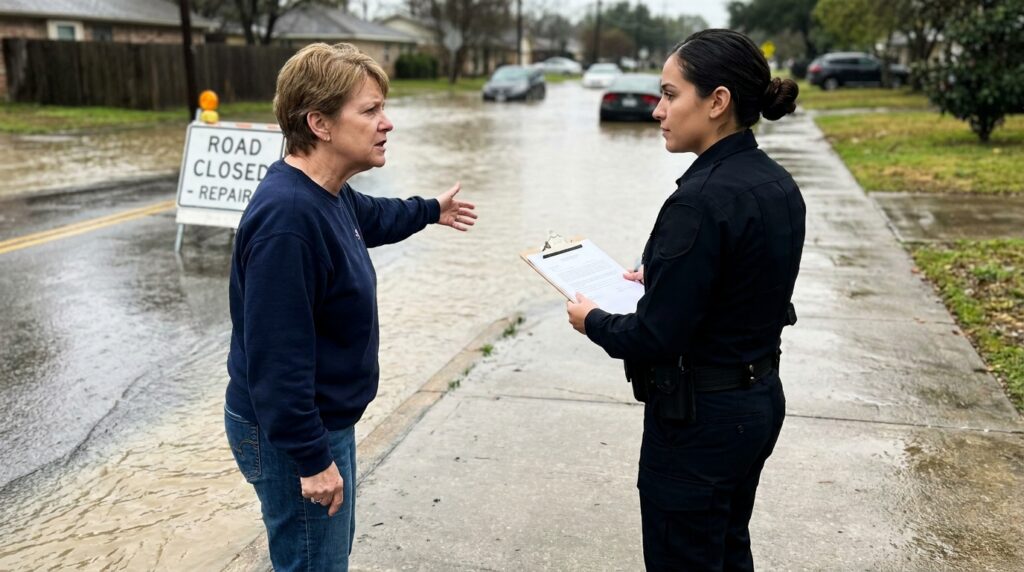
The static from Officer Miller’s shoulder microphone lingered in the humid space between them, a dry, electronic hiss that felt completely separate from the heavy gurgle of the gutter. Mrs. Gable didn’t drop her clipboard. Her fingers, small and spotted with pale liver marks, gripped the plastic edge so hard the cardboard backing groaned under the pressure. The wet hem of her navy sweatshirt shook slightly as she drew in a shallow, cold breath.
“An unrecorded water diversion?” Her voice didn’t carry the high pitch of panic; instead, it dropped into the low, calculated grit of a property owner who knew how many feet of pipe constituted a code violation. “This is an old retaining wall, Officer. If there’s plastic in there, it was put in by the previous owner to manage the spring line. My husband didn’t touch the township easement. We paid the assessment fees in 2018.”
“The assessment in 2018 didn’t include a four-inch commercial-grade PVC drainage sleeve running parallel to a high-pressure gas main, Mrs. Gable,” Miller said. She didn’t look at the older woman. Her hand remained resting on the black nylon grip of her heavy flashlight, the high-intensity beam still pinned to the muddy gap beneath the limestone blocks. The white plastic pipe gleamed through the silt like an old bone. “The gas company doesn’t leave their tracer wire loose for fun. That line was cut clean by a square-point shovel. You can see the spade scoring on the clay right behind the third course of stone.”
Arthur stood exactly where he had been told to stay, three feet inside his own property line, his boots sinking deeper into the oversaturated turf. The iron surveyor’s pin was completely lost beneath the tea-colored pool now, but his mind kept the coordinates locked. He could feel a strange, rhythmic vibration through the soles of his shoes—not the deep rumble of the logistics park trucks up on the ridge road, but something smaller, faster. A mechanical pulse. It was coming from the ground directly beneath Mrs. Gable’s retaining wall.
“Officer,” Arthur said, his hands still deep inside his hoodie pockets, his thumbs working the grooved edges of the water key. He didn’t look at Mrs. Gable; he kept his eyes on the grey foam swirling around the limestone. “That pipe isn’t pulling water in from the street. Look at the flow pattern near the edge of her grass. The water is backing out from behind her wall. The siphon I mentioned earlier—it just flipped.”
Miller shifted her gaze, tracking the beam of her light to the spot Arthur indicated. The tiny whirlpool that had been siphoning the street water into the gap had vanished. In its place, a steady, pulsing plume of yellowish, rusty water was pumping out from between the limestone joints, pushing against the grey street runoff like a small artesian spring. The smell changed instantly, shifting from the stagnant stink of dead leaves to the chemical sharpness of fresh lime and concrete curing agent.
“That’s enough,” Mrs. Gable snapped, her face turning a sharp, blotchy red under the grey morning light. She finally looked at Arthur, her dark lenses catching his silhouette against the white siding of his house. “You’ve been monitoring my property for three months, Arthur. Don’t think I haven’t seen you out here with your level and your string lines. You think because you bought the corner lot you own the flow calculations for the entire block?”
“I own the foundation of my garage, Mrs. Gable,” Arthur said. His voice was flat, empty of anger, carrying only the hard reality of a man who spent his life checking decimal points on iron castings. “And right now, your basement sump pump is overriding the city culvert because you buried your overflow line inside the public utility right-of-way. Every time your pump kicks on, it pours two hundred gallons of groundwater directly against my lower driveway apron.”
“It’s a protective measure,” she said, her voice dropping all pretense of unearned civic authority, replacing it with the sharp, defensive logic of a resident who felt cornered by the topography. “The ridge road development changed the water table three years ago. The county didn’t update the culverts under the avenue. If I don’t pump that crawlspace out twice a day during a front like this, the western foundation wall shears. The township wouldn’t help us. My husband had to lay that pipe himself before he passed.”
Miller let out a short, nasal sigh that looked like smoke in the damp air. She didn’t offer sympathy, nor did she issue a verbal warning. She simply took her yellow grease pencil and made two more thick, horizontal marks across the limestone wall, framing the white PVC pipe like a target.
“Your husband should have applied for a municipal variance, then,” Miller said, her boots making a slow, sucking sound as she pulled them from the gutter silt. She looked down the block toward the intersection, where the distant, rhythmic whine of a heavy diesel engine was getting louder. “Because Public Works just put the locator truck on the radio. They’re running a diagnostic on the whole street main. If that pipe of yours is tied into the gas company’s gravel bedding, it’s not just a code violation anymore. It’s an unpermitted hazardous infrastructure intersection.”
Arthur watched the water line. It had stopped rising against his lower driveway, held in check by the steady, counter-pressure of the rusty volume pumping out from behind Mrs. Gable’s wall. But the ground beneath his feet didn’t feel solid anymore. The small, fast vibration was growing stronger, traveling up through his ankles. It wasn’t the sump pump. The frequency was too low, too heavy, like an engine turning over deep inside the limestone ridge itself.