
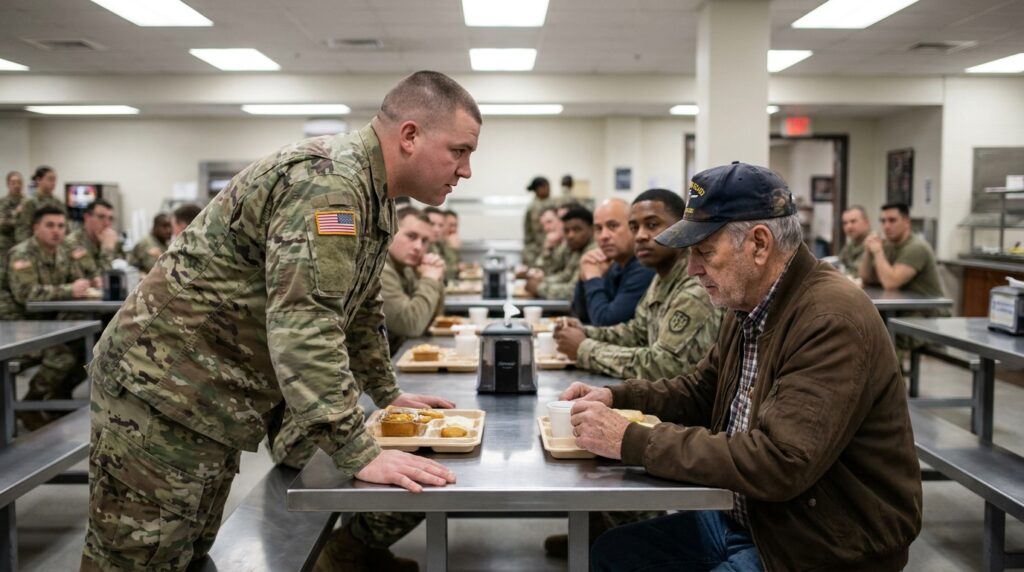
CHAPTER 8: THE LAST COLD LINE
The heavy whip antennas of the communication van sliced through the low pine branches with a sharp, mechanical hiss that sounded like water hitting a hot stove pipe. As the massive, mud-flaked tires ground to a halt against the red clay perimeter, the wall of dust collapsed over the grey staff car, coating Stern’s polished silver blocks in a thick, uniform layer of red silt. The roar of the large diesel block didn’t rattle Marcus’s teeth; it matched the steady, old vibration that had lived behind his breastbone since the brown-water patrols went dark.
The side door of the van did not pop open with the light click of a modern vehicle. It slid back on a massive, dry iron rail, the iron-to-iron screech freezing the two shooters in their tracks.
Stern did not move his hands from his web belt. He stood perfectly still as a gray-haired master sergeant—a man whose utility shirt showed the faint ghost lines where a Command Sergeant Major’s wreaths had been unstitched—dropped down into the limestone gravel. The old soldier carried a heavy leather logbook with brass corners, its spine scarred by the oil of a hundred engine bays. He did not look at the shooters, nor did he look at the fallen acoustic wand in the mud. He walked straight past Stern’s shoulder and stopped two inches from Marcus’s torn sleeve.
For three seconds, the only sound was the deep, rhythmic thump-thump-thump of the van’s compressor. The master sergeant looked down at Marcus’s left hand, his eyes locking onto the smooth, unengraved face of the silver signet ring.
The master sergeant didn’t offer a modern salute. He simply reached out and flattened his palm against the brass corner of his own logbook, a gesture used by the old detachment handlers when the radios were compromised and the line was officially closed.
“The registry is clear, Mr. Vance,” the old sergeant said. His voice was a dry, heavy rattle that had the same iron density as Kowalski’s tools. “The Dover account was logged out of the central terminal at noon. The duplicate index cards in Building 400 have been moved to the incinerator bin under special voucher seven-one-six.”
Stern shifted his weight, his boots making a wet, crunching slide in the red clay. “The captain has an active retrieval asset order from the maritime division,” he said, his voice losing its flat authority, dropping into the careful register of an administrator who had just realized he was standing on a shifting foundation. “The file under his arm is military property.”
“The file under his arm doesn’t exist on the active index,” the old sergeant replied without turning his head. He reached down and lifted the yellow carbon copy from the truck’s running board, his thick thumb resting precisely over the faded blue ink thumbprint on the reverse side—the permanent mark left by Major General Miller before the barge was cleared from the log. “This lot was written off as unrecoverable river silt forty-five years ago. The names are registered on the independent logistics roll. They don’t report to Building 400.”
The lead shooter pulled his hand completely out of his utility cargo pocket. He didn’t look at Marcus or the folder; he looked at the open door of the communication van, where three modern electronic terminals were humming in the dark, their screens displaying the old four-digit grid coordinates from the Mekong Delta in bright, unblinking green phosphorus. The modern squad knew how to handle an old man at a table, but they didn’t have a counter-move for an unacknowledged command loop that could rewrite their unit’s payroll from a vehicle behind the maintenance shed.
Marcus took a slow, deep breath, his fingers relaxing their grip on the manila cover. The ache in his ribs was still sharp, but the internal pressure of the base seemed to drop, the heavy institutional weight of the installation sliding away from his shoulders like dry sand off a tin roof. The decoy secret—the false discharge that had served as his mask for forty-four years—was gone, but the final truth remained locked in the iron-bound pages of the leather logbook.
“You should have stayed in the kitchen, Vance,” Stern murmured, his hands finally dropping from his belt as he turned back toward the rear seat of his staff car. “The dust out here doesn’t clear.”
“The dust keeps the rust from setting too fast,” Marcus said, his voice flat and thin as he settled his navy service cap lower over his eyes.
The old master sergeant held the van’s rail open, his head tilted just enough to indicate the narrow gravel lane that led past the secondary gate toward the state highway. “The road is clear to the bridge, sir,” he said, using the title with a quiet, generational gravity that made the two shooters stand back from the wire. “The gate guards have the old bypass plates on their clips.”
Marcus didn’t answer with a speech. He didn’t look back at the stocky corporal’s fallen wand or the grey staff car idling in the limestone haze. He stepped out of the red clay enclosure, his heavy leather boots catching the hard, unyielding grain of the asphalt road that led away from the frontier. He held the yellowed folder against his ribs, no longer a hidden asset or a marked target, but a man walking through the white midday glare of his own country, unchanged, un-reconstructed, and entirely done with the ledger.








