
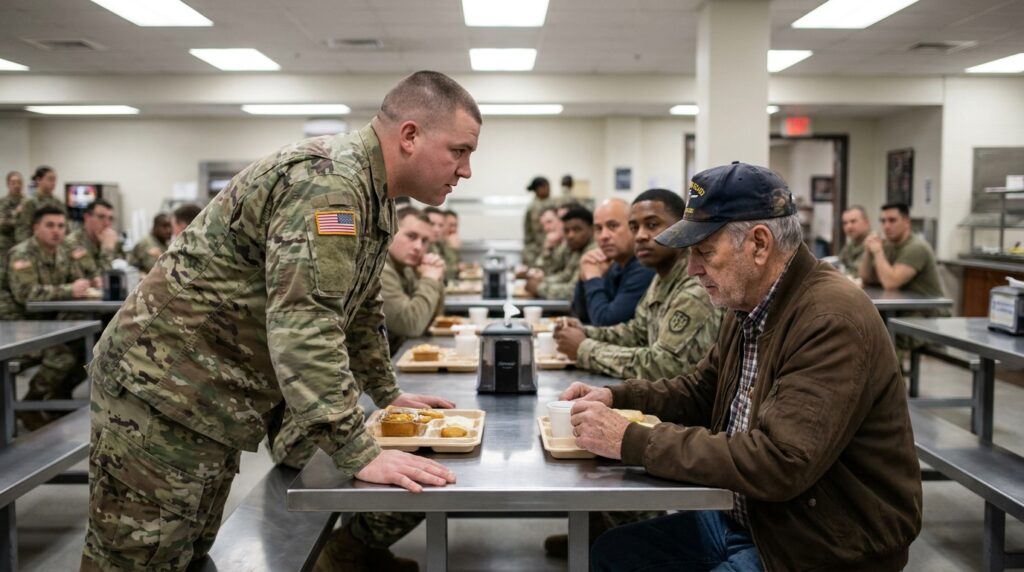
CHAPTER 3: THE CONDIMENT STATION STANDOFF
The thin man did not slip the black notebook back into his coat pocket until Marcus took his fourth step. The screen doors of the dining hall were still rattling on their rusted coil springs from the sudden drop in air pressure behind him. Marcus kept his left thumb pressed firmly against the edge of the yellowed folder, feeling the slight indentation where the heavy iron binding staples bit into the cardboard cover.
“You move clean for a man who doesn’t exist on the active payroll,” the thin man said. He had an accent that belonged to the Tidewater country—flat, dry, with vowels that sounded like river gravel grinding together under a low tide. His base access badge hung from a woven black lanyard that showed signs of fraying around the plastic clip.
Marcus didn’t stop, but he adjusted his stride, his heavy leather boot soles catching the grain of the concrete apron outside the cafeteria doors. The air out here was thick with the midday exhaust of the logistics trucks idling by the secondary fuel depot. The ground vibrated with a dull, sixty-cycle hum that Marcus felt in the back of his teeth.
“The payroll hasn’t been my concern since the year they stopped using silver in the quarters,” Marcus replied. He kept his head down, the bill of his navy cap angled just enough to break the direct glare of the sun hitting the gravel lane.
The thin man stepped into the path, his leather dress shoes looking thin and brittle against the heavy granite crushed stone of the driveway. He didn’t have the posture of a soldier—his shoulders were slightly rounded from years of leaning over steel filing cabinets—but he had the stillness that belonged to men who spent their lives reading things other people thought they had burned. On the lower corner of his laminated credential, a faint, purple-inked stamp read G-2-Record-Audit, the ink oxidized into a dark, dried-blood color that matched the alphanumeric marks on the bottom of Marcus’s folder.
“The record office at Fort Holabird closed down thirty-five years ago,” the thin man said, his eyes scanning Marcus’s brown bomber jacket, lingering on the small grease stain near the pocket flap where an old oil can had leaked during his time at the railway yards. “Most of the files from the seventy-one cycle were supposed to be in the furnace at Aberdeen before the treaties were signed. Yet you’re walking across a modern installation with an unvented ledger corner under your arm.”
Marcus stopped five inches short of the man’s shoulder. The proximity allowed him to smell the dry scent of carbon paper and old paste coming off the clerk’s wool trousers. “A folder doesn’t burn well when it’s packed too tight,” Marcus muttered. “The center stays cold.”
“The center of this one is hot enough to interest three different offices in the Pentagon, Mr. Vance,” the clerk said, using the name with a quiet, transactional flatness that suggested he had spent the morning looking at old microfiche screens until his retinas were scorched. “We’ve been tracking the serial numbers on that specific lot of cardstock since the transit office in Saigon cleared the logs in May of seventy-two. We thought they went into the river.”
Marcus looked down at the folder. Through the dry cardboard, he could feel the ghost of the old administrative ink. He knew what was typed on the first leaf—the three-letter designation that claimed he had abandoned his post at the logistics dock in Vung Tau to sell stolen generator parts to the locals. A dishonorable discharge recommendation, signed by a major who had died of a stroke in a Florida retirement community twelve years back. It was a useful document; it kept people from asking him what he had been doing with four hundred pounds of dry batteries and three boxes of zinc strips fifty miles upstream from the Cambodian line.
“The river was low that year,” Marcus said. His hand shifted, the silver signet ring scraping against the manila folder with a sound like a small animal scratching at a dry door. “A lot of things didn’t sink the way the planners intended.”
The clerk reached out, his long, ink-stained index finger stopping short of touching the metal prong binding on Marcus’s file. “The current commander of the transit wing doesn’t know what’s in that drawer. He thinks you’re just another old veteran with a grudge about his pension index. But if that corporal inside gets his captain involved, they’re going to run your fingerprints through the modern terminal at the gate. The new system doesn’t recognize the seventy-one bypass codes. It’ll flag the file as an active recovery asset.”
Marcus turned his head slightly, his gaze drifting past the clerk’s shoulder toward the low, corrugated tin roof of the base maintenance shed. A line of six-ton trucks stood there, their grilles caked in the yellow clay of the Virginia training grounds. “Then I’ll have to use the secondary gate,” Marcus said.
“The secondary gate has a double-strand barrier now, and three cameras with digital resolution clear enough to count the threads on your service cap,” the clerk whispered, his voice tightening as an officer’s staff car rumbled past the motor pool, its tires throwing up small spurts of limestone dust. “You won’t make the state line before the terminal locks your identity down. There’s an audit team already down at the archives room in Building 400. They found the duplicate index card an hour ago. The card that says your file was supposed to be delivered to a Major General named Miller back when the walls were still wet.”
Marcus’s thumb remained locked on the corner of the paper. He didn’t tell the clerk that he had known about the duplicate card for twenty years. He didn’t tell him that the Major General had been buried with full honors at Arlington before the current active-duty generation was old enough to hold a wooden rifle.
“Let them look,” Marcus said, his step resuming as he edged past the clerk’s sleeve. “The archives room has two thousand feet of shelving, and the air conditioning has been broken since Tuesday. They’ll get tired of the dust before they find the third key.”
The clerk didn’t grab his arm—he didn’t have the muscle for it, and he knew what had just happened to the stocky corporal inside the dining facility—but he turned as Marcus passed, his voice rising just enough to carry over the low, thrumming growl of the diesel generators.
“They won’t get tired, Mr. Vance,” the clerk called out, his notebook clamped hard under his elbow. “Because the signature on the recovery order didn’t come from the record branch. It came from the office that handles the old riverine logistics accounts. The ones that don’t have a name on the door.”
Marcus kept moving, his boots crunching rhythmically against the hot gravel as he headed toward the long shadow of the logistics warehouse. He could feel the dry friction of the old paper against his ribs, a weight that had traveled ten thousand miles over salt water just to find him again under the pale, flat sky of Maryland.








