
CHAPTER 2: THE BOUNDARY OF RUST
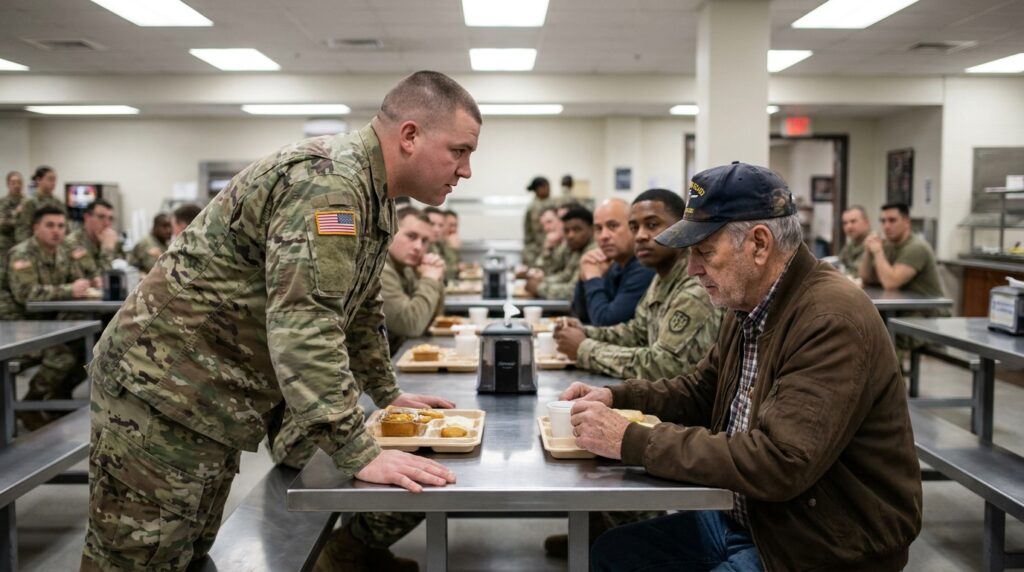
“Keep your hand off the brim,” Marcus said.
The words didn’t carry the weight of a shout; they had the thin, dry scrape of a file over an iron bolt. The corporal’s fingers stayed suspended two inches above the faded blue twill of the navy service cap. For a split second, the only movement in the Fort Meade dining hall was the slow, greasy wobble of yellowish gravy settling on Marcus’s tray. The young soldier’s face went through three distinct changes—confusion, a flash of targeted cruelty, and then a tightening of the jaw as his knuckles shifted into a hard, defensive knot.
“You’ve got a lot of nerve for a ghost,” the corporal whispered. He didn’t pull his hand back. He dropped his weight lower, his camouflage chest pocket brushing the edge of the laminate table. The fabric gave off the synthetic, chemical scent of base laundry starch, sharp enough to cut through the heavy smell of fried lard from the scullery. “The gate guards must be slipping to let an old civilian stray this far into the barracks.”
Marcus didn’t shift his hips. His spine remained a straight, rigid column against the orange fiberglass bench, a shape formed by old transit trucks and wet trenches before the corporal’s squad-mates were even names on a draft registry. He noticed the slight tremor in the corporal’s left knee—an uncalculated leak of adrenaline. The boy was ready to shove the tray into Marcus’s chest just to see if the old bones would rattle.
“The gate didn’t have a lock on it when I was your size,” Marcus murmured, his voice maintaining that small, flat baseline. His left hand, still resting near the fork, didn’t move toward a weapon. His thumb simply felt the smooth, cold metal of his worn signet ring. “And the men inside knew how to clear a table without making a spectacle.”
A low snicker escaped from one of the junior enlisted men two benches down. It was a small, dangerous sound, the kind that strips an insecure non-com of his leverage faster than a formal demotion. The corporal’s face went dark, the skin around his buzz cut turning a mottled, furious red. His fingers curled into a claw, his forearm tensing as he prepared to grab the old man by the collar of his brown bomber jacket and drag him out into the gravel lane.
Marcus didn’t wait for the grip to close.
The transition wasn’t a movie fight; it was pure geometry and old iron. Marcus stood up. He didn’t scramble or lunged; he simply corrected his posture, his six-foot frame uncoiling with a sudden, heavy mass that caught the corporal completely off-balance. Before the younger man’s hand could find leather, Marcus’s left forearm rose—not a punch, but a solid, angled wedge that met the corporal’s wrist mid-air.
The impact was short, a dull thud of bone against starched sleeve. Marcus didn’t try to hold the arm. He let the corporal’s own forward momentum do the work. With his thumb locked down against his palm, Marcus pivoted his heel on the grease-filmed linoleum, shifting his hip just enough to take away the corporal’s spatial anchor. A single, short downward stroke of his palm against the corporal’s inner elbow broke the younger man’s posture entirely.
The corporal didn’t roll; he dropped. His stocky frame hit the floor with a flat, ringing slam that rattled the bolted legs of the neighboring benches. A metal salt shaker fell off the table, rolling three feet before hitting the corporal’s boot with a tiny, hollow click.
The entire wing of the cafeteria went dead. A private three tables over froze with a plastic cup of milk halfway to his chin, his eyes wide, tracking the sudden change in elevation. The clatter of the conveyor belt near the dishwashing station seemed to double in volume against the sudden, absolute silence of the room.
Marcus remained standing. He didn’t huff; his breathing was the same dry click through his nose. His brown bomber jacket had shifted slightly at the shoulder, revealing the fraying gray thread along the seam of the lining. He looked down at the floor, his gaze detached, like a farmer looking at a broken fence post that needed to be hammered back into the dirt.
The corporal lay on his side for two long seconds, his breath knocked loose from his lungs, his camouflage trousers covered in the gray dust of the linoleum floor. His hands scrambled against the slick tile, trying to find traction, his face twisted in a mixture of raw shock and the sudden, terrifying realization that three dozen of his subordinates had just seen him handled like a heavy sack of grain.
Marcus reached down. His hand didn’t go for the corporal’s throat; his fingers closed around the edges of a faded manila folder that had been tucked under his meal tray—the administrative file he had carried through the main gate three hours ago. The paper was old, the corners slightly yellowed, but the metal prong binding inside was pristine, entirely free of rust.
“Respect is earned, son,” Marcus said, his tone dropping into the cold silence like a stone into a dry well. “Don’t mistake age for weakness.”
The corporal was on his knees now, his hands shaking as he wiped a smear of floor-wax grease from his sleeve. His squad-mates hadn’t moved to help him; they stayed locked in their seats, their expressions careful, none of them willing to meet the eyes of the man who had just moved with the heavy, unblinking certainty of an old machine.
Marcus picked up his navy service cap, settling the brim low over his forehead until the shadow hid the gray stubble along his cheek. He didn’t look back at the tray.
“Pick yourself up,” Marcus said, his voice flat as he turned toward the exit lane. “And learn.”
He took three steps toward the double screen doors before he noticed the change in the light. Standing near the condiment station, a thin man in a civilian suit with an base access badge pinned to his lapel was watching him. The man wasn’t looking at the corporal on the floor; his eyes were fixed on the yellowed corner of the manila folder in Marcus’s hand, his fingers lifting a small black notebook from his breast pocket.








