
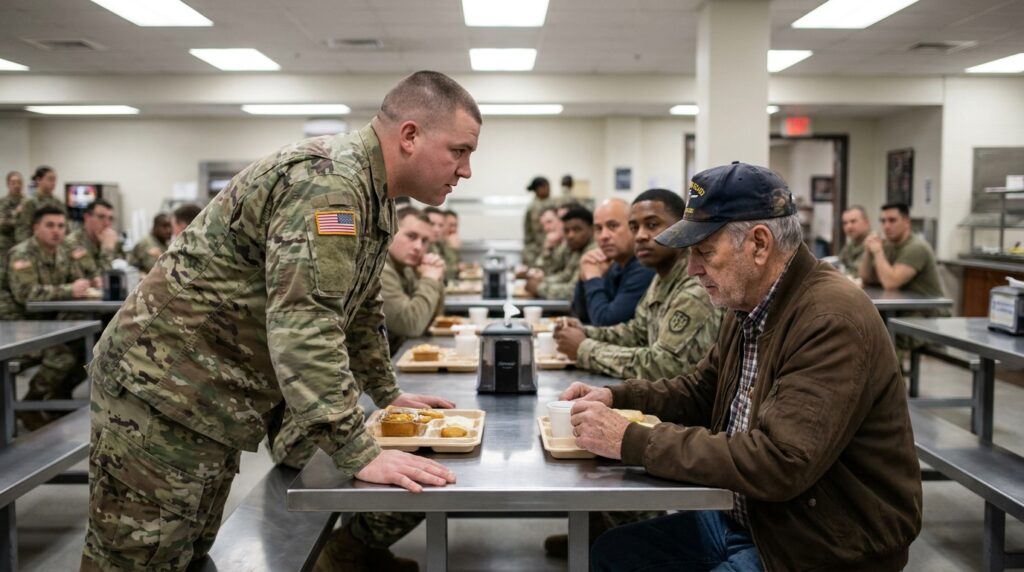
CHAPTER 5: THE COLD SILENCE THROUGH THE SCREEN
Marcus did not accelerate his pace when the gravel gave way to the packed red clay along the fence line. Behind him, the mechanical hum of Bay 4 was completely swallowed by the dry, whistling sigh of the Maryland pines. He kept his right arm pressed hard against the bulge in his leather bomber jacket, feeling the sharp corner of the yellowed folder digging into his lower ribs like a broken tooth.
The secondary fence stood ten feet tall, its galvanized steel links encrusted with gray lichen and orange flakes of rust where the salt from the winter road crews had drifted against the wire. Fifty yards down the line, a security truck with matte-black quarter-panels idled near the drainage ditch, its exhaust pipe puffing thin, greasy rings of blue diesel smoke into the stagnant heat.
“You’re walking the wrong way from the bus stop, Vance,” a voice said from the brush.
It wasn’t a soldier. It was the audit clerk, his thin wool trousers snagged on a wild blackberry vine, his face pasty under the flat glare of the sky. He had three distinct sweat rings encircling his collar, and his leather dress shoes were caked in dry, yellow mud that had hardened into a crust over his laces. He held a piece of yellow carbon paper between two ink-stained fingers—a duplicate voucher with a hand-written requisition code at the top.
Marcus stopped near the rusted turnbuckle of a guy-wire. The silver signet ring on his thumb clicked against the zinc coating of the post with a dry, metallic snap. “The bus stop doesn’t go where I need to be,” Marcus said.
“The captain from Building 400 just pulled your full index,” the clerk whispered, his teeth clicking together slightly from an excess of adrenaline. He held out the yellow slip, the paper rustling in the dry wind like a dead leaf. “Look at the line beneath the seventy-one discharge recommendation. It’s not an administrative entry. It’s a recovery manifest for three tons of battery plates and sixteen crates of copper bullion from the river pool at Chau Doc. They didn’t kick you out for selling generator parts, Vance. They used the dishonorable recommendation to strip your security clearance so you couldn’t be called to testify before the maritime committee.”
Marcus looked at the yellow slip, his eyes fixed on the purple alphanumeric code typed across the header. It was the same stamp that marked the corner of his own folder—the one Kowalski had warned him to bury. He didn’t take the paper from the clerk’s hand.
“The committee has been out of session for forty years,” Marcus said, his voice dropping into the lower register of the wind.
“The money hasn’t,” the clerk said, his hand shaking as he dropped the slip back onto his notebook. “The corporate entity that took over the old riverine logistics contracts still has an active ledger at the treasury. If you cross that fence with the original staples intact, you’re not just breaking an installation rule. You’re exposing a fifty-year-old operational reserve that’s currently funding three black-budget maritime satellite programs. The captain isn’t looking for a thief, Vance. He’s closing an account.”
A sharp, metallic clatter echoed from the drainage ditch. The door of the security truck swung open, and two men in sterile utility uniforms—no name-tapes, no rank badges, just clean green twill and high-gloss black boots—stepped down into the gravel. One of them carried a heavy, short-barreled bolt-cutter with long, blue-painted handles; the other kept his right hand tucked casually inside his cargo pocket, his elbow angled out in the unmistakable posture of a shooter waiting for an indicator.
Marcus didn’t move toward the wire, nor did he look back toward the warehouse bay. He stood perfectly still against the rusted post, his body absorbing the low, rhythmic thud of the truck’s engine vibrating through the red clay.
“You should have stayed at the table inside,” the lead shooter said, his voice completely flat, devoid of the young corporal’s anger or the clerk’s panic. He didn’t pull a weapon, but he moved with the economical efficiency of a modern machine, his boots clearing the blackberry briars without a single rustle. “The captain wants the folder back in the cabinet, Mr. Vance. You can walk back to Building 400 with us, or we can carry the file alone. It doesn’t make a difference on the log.”
The clerk took two short, scraping steps backward into the scrub pine, his eyes fixed on the blue handles of the bolt-cutter. He knew what happened to auditors who stayed in the room when the balance sheets were cleared by force.
Marcus reached into his bomber jacket. His hand didn’t move fast enough to trigger a draw-response from the shooter, but his fingers found the yellowed cardboard cover of his file. With a single, sharp twist of his wrist inside the leather pocket, he caught the rusted iron staple on the third leaf against the inner ring of his signet ring.
The old metal gave way with a dry, screeching pop that felt like a needle driving into his thumb. The leaf flew open, the rough paper scraping against his skin as the hidden carbon copy inside slipped loose from its binding.
“The file is already open,” Marcus said, his voice thin and level as he drew his hand out, holding the unsealed third leaf between his fingers. The pristine yellow carbon copy beneath the staples was exposed to the light for the first time since the summer of 1971, the purple ink bright and clean, completely un-faded by the years.
The lead shooter stopped five feet from the post, his boots sinking an inch into the soft clay. His eyes dropped to the paper, tracking the column of twelve hand-written names and the specific, four-digit grid coordinates marked along the margins—the extraction points where the unacknowledged black-budget crews had been pulled out of the Delta while their units were being listed as missing in action.
“That copy doesn’t leave the perimeter,” the shooter said, his elbow shifting three inches as his hand began to tighten inside his cargo pocket.
Before Marcus could answer, the low, metallic squawk of the truck’s radio turned into a solid, high-frequency whine that shattered the quiet of the woodlot. From the gravel drive behind Bay 4, a second vehicle—a dark grey staff car with a silver star mounted on the front grille—rumbled into view, its tires throwing up a wide, blinding screen of limestone dust that completely swallowed the fence line.








