
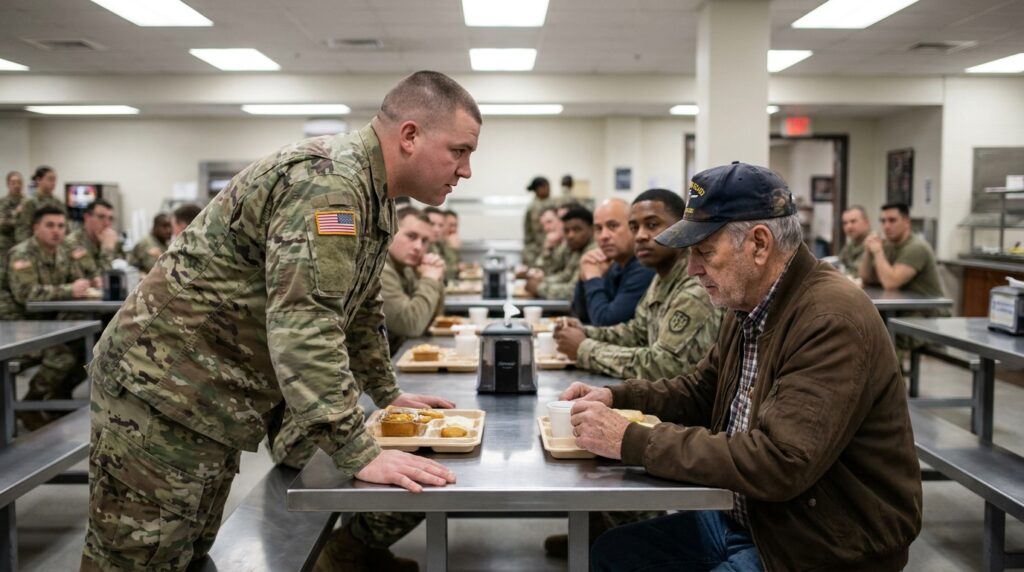
CHAPTER 4: THE SHADOW OF THE BAY
The shadow of the logistics warehouse didn’t bring cool air; it just smelled older, thick with the grease of heavy winches and the stagnant heat trapped beneath thousands of square feet of corrugated tin. Marcus slid his boots from the white limestone gravel of the driveway onto the oil-blackened concrete floor of Bay 4. Behind him, the low thrum of the base generators dropped a octave as the heavy machinery inside the maintenance shop kicked into gear, sending a steady, greasy vibration through his heels.
He did not tuck the manila file under his jacket. He held it flat against his thigh, his fingers curled over the edge where the coarse paper had worn white from his grip.
A shadow moved between two stacks of olive-drab engine crates. It wasn’t the thin clerk from the cafeteria. This shape was wide, low-slung, and carried the specific, unhurried weight of a senior non-commissioned officer who had spent thirty years watching officers come and go through the same gates. A pair of greasy coveralls hung loose from his shoulders, the name KOWALSKI stenciled in faded black across the pocket tab, just below a master sergeant’s insignia that had been blackened with boot polish to kill the shine.
“The transit gate is three hundred yards back, traveler,” Kowalski said. He didn’t look up from the brass coupling he was scraping with a wire brush. The metallic scratch of the steel bristles against the metal was rhythmic, dry, and sharp enough to make the air feel thin.
Marcus stopped near a stacked column of heavy truck tires. The rubber gave off a dense, sulfurous stink that mixed with the odor of damp oil cloths rotting in the corner of the bay. “The transit gate has too many questions today,” Marcus said. “I’m looking for the old administrative siding. The one that used to handle the riverine equipment pools.”
The mechanic stopped scraping. The wire brush remained motionless in his thick, scarred palm, the gray grease on his knuckles catching a stray beam of light from a cracked pane in the roof. He slowly turned his head, his small, dark eyes shifting from Marcus’s worn navy service cap down to the yellowed folder held against his leg.
“That siding was filled in with gravel during the ninety-six consolidation,” Kowalski muttered, his voice dropping into the lower register of the shop’s exhaust fans. “Nothing left out there but rusty tie-downs and three acres of scrub pine. If you’ve got papers to file, the clerk’s office is in Building 400. They’ve got air conditioning and three computers that don’t like dirt.”
“Computers don’t read seventy-one lot numbers,” Marcus said. He stepped closer, his boots making a dry, scratching sound against the grit on the floor. He laid the folder down on the flat top of an iron tool chest. The heavy steel lid was pitted with orange spots of rust where water had dripped from the ceiling during the spring rains. “The clerk outside says there’s an audit team looking for the duplicate index card. I want to know who signed the retrieval requisition.”
Kowalski wiped his hands on a scrap of burlap, the rough fabric making a dry, rasping noise against his calloused skin. He didn’t touch the file, but he leaned over it, his eyes tracking the alphanumeric stamp on the lower rim of the cardboard cover. He noticed what the young corporal in the dining hall had missed—the single, rusted iron binding staple that pinned the third leaf of the document completely shut, preventing the pages from turning cleanly.
“The signature on the lot log doesn’t belong to anyone active on this post,” Kowalski said, his thumb tracking a jagged white scar that ran from his wrist up into his sleeve. “The order came through the old maritime logistics desk at the annex. The one they forgot to close when they dismantled the brown-water assets in California. A man named Miller.”
Marcus kept his hands loose, his thumb resting over his signet ring. “Miller’s been in the ground at Arlington since the winter after the drawdown.”
“Then his desk is still writing letters,” the mechanic said. He reached down and picked up an ancient, heavy iron spanner from the bench, the tool cold and dark with decades of industrial oil. He didn’t brandish it; he just turned it over in his hand, checking the balance like a man preparing to clear a jammed gear. “They didn’t just flag your file, Vance. They locked the gate log three minutes ago. I can hear the air brakes on the security trucks over by the main barrier. They aren’t looking for a civilian who strayed off the path. They’re looking for the man who brought the seventy-one ledger back through the gate.”
Marcus didn’t flinch. He looked through the open bay door toward the perimeter fence, where the double-strand wire glinted like silver thread against the dry pine needles of the woodlot. He could hear the distant, metallic squawk of a security radio from the guard shack, the sound chopped into fragments by the hot wind.
“The ledger stays here,” Marcus said, his voice flat.
“The ledger doesn’t belong here,” Kowalski countered, his fingers tightening around the cold iron of the spanner. “It belongs in the furnace at Aberdeen with the rest of the garbage from the Delta. If you open that third leaf, you’re going to find twelve names that don’t match the casualty logs at the memorial. Six of them are still drawing checks under different social numbers in Delaware. If the captain from the audit team sees that purple stamp, he’s not going to put you in the brig. He’s going to put you in a car that doesn’t have handles on the inside of the doors.”
Marcus reached out, his calloused palm flattening against the yellow cover of the folder, his fingers covering the rusted iron staple. He felt the cold truth of the metal beneath his skin—the heavy, unyielding fact of an event that had been scrubbed from the history books but remained locked in the bone memory of the survivors.
“Let them bring the car,” Marcus said, his voice dropping below the steady, grinding rhythm of the shop. “The gate’s only half a mile from the state line, and the secondary fence has three panels that were put up with standard steel bolts. They turn easy when you have the right wrench.”
Kowalski looked at Marcus’s worn cap, then down at the silver signet ring with its smooth, flat face. A slow, heavy silence settled between them, the internal pressure of the bay rising as the shadows outside began to lengthen across the concrete apron.
“The captain’s already in Building 400,” Kowalski whispered, setting the iron spanner down on the tool chest with a dull, heavy clink that echoed through the empty rafters. “And he didn’t bring clerks. He brought four boys from the command squad who have new boots and no names on their shirts.”
Marcus didn’t answer. He picked up the file, tucking it firmly into the deep interior pocket of his brown bomber jacket, the coarse paper scraping against the leather with a sound like dry grass moving in the wind. He turned toward the narrow exit lane behind the engine stacks, his active agency driving him toward the high-friction boundary of the base where the real truth remained locked behind three layers of iron wire.








