
CHAPTER 6: THE RED CLAY TURNING
The limestone dust hit the fence line like a dry wave, taste-testing the back of Marcus’s throat with the chalky grit of ground mountain stone. It coated the lichen-crusted links of the wire, turning the orange flakes of rust into a pale, pasty slurry where the hot air from the staff car’s radiator fanned against the post.
Marcus didn’t blink. Through the white cloud, the silhouette of the grey staff car slammed to a stop, its brake linings giving off a short, mechanical shriek that vibrated through the clay beneath his boots. The shooters didn’t draw; their postures remained locked, their weight distributed low into the grit, their eyes tracking the sudden shift in administrative shadow.
The rear door didn’t swing open fast. It opened with a heavy, oiled click—the sound of an armored seal releasing.
An administrative clerk from Building 400 didn’t step out. A man with three silver blocks pinned to his starched utility collar slid his boots onto the gravel lane. He was old—not Marcus’s age, but deep enough into his fifties that his skin had the dry, cross-hatched leathering of a man who had spent his youth on river patrol boats before the black-budget accounts were moved to the computers. His nametag read STERN, stenciled in sharp, block letters that looked entirely permanent against the green twill of his chest pocket.
Stern didn’t look at the two shooters by the truck, nor did he look at the pasty auditor trembling in the blackberry briars. He looked at Marcus’s worn navy service cap, then his eyes dropped to the exposed yellow carbon copy held between Marcus’s scarred fingers.
“The log says you passed through the transit barrier with a civilian card, Vance,” Stern said. His voice was deeper than the clerk’s, holding the slow, rhythmic cadence of a man who spent his mornings signing destruction vouchers for things that didn’t go into the fire. “But your card index has an old riverine prefix that hasn’t been active since the year the dock at Vung Tau was dismantled.”
Marcus held the paper steady, the hot wind from the car’s engine compartment blowing the edge of the sheet until it flagged against his sleeve. Along the inner margin fold, just below the twelve handwritten names, a small purple-inked “V-7” designation was visible—a stamp used only by the logistics teams that supplied the unacknowledged operations fifty miles inside the line.
“The card works if you know which slot to put it in,” Marcus said, his voice level against the thrumming engine.
“The slot was welded shut during the ninety-six audit,” Stern replied, stepping closer until the smell of hot motor oil and leather seats from the staff car crowded out the sulfurous stink of the maintenance yard. “The captain thinks you’re trying to leverage a private settlement out of the logistics office. He thinks that lot number belongs to a pile of surplus generator sets that were written off as scrap. But he doesn’t know how to read the purple ink, Vance. He doesn’t know that every name on that carbon has an active insurance annuity being paid out of an administrative shell company in Dover.”
The lead shooter shifted his weight, his fingers twitching inside his cargo pocket as he looked at Stern for a signal to close the space.
Stern didn’t give it. He reached out, his hand stopping six inches away from the folder. “The 1971 discharge recommendation has a lock on it. If you walk that carbon copy past the second barrier, the computerized system at the gate is going to send an automated alert to the district court. The lawyers for the Dover account won’t let you reach the highway. They’ll use the old sovereign property statutes to claim you’re hauling unauthorized military records, and they’ll have the marshals pick you up before you clear the county line.”
Marcus looked down at the paper. The names were still sharp, written in the indelible ballpoint ink of an era when people expected documents to outlast the houses they were signed in. “The county line is four miles down the ridge road,” Marcus said. “And the marshals don’t have the key to the archives where the original manifest is logged.”
“The original manifest is gone,” Stern said, his voice dropping into a flat whisper that didn’t carry past the radiator grille of his car. “The major who signed that paper burned the primary logbook before he left the terminal at Long Binh. This yellow slip in your hand is the only piece of cardstock left that connects the Dover fund to the extraction points at Chau Doc. If you drop it into the furnace here, your service card gets re-indexed with an honorable classification, and the back-pension from seventy-two is deposited into your bank by Friday. A clean trade.”
Marcus felt the smooth metal of his signet ring press against the rough edge of the yellow carbon copy. It would be a simple conclusion—an easy calculation that would let his bones rest in a small house near the coast without the weight of the old iron siding hanging over his shoulder. The narrative appeared to offer a clean exit, a resolution that satisfied the paperwork.
But he knew how the logistics desks worked. A clean trade on a Friday always meant another folder was opened on Monday with a different colored stamp on the cover.
“The back-pension wouldn’t cover the cost of the bread,” Marcus said, his thumb tightening over the purple “V-7” stamp until the paper creased under the pressure of his calloused skin. “And the major didn’t burn the logbook. He gave it to a general named Miller who told me to keep the duplicate safe until the line went dark.”
Stern’s jaw tightened, the leathered skin around his collar turning a dark, dangerous red that matched the oxidized ink on the folder. “Miller’s dead, Vance. The line is as dark as it’s ever going to get.”
“Not while I can still read the ink,” Marcus muttered.
Before Stern could signal the men behind him, the lead shooter’s hand came out of his cargo pocket, his fingers wrapped around a small, heavy black cylinder—an un-serialized acoustic pressure wand used for non-lethal compliance within institutional confines. He took one sharp step forward, his boot grinding a piece of limestone gravel into powder as he reached for Marcus’s collar.
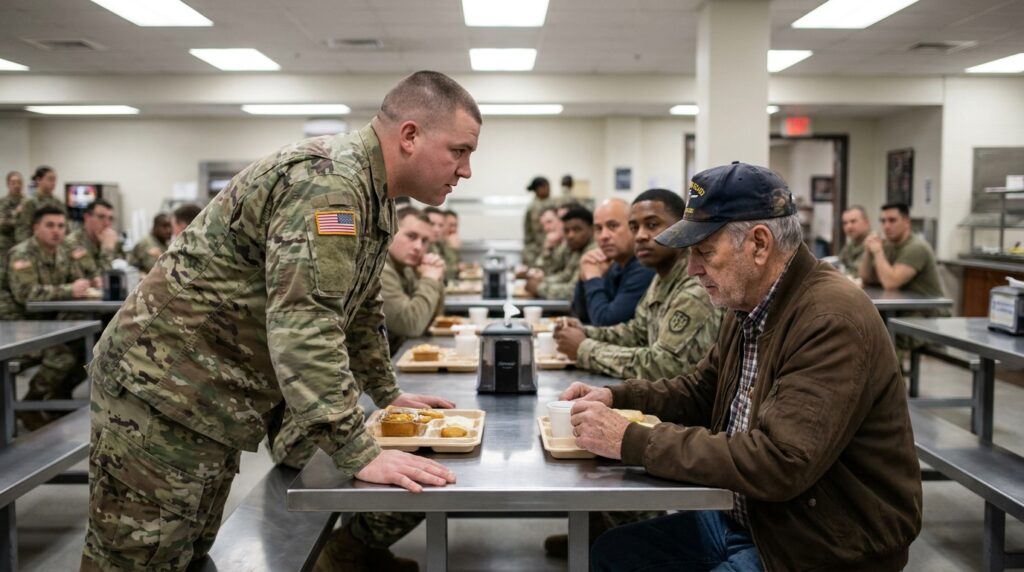
Marcus didn’t move backward. His active agency drove his weight into his front heel, his left hand rising in a sudden, short arc that caught the shooter’s wrist before the black cylinder could align. The impact was dry and heavy, the kinetic energy of the old man’s frame absorbing the rush and breaking the shooter’s spatial balance with the same mechanical certainty he had used on the floor inside the dining facility.
The acoustic wand flew from the shooter’s grip, landing with a dull thud in the soft red clay near the wild blackberry briars.








