
CHAPTER 7: THE PHARMACY ALLIANCE
The air at the end of Tier Four didn’t smell of old cabbage or cold grease anymore; it tasted of scorched PVC insulation and the sharp, chemical dry-ice discharge of an expired fire extinguisher. Silas dragged his left foot across the threshold of the pharmacy vestibule, his fingers clamped so tightly around the rusted rebar spike that the coarse iron ridges began to split his calloused palm. The red beacon above the security enclosure continued its slow, mechanical rotation, painting the wire-reinforced glass partitions in alternating slashes of dark crimson and heavy shadow.
The heavy steel mesh gate to the medical intake vault had been wrenched outward by a hydraulic vehicle jack, its anchor bolts sheared clean from the reinforced concrete casing. Inside the narrow room, among overturned metal trays of saline bags and scattered white paper cups, Henderson was slumped against the backup power generator. His remaining thumb was hooked into the heavy chain of a floor-mounted lockbox, and his face was slick with gray sweat that highlighted the deep lines of thirty years of subterranean labor.
“You’re late, Silas,” Henderson rasped, his breath coming in a wet whistle that suggested his own lungs were filling from the thick, hovering layer of plastic smoke. “Miller didn’t take the outer elevator. He went back through the service crawlways behind the water lines.”
Silas dropped to his good knee beside the generator, his joints letting out a dry click that seemed abnormally loud against the low, hum of the emergency sirens. He didn’t pick up the medicine bottles scattered by his boot. His vision was still tunneled by the irregular, racing stammer in his chest—a frantic, dry-pump rhythm that left his throat parched. “Where is the ledger?”
“He didn’t have it when he came through the cage,” Henderson whispered, his hand trembling as he gestured toward the shattered glass partition of the primary pharmacy office. “He had a courier bag, but it was light. He was looking for the master override key—the heavy brass one with the blank head that unlocks the warden’s private elevator in the administration wing. He’s running, Silas. He knows the Warden sent Vance’s crew to clear your block, and he knows he’s the next variable they’re going to delete to keep the offshore accounts from leaking.”
The trap had widened. It had broken out of the simple transactional violence of the cells and entered the survival logic of the administrative staff. Miller wasn’t an enforcer looking for a long-term pension anymore; he was a rabbit who had stolen the hawk’s nesting records and was trying to reach the highway before the perimeter gates locked for the state audit.
“Did he get the override?” Silas asked, his fingers tightening around the rebar spike as he calculated the distance to the central administrative stairwell.
“He didn’t find the original,” Henderson said, pulling a heavy, unnotched brass key from beneath his oil-stained canvas work apron. The key was clean, but its blank head was stamped with a single, deep horizontal scratch—the mark of a duplicate made in the machine shop forty-eight hours ago. “I switched the cabinet tags before the morning shift rotation. He took the dummy from the medical locker. If he tries to jam that into the administration gate elevator, the cylinder will freeze, and the electronic relays will lock him inside the shaft cage until the main guard desk resets the grid.”
Silas took the brass key from Henderson’s hand. The cold metal was heavy, its surfaces unpolished and sharp along the shoulder grooves. This was the real tool—the single mechanical leverage point that could get him out of the housing tier and into the upper executive offices where the true ledger was being processed for destruction. But the victory felt dirty, paid for with the immediate collapse of his own safety margin.
“The Warden’s personal enforcers are already coming down the north stairs,” Henderson said, his head dropping back against the vibrating casing of the generator. “They aren’t block guards, Silas. They’re the riot crew from the executive detail. They have the black vests and the heavy wooden clubs. They aren’t here to check your ID tokens. They’re here to clean the block before the state inspectors arrive at five o’clock.”
A sudden, sharp series of metallic thuds echoed from the access tunnel behind the pharmacy enclosure. The security gates at the end of the corridor were being struck with heavy iron pry-bars, the sound ringing through the structural pipes like a series of rapid hammer blows. The unlatched movement window was closing; the administration was forcing the grid back into operation ahead of schedule to trap the survivors inside the burning tiers.
Silas pulled Henderson upward by his canvas apron, but the older lifer’s legs remained loose, his boots sliding uselessly through the oil and spilled medicine on the floor.
“Leave it, Silas,” Henderson muttered, his hand weakly pushing at the old man’s forearm. “My knees are done. I’ve been down in this damp since seventy-two. There’s no parole waiting for a five-to-life man with fluid in his chest. You get across the service bridge. You use the scratch-key on the administrative lift. If you find that book, you don’t take it to a lawyer. You drop it into the public furnace line by the power house. You let the whole block see the soot.”
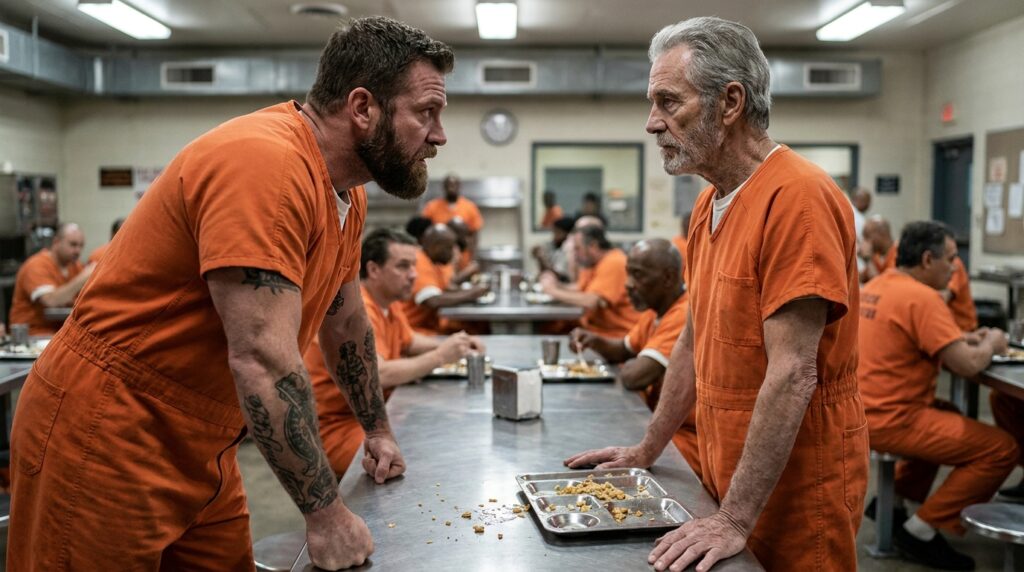
The iron gate at the entry vestibule gave way with a final, tearing screech of metal. Three figures in dark, unlabeled ballistic vests and visored helmets stepped through the black smoke, their long wooden batons raised as they began their rhythmic, silent advance through the wreckage of the medical cage. They didn’t offer verbal commands; their boots moved with the synchronized, heavy precision of a machine designed to grind down everything in its lane. Silas stood up, his spine straight against the wall, the real brass key hidden inside his closed fist while the red light continued its bloody, mechanical sweep across the visors of the oncoming crew.








