
CHAPTER 2: THE ISOLATION CAGE
The heavy iron gate didn’t swing; it shrieked along a rusted floor groove, a sound that vibrated straight through the soles of the older man’s split leather boots. Officer Miller’s hand remained flat against the textured grip of his heavy wooden baton, the small black medical notebook protruding from his hip pocket like a dark wedge. He didn’t issue an order. He simply canted his head toward the dark corridor that smelled of industrial bleach and seventy years of trapped damp.
“Walk, old man,” Miller said, his tone flat, entirely stripped of the performative hostility he used when the shifts changed.
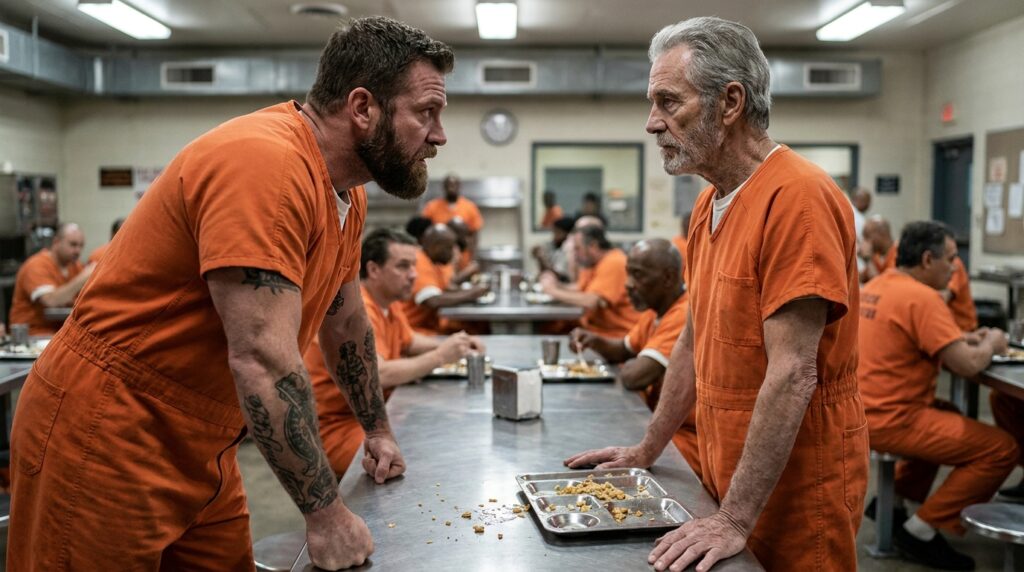
The older man moved. Every step was an internal inventory of damage. The brief kinetic burst in the cafeteria had cost him more than the enforcer on the floor; his right knee joint grinded with a dry, iron-on-iron friction, and a dull, deep ache beneath his left ribs signaled a hairline fracture where the younger man’s elbow had grazed him during the descent. He held his breath to stabilize his diaphragm, keeping his lips pressed tightly over the thin copper washer tucked into the recess of his lower gum. The metallic tang of the coin mixed with the sour taste of adrenaline.
The isolation wing was a separate architecture of despair, situated in the basement beneath the laundry tier where the walls were perpetually slick with condensed sweat. They reached Cell 4—a narrow slit of concrete with a solid iron door and a viewless, rusted ventilation grate near the ceiling.
“Strip it down,” Miller commanded, leaning against the door frame. His keys clattered against his belt, a sharp, transactional ring that filled the six-by-nine space.
The older man unbuttoned his orange cotton uniform shirt with steady, thick-jointed fingers, dropping the fabric onto the concrete. He didn’t look at Miller’s eyes; he focused on the guard’s midsection, watching the small black notebook. That book contained the pharmacy cage logs—the double-entry verification that proved his clinical need for the beta-blockers that kept his irregular heartbeat from triggering an ischemic stroke. Without those entries, his pending medical parole application would be automatically discarded as non-essential.
Miller stepped into the cell, his heavy boot pinning the discarded orange shirt to the floor. He leaned in, his breath smelling of stale coffee and wintergreen tobacco. “You’ve got an active imagination for an old timer. Thinking you can drop a tier boss’s favorite runner and just walk back to your bunk.”
“He crossed the lane,” the older man said, his gravelly voice tight, compressed by the pain in his ribs. “The table anchor is common ground. You saw the tray.”
“I saw an old man getting erratic,” Miller whispered, his face inches away. He reached back and tapped the black notebook in his pocket. “The documentation says you’ve been refusing your daily vitals. Says you’re non-compliant. A man who won’t take his heart pills isn’t a candidate for early release. He’s a liability. The state doesn’t parole liabilities; it buries them in the outer yard.”
The older man stayed rigid, his bare chest rising and falling in shallow, metered increments to avoid aggravating the rib. The trap was clumsy but absolute. The administrative syndicate didn’t need to stab him in the shower tier; they just needed to let his own cardiovascular system do the work by withholding the daily white tablets under the guise of behavioral non-compliance. It was a clean, paperwork-driven execution.
“Who told you to pull the log?” the older man asked, keeping his subtext bare, transactional.
Miller smiled, a thin line that didn’t reach his eyes, and stepped back into the corridor. “The administration likes a clean ledger, Silas. Some names aren’t supposed to leave the roster. You’ve been here thirty years. You’re part of the masonry now. Why would we let a piece of the foundation just walk out the front gate?”
The heavy iron door slammed shut, the deadbolt engaging with a dry, mechanical thud that echoed down the isolation tier. The light inside the cell died instantly, leaving only a dim, desaturated gray rectangle where the door’s food slot sat closed.
Silas stood in the dark, the cold of the concrete floor rising through his socks. He reached into his mouth, pulled the small copper washer from behind his teeth, and pressed it firmly against his split lower lip. The pain was grounding. They thought they were rewriting his medical files to kill his parole, but they didn’t know he had already survived three administrations by knowing exactly which ledgers were kept in the dark. He felt along the rusted seam where the iron frame of the bunk met the stone wall, his fingertips tracing a small, sharp indentation in the mortar. The decoy secret—the guard’s forged medical logs—was meant to keep him look downward, focusing on his own survival, while the real ledger remained hidden where the infrastructure was rotting from the inside out.
He sat down on the bare steel springs of the bunk, his ears tuning to the rhythmic, low-frequency hum of the industrial laundry dryers two floors above. The vibration traveled through the stone, a steady, mechanical pulse that told him the shift rotation was beginning. He had exactly twenty-four hours before his heart muscle began to misfire without the medication, and the only man who could get him past the tier gates was currently waiting in the steam of the washroom.








