
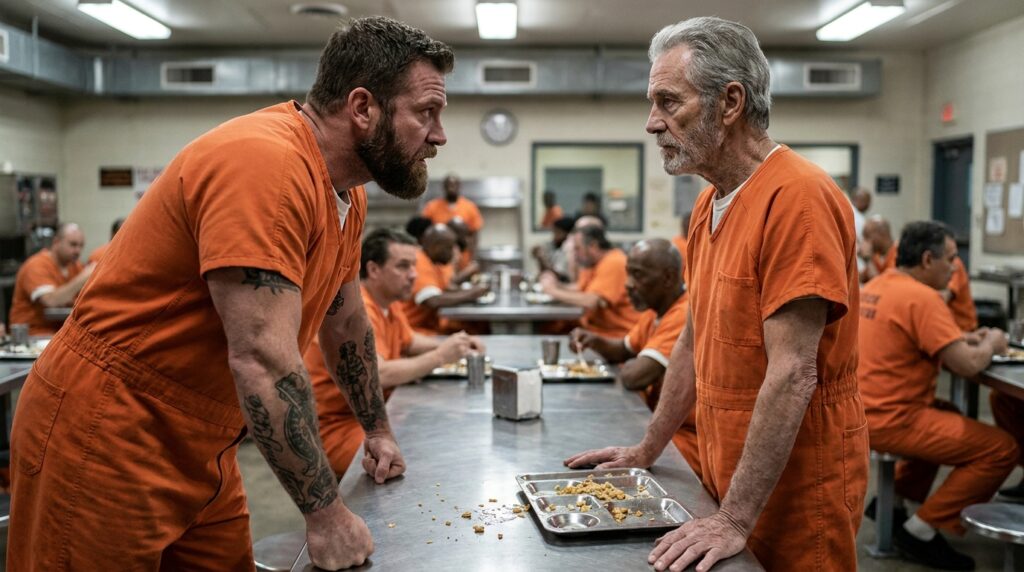
CHAPTER 4: THE RECREATION YARD
The transition from the laundry basement to the yard was a blunt shock of cold air and blinding, desaturated light. Silas kept his left arm pressed slightly against his ribs, trying to damp the internal friction of the bone with the weight of his forearm. The two guards didn’t speak as they escorted him past the weight piles, where the rusted iron plates sat in puddles of brackish water. The general population had been cleared from the north corner of the enclosure, leaving an artificial vacuum against the chain-link fence.
Sitting on a bolted steel bench beneath the shadow of watchtower three was Vance. He didn’t look like an inmate who had spent twenty years in the iron. His orange uniform was pressed, his boots were free of yard mud, and his fingernails were clean. Vance was the undisputed engine of the block’s black market, a man who survived three separate gang wars by making himself indispensable to the administrative staff upstairs.
The guards stopped ten paces back, crossing their arms. They weren’t watching Vance; they were watching the perimeter, acting as a human screen.
“Sit, Silas,” Vance said, his voice quiet, holding the calm precision of a man who dealt exclusively in balances. He didn’t offer a cigarette. He didn’t acknowledge the dark bruise forming along Silas’s jaw.
Silas remained standing. The cold wind from the fence line cut through his damp uniform shirt, causing the muscles across his back to seize. “The laundry line wasn’t finished.”
“The laundry is irrelevant,” Vance replied, his eyes narrowing as he looked at the old man’s posture. “You survived the cafeteria because the kid was sloppy. He thought he was proving a point. I don’t care about points, Silas. I care about consistency. You’re holding something that belongs to a very delicate ecosystem.”
Silas felt the cold metal washer beneath his tongue. He didn’t blink. “I’m an old lifer with an irregular heartbeat, Vance. I don’t hold anything but my breath.”
Vance smiled, a slow, humorless movement of his lips that looked like a scar opening. He reached into his pocket and pulled out a small, yellowed index card—the master release manifest from the records department. “Your medical parole application passed the first administrative desk last night. It was supposed to die in the pharmacy log under non-compliance. Miller was supposed to handle that cleanly. But you’ve been digging around the linen bins, and Miller tells me you have a piece of carbon paper that doesn’t belong to you.”
Vance leaned forward, his elbows resting on his knees, his eyes dropping to the waistband where Silas had tucked the stolen register sheet. “You think that carbon paper is your leverage. You think proving the administration is forging your medical refusal will force the state board to let you out early. That’s your decoy, Silas. You’re playing a small game about a heart pill.”
Silas kept his face clear of expression, but his heart gave a violent, irregular thump against his fractured rib cage. The internal pressure was growing.
“The Warden doesn’t care about a medical lawsuit,” Vance continued, his voice dropping an octave, competing with the distant hum of the perimeter wire. “He cares about the thirty-year ledger. The one from the old basement archive. The ledger that details every offshore transaction handled through the inmate welfare fund since 1996. The ledger you re-indexed when you were the library trustee.”
The revelation hit Silas like a physical blow, colder than the wind off the fence. The carbon paper in his pocket wasn’t his shield; it was the bait that had drawn him out into the open yard. They didn’t want him dead in his cell because of a parole dispute. They wanted the financial records that could dismantle the entire administrative structure of the state correctional system.
“The kid in the cafeteria was a test,” Vance whispered. “If you were weak, we’d just let the medical log handle you. But you’re still functional. You’re still sharp enough to break a runner’s leg. Which means you’re still dangerous enough to take that ledger to the federal prosecutor the minute you cross the state line.”
Silas looked up at watchtower three. The guard in the glass booth wasn’t looking at the yard; his rifle was unslung, his back turned to the fence. The isolation was absolute.
“You have until the evening lockup to drop that ledger in the laundry chute,” Vance said, rising from the steel bench. He stepped close, his breath a cold mist between them. “If it’s not there when the tier count clears, the guards won’t bother with the pharmacy records. The doors on tier four will simply fail to lock during the night shift. Every unaligned runner on the block will have five minutes of free movement, and your cell door will be unlatched from the master control.”
Vance turned and walked toward the main corridor gate, the two escort guards immediately falling into step behind him. Silas was left alone against the chain-link fence, his hand shaking slightly as he reached into his pocket to touch the folded carbon paper. The small piece of leverage was gone, dissolved by the weight of a thirty-year secret he had hoped the world had forgotten.
He turned toward the housing block, his boots crunching against the desaturated gravel of the yard. The sky above the concrete walls was darkening, a heavy slate gray that promised rain before lockup. He had four hours before the tier gates closed, and the ledger was hidden where no one—not even Vance—could reach it without tearing the foundation of his own cell apart.








