
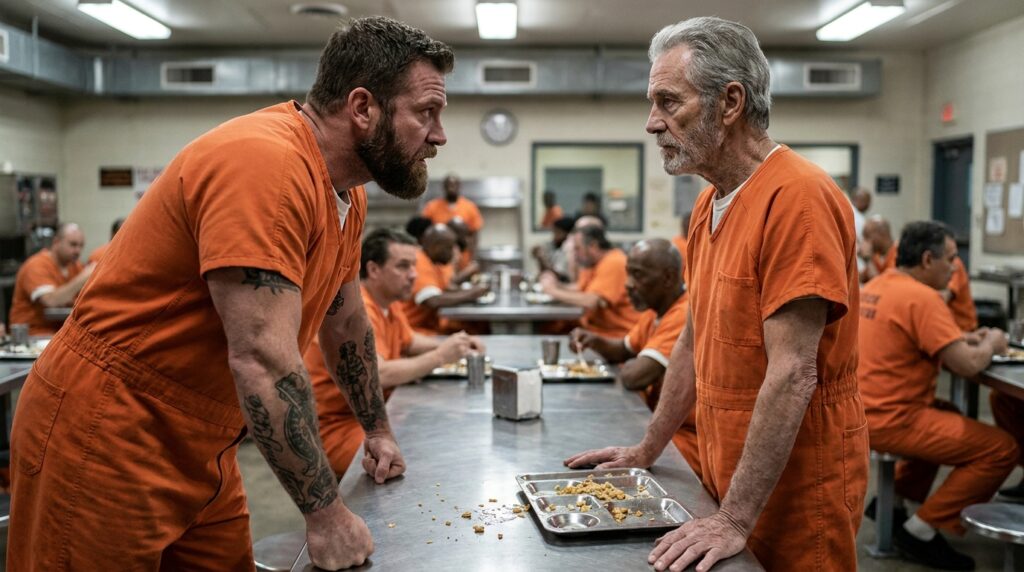
CHAPTER 5: THE SHATTERED BED
The steel door to Cell 12 didn’t close with its usual mechanical click; it dropped into the housing frame with a heavy, unyielding vibration that rattled Silas’s teeth. The single unshaded bulb hanging from the center of the tier ceiling flickered twice, casting a desaturated, yellow glare across the narrow room.
Silas stopped on the threshold. The small space had been systematically disassembled. His state-issued mattress had been dragged from the iron spring frame and split down the center seam, its compressed gray linen fibers spilling across the concrete floor like dirty snow. His replacement uniform shirts had been ripped from their plastic hooks, their sleeves tangled around the base of the stainless steel sink.
They hadn’t just searched the cell. They had gutted it.
He stood perfectly still, his left forearm clamped hard against his ribs to suppress the sharp, grinding heat of the hairline fracture. The internal skipping in his chest had grown more pronounced, a rapid, uneven flutter that tasted like pennies at the back of his throat. He had less than an hour before the final evening siren, and the yard guards were already executing the pre-lockout tier sweep.
He didn’t move toward the shredded mattress. He knew Vance’s crews wouldn’t find what they were looking for inside the cotton batting; that was a novice hiding place, the kind used by short-timers smuggling tobacco or sublingual strips. Silas closed his eyes, listening to the rhythmic, distant clanking of the tier gates closing on the lower levels.
He walked slowly to the rear wall, his split leather boots crunching against a piece of shattered institutional soap. Kneeling beside the rusted iron anchor where the bunk frame was bolted directly into the stone foundation, he ran his cracked fingers across the vertical mortar seam. The mortar was cold, rough, and damp from the rain dripping down the outer ventilation shaft.
His fingers found the specific indentation he had traced in the dark of the isolation cage. He pressed his thumbnail into the crease. The dried gray material didn’t crumble; it shifted backward as a solid block. Silas reached into his mouth, pulled the worn copper washer from beneath his tongue, and used its thin, notched edge to pry the hidden stone out of the recess.
The cavity behind the stone was completely empty.
A cold stillness settled into the marrow of his bones, heavier than the damp basement air. The ledger—the thirty-year record of the warden’s offshore accounts that he had extracted from the library archive before the re-indexing—was gone.
“Looking for this, old man?”
The voice came from the open food slot of the cell door. Silas didn’t turn around immediately. He carefully replaced the loose stone, stood up by leveraging his weight against the iron sink, and turned his face toward the small, rectangular opening in the steel.
Officer Miller was looking through the mesh. In his left hand, he held a thick, canvas-bound ledger with brass corners, its spine cracked and stained with the black ink of a dozens of audit stamps. In his right hand, he held a plastic syringe filled with a clear, colorless solution—the high-dosage synthetic beta-blocker that Silas’s heart required to prevent a fatal stroke.
“Vance thinks he runs the tier,” Miller said, his voice dropping into a flat, transactional whisper that barely cleared the iron slot. “Vance thinks everything in these walls belongs to his ecosystem. But Vance doesn’t look at the master payroll. He doesn’t see who authorizes the transfers.”
Silas leaned against the sink, his fingers gripping the cold, pitted metal to keep his knees from buckling under the irregular pounding in his chest. “You didn’t take it to Vance.”
“Vance wants to swap this book for a favor from the Warden,” Miller said, tapping the canvas cover against the iron door. “A reduction in his minimum date. A move to a low-security camp out west. Small-time thinking. This ledger isn’t a bargaining chip for a better room, Silas. This book is an insurance policy against the entire department.”
The old man understood the geometry of the trap now. The predatory hierarchy didn’t end with the cellblock syndicates or the warden’s inner office. It went down into the shift rotations, into the hands of the low-wage enforcers who kept the keys and watched the gates. Miller wasn’t working for Vance, and he wasn’t protecting the warden; he was securing his own retirement by collecting the chains that held them both.
“The block doors are unlatching in ten minutes,” Miller whispered, sliding the plastic syringe halfway through the food slot until it rested on the iron lip. “The control panel is going dark for the tier sweep. You give me the authorization codes for the encrypted columns on page forty-two, and I leave the needle on the shelf. You keep your mouth shut, and your heart stays inside your ribs until the morning shift.”
Silas looked at the clear fluid in the cylinder, then up at Miller’s eyes—cold, calculation-driven, entirely devoid of empathy. If he gave up the codes, the ledger became a live weapon in the hands of a dirty tier guard, and his life would be worth exactly nothing the moment the ink dried. If he refused, his door would slide open in ten minutes, and Vance’s runners would clear the debt with five inches of sharpened fence wire.
He reached down, his fingers closing around the cold plastic of the syringe. He didn’t look at the needle. He looked at the copper washer he still held tight in his left palm, the metal worn smooth by thirty years of keeping his teeth together.
“The code isn’t on page forty-two,” Silas said, his gravelly voice dropping into a hard, unyielding rasp. “It’s in the masonry. And you’re going to have to leave the door open if you want to find it.”
Miller’s eyes hardened, his hand pulling the canvas ledger back against his chest as the first long, rhythmic blast of the lockout siren began to wail across the tier.








