
CHAPTER 4: THE PERIMETER CHECK
The tires hit the limestone wash at the foot of my driveway with a dry, crunching roar that rattled the loose steel tools in the truck bed. I didn’t even kill the headlights. The two yellow beams cut straight through the rising dust, painting the thick, gray oak trunks along the lane in a pale, sickly light.
They were already there.
The dually sat idling at the edge of my fence line, its massive black silhouette blocking the gravel turn-around like an iron wedge driven into the clay. The twin chrome exhaust stacks behind the cab belched a thick, oily plume of diesel smoke into the dark violet sky, the heavy odor of unburnt fuel settling over the sweet clover weeds like a wet blanket.
I let my F-150 coast to a halt ten feet from their bumper, the worn brake pads squealing a thin, metallic note that died instantly against the deep, rhythmic thrum of their larger engine. My hands stayed wrapped around the steering wheel, the cracked vinyl cold against my palms. Through the dust-streaked windshield, I could see two figures behind the dark glass of the dually.
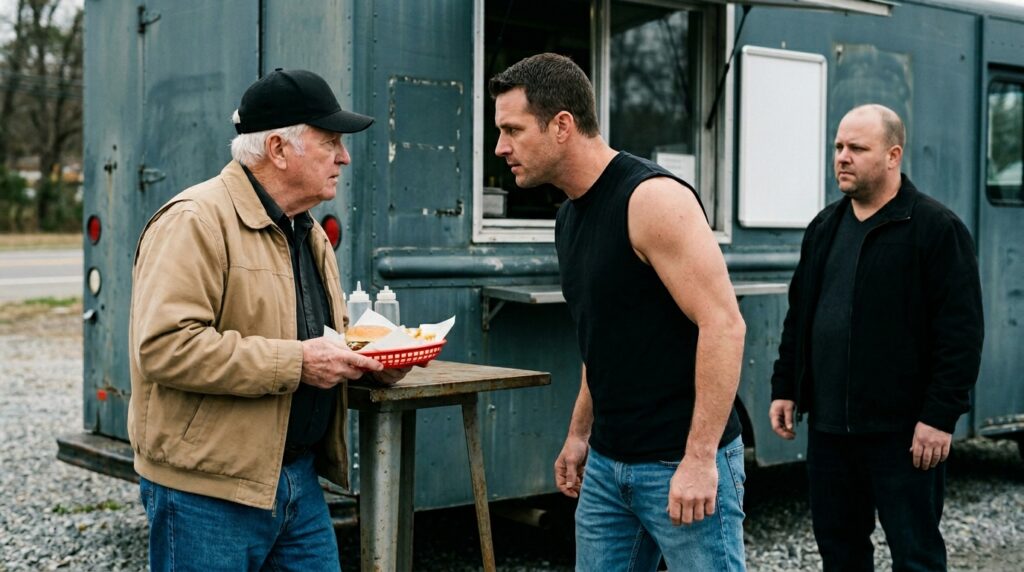
The driver’s side door opened with a slow, heavy groan of ungreased hinges. Caleb swung his boots down into my gravel, his large frame silhouetted by the orange amber glow of his running lights. He didn’t have his work shirt on now; he wore a sleeveless undershirt stained with grease at the collar, his thick forearms pale under the twilight. He didn’t approach the truck. He walked to the edge of my ditch line, standing right where the fence wire hung slack from the loosened staples.
The passenger door remained shut, but the window rolled down three inches. The smooth, hairless crown of the bald man’s head caught the yellow reflection of my high beams. He didn’t move. He just watched through the narrow opening, a silent, heavy weight keeping the truck anchored to my dirt.
I checked the iron latch on my door, slipped my thumb through the loop of the fence tool on the seat beside me—a solid, fourteen-inch piece of forged iron with a cold chisel head—and stepped out into the night air. The dust coat on my boots was thick, rising in small gray puffs around my ankles as I walked toward the front fender.
“You’re back early,” I said, my voice staying low, even, carrying no more weight than a dry wind through an empty barn.
Caleb didn’t look at me. He kicked a loose chunk of limestone into the ditch with the steel toe of his boot. “The county’s changing the zoning on the lower marsh route, old man. They’re running the survey line straight through the oak grove. Your nephew Jesse signed the access waiver at noon today.”
The cold iron weight behind my ribs tightened until it felt like a band of steel. Jesse had done it. He’d signed the paper that gave these bastards the right to bring the heavy yellow iron across the boundary line. But Caleb wasn’t looking at the trees. His eyes were fixed on the small concrete blockhouse sixty yards behind my kitchen—the pump-house that drew the deep well water from the limestone shelf below.
“Jesse doesn’t have the deed to this section,” I said, my fingers tightening around the forged iron tool in my jacket pocket until the metal corners bit into my callouses. “His name isn’t on the land registry.”
“It’s on his daddy’s probate file,” Caleb said, finally turning his head to fix me with that flat, predatory stare. “And that’s enough for the state road office to grant a temporary easement for the utility core. We bring the clearing dozers through at seven tomorrow morning. If the fence is still up, the blades will do the work for us.”
Behind him, from the dark interior of the dually, a sharp, metallic click echoed through the gap in the passenger window—the distinct, heavy sound of a lighter wheel striking flint, followed by the orange ember of a cigarette glowing in the shadows. The bald man didn’t lean out, but the smoke drifted through the opening, sour and thick.
“The easement requires a certified notice,” I said, stepping closer until the heat from the dually’s radiator hit my face like a furnace blast. “A registered copy delivered by the clerk. You don’t carry the county paper in a tool box, Caleb.”
A slow, ugly grin split Caleb’s face, but his eyes stayed dead, calculating the distance between my boots and his bumper. He leaned back against his truck’s fender, the sheet metal popping under his weight. “You want the paper? Go ask Jesse. He’s sitting in his trailer down by the old gravel pit, looking at the check they cut him for the timber rights. Or you can look in the folder on my dash. It’s all the same ink.”
He reached back, his hand tapping the dark tinted glass of the dually’s windshield right above the instrument cluster, where a thick, manila envelope sat flat against the plastic trim.
My heart hammered against my ribs, a fast, shallow rhythm that felt too fragile for the size of the dark valley around us. It was a decoy—a piece of corporate misdirection designed to make me turn my back on the ridge and hunt down my own blood while they set the stakes for the industrial corridor. But beneath the diesel exhaust and the sour tobacco smoke, a stranger detail caught my attention.
A low, rhythmic vibration was hummed through the soles of my boots. It wasn’t the engine of the dually. It was a deep, underground throb coming from the direction of the pump-house—the distinct, hollow knocking of an overloaded suction valve trying to draw water through a choked line. My well was running dry, or something down in the dark aquifer was fighting the pump.
“Seven AM, Silas,” Caleb said, his voice dropping into a tight, transactional rasp as he stepped back toward the open cab door. “Have the gate unchained, or we’ll leave the iron in the weeds.”
He swung up into the seat, the door slamming shut with a heavy, double-striking thud that echoed off the dry silos across the road. The dually lunged forward in reverse, its massive tires tearing two deep, white trenches through the limestone gravel of my turn-around before spinning out onto the dark asphalt of the county line.
I stood in the settlement of the dust plume, the red taillights of their truck shrinking into two bloody pinpricks against the black horizon. The iron tool in my pocket felt frozen against my thigh, but the low, hollow thumping from the pump-house was getting louder, a rhythmic shuddering in the limestone shelf that felt like a dying pulse deep inside the earth.








