
CHAPTER 3: THE PRICE OF COLD IRON
The overhead tin roof of Miller’s Supply groaned under the heat, expanding with a series of sharp, rhythmic pops that sounded like small-caliber fire. Inside, the air was thick with the smell of floor sweep, kerosene, and ninety years of oxidized iron. It was a dark, narrow cave of a store where the shelves reached the ceiling, packed with cardboard boxes whose labels had faded from black to a ghostly, water-logged gray.
I set a plastic bucket of heavy fencing staples onto the wooden counter. The wood beneath my palms was deeply grooved, scarred by generations of farmers sliding logging chains and disk blades across the pine planks.
Old man Miller didn’t look up right away. He was scraping a thick crust of hardened grease off an ancient threading die with a dull pocketknife. His knuckles were swollen into pale knots, his breath coming in a dry, whistling rattle through his teeth.
“Twenty pounds of the inch-and-a-half,” I said.
Miller stopped his scraping. He wiped the blade of his knife against the thigh of his grease-blackened overalls, leaving a dark, oily smear. He looked at the bucket, then at my hands, his eyes squinting through grease-smudged spectacles held together at the bridge by yellowed masking tape.
“Hear you had a bit of friction out by Martha’s truck yesterday,” Miller said, his voice flat, rhythmic, carrying the non-committal caution of a man who had seen three generations of families go broke in this valley.
“A misunderstanding about space,” I said, keeping my hands flat on the pine counter. “Nothing that didn’t clear itself up.”
“Caleb don’t clear things up,” Miller muttered, reaching behind him to pull a heavy ledger from a shelf covered in dry-rot dust. He flipped the pages with a thick thumb, the yellowed paper crackling like dry corn husks. “He unloads. He’s been buying up structural posts, heavy-gauge t-posts, and three-ply wire for a month now. All of it billed to the county road commission account, but none of it going toward the state routes.”
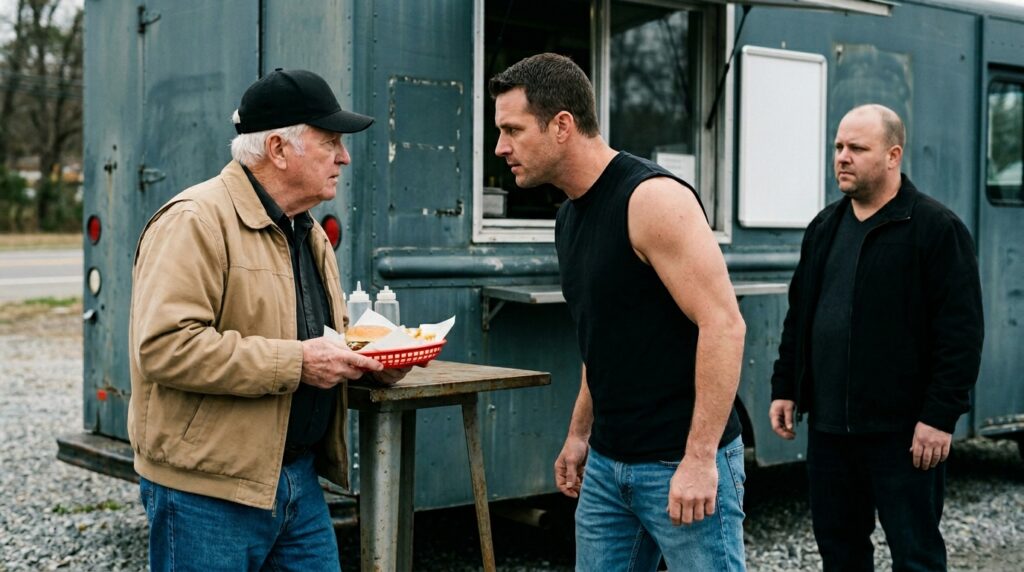
I didn’t answer. I reached into my tan jacket pocket, my fingers brushing against the cold, notched edge of the key to my pump-house before pulling out a handful of crumpled bills. As I pulled the hand back, a faint, chemical tang hit my nose—a sharp, copper-and-sulfur scent that had stayed on my skin ever since I inspected the eastern boundary fence line this morning. It wasn’t the smell of cedar or ditch weed. It smelled like the runoff from an old battery vault.
“Who’s signing the vouchers on that county account?” I asked, dropping the bills onto the ledger.
Miller stopped his pencil midway down a column of figures. He looked toward the open screen door, where the heat waves were dancing off the rusted hood of my truck parked in the gravel lot. A lone bluebottle fly buzzed frantically against the wire mesh, trapped between the iron screen and the heavy wood frame.
“A name you know,” Miller said softly, his voice dropping into the lower register reserved for bad news. “Your boy Jesse’s name is on three of the haul receipts. The ones for the survey stakes and the lime bags.”
The iron spike in my back didn’t fire this time, but a cold, heavy weight settled directly behind my ribs. Jesse. My late brother’s boy. A lad who had spent his thirty-something years drifting from one municipal road crew to another, always looking for a shortcut through the clay, always six months behind on his truck notes.
“Jesse doesn’t own anything on that ridge,” I said, the words coming out stiff, like ungreased gears turning in winter.
“He don’t own the dirt,” Miller agreed, closing the ledger with a heavy thud that puffed a tiny cloud of lime dust from the seam. “But he’s got the registration on your late brother’s estate car. And he’s been sitting in the back booth of the Diner with the supervisors from the regional syndicate three nights a week. The ones running the new industrial corridor through the lower marsh.”
He pushed the bucket of staples toward me. The heavy wire fasteners rattled against the plastic sides with a sound like loose teeth.
“They’re looking for a leverage point, Silas,” Miller added, leaning over the counter until I could smell the peppermint lozenge he was sucking on to hide his tobacco breath. “Caleb’s just the hammer they use to find the soft spot in the timber. If the wood don’t split, they bring the saw.”
I took the handle of the bucket, the wire cutting into the callouses of my palm. “The wood’s oak,” I said. “It don’t saw easy.”
“Everything saws when the blade’s got teeth enough,” Miller said, turning back to his threading die without another word.
I walked out into the glare of the gravel lot, the heat hitting me like a physical blow against the tan jacket. The air smelled of hot tar and parched weeds. I threw the bucket into the bed of the F-150 next to the fence tool, the metal clanging against the wheel well with a hollow, lonely ring.
As I climbed into the cab, my eyes caught the small commercial folder tucked into the side pocket of the passenger door—an old map of the county water districts I’d kept since my time on the drainage board twenty years ago. I pulled it out, the paper stiff and yellowed along the folds. My thumb left a faint gray smudge of hardware grease near the blue line that marked the aquifer under my eastern section.
The water line ran straight under the dead creek bed, right where Caleb had left his boot heel in the clay.
I put the truck in gear, the transmission whining as I pulled onto the empty main street. The storefronts were mostly dark now, their display windows covered in gray grime or boarded over with rough plywood that had started to warp and cup under the June sun. The town wasn’t dying; it was being hollowed out from the inside, the old framework left to stand while something new and greasy took root in the basement.
I didn’t go home. I drove toward the county records office behind the courthouse, my foot steady on the gas pedal despite the tremor in my knee. I needed to see exactly what kind of paper Jesse had been putting his name to, and whose ink was drying on the back of my fence posts.








