
CHAPTER 1: THE WEIGHT OF A BASKET
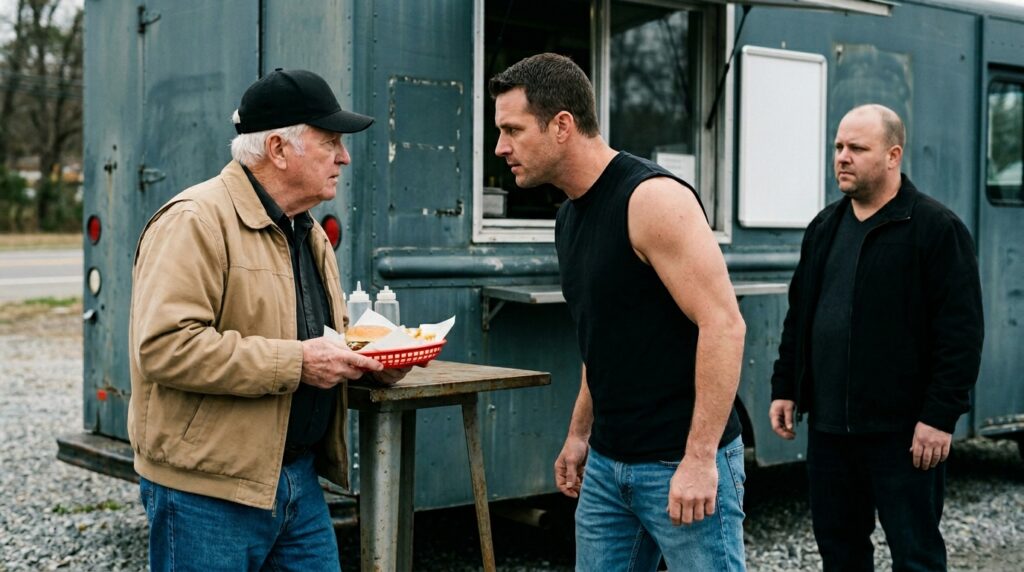
“You’re breathing my air, old man.”
The words smelled of stale tobacco and cheap energy drinks. They came from a mouth that hadn’t smiled with anything resembling sincerity in a decade.
I didn’t turn my head right away. My thumb was pressed against the rough wicker handle of the food basket, feeling the grease-soaked wax paper beneath the fried chicken. The metal counter of the truck’s service window was cold, pitted with rust along the welded seams where the salt air and diesel exhaust had eaten through the zinc coating over twenty years.
“I asked you a question,” the voice grated closer. A heavy work boot came down on the loose gravel behind me, the sharp crunch of limestone echoing against the side of the aluminum trailer.
“I heard you,” I said. My voice sounded like dry gravel shifting in a bucket. I didn’t look at the big man in his late thirties—the one with the tight neck muscles and the faded tattoo of a dying hawk stretching out from under his grease-stained collar. Instead, my eyes locked on his shadow, which had completely erased my own against the sun-bleached wood of the menu board.
Behind him stood the other one. A heavy-set, bald man in a stiff black nylon jacket that crinkled every time he shifted his weight. He didn’t speak. He just leaned against the rusted fender of a parked dually, his arms crossed over his chest, his eyes dead as ditch-water. He was the witness. The kind of man who didn’t throw the punch but held the jacket so the blood wouldn’t splatter.
“Then move,” the younger man spit, stepping directly into my peripheral vision. He didn’t want the spot at the counter. The truck wasn’t even busy. He wanted the dirt I was standing on. He wanted to see if seventy-something years of living had left anything solid inside the tan jacket, or if it was just hollow straw ready to be scattered by the county wind.
I tucked the food basket tighter against my ribs, using it as a shield between my sternum and his chest. My black cap cast a shadow down to my nose, but I could feel the heat radiating off him—the erratic, sour heat of a man who believed the world owed him a debt the local banks wouldn’t pay.
“I’m just here to eat,” I said, keeping my heels dug into the limestone. “Take the trouble down the road. There’s plenty of it out there.”
“The road’s full,” he said. His hand came down on the metal counter with a dull, ringing thud that shook the napkin dispenser. “And your time’s up. You and that patch of scrub pine you’re sitting on.”
The mention of the land wasn’t an accident. It settled in the pit of my stomach like a cold stone. This wasn’t about the line. It was about the long, slow squeeze.
Before I could pull air into my lungs, his shoulder swiveled. A thick, calloused palm shoved hard against my left arm, aiming to spin me off the platform and into the dirt. My boots slipped an inch on the loose stones, the sudden strain firing a hot, iron spike of pain straight up my lower lumbar—the old injury from the foundry days, reminding me exactly how few miles were left on the clock.
But forty years of lifting pig iron teaches you how to drop your center. I didn’t fall. I let the basket take the brunt against the counter, the cardboard box inside groaning under the pressure. My right hand, stiff and thick-jointed from arthritis, locked onto the lip of the metal window frame.
“I told you,” I breathed, my teeth clicking together as I lunged back into his space, using the rigid bone of my forearm to wedge between his collarbones. “I don’t get pushed.”
For three seconds, it was just the wet, heavy sound of two men breathing in the humidity. We were locked there, the rusted metal of the truck creaking under our collective weight. I could see the broken veins in his nose, the yellow tint in the whites of his eyes. My strength was leaking out through my knees—I could feel the tremor starting deep in my thighs—but I didn’t give him the inch.
The cook inside the truck, an older woman named Martha who had known my dead wife, pulled the slide wire shut with a sharp, metallic screech. She didn’t call out. In this town, you didn’t call the sheriff unless someone was already dead on the floor.
The bald man off the truck finally took his hands out of his pockets. “Hey. Caleb. Let it go. People are looking from the crossroads.”
The younger man—Caleb—swung his eyes toward the road, then back to me. The heat in him didn’t cool; it just went underground, turning into something dark and calculated. He stepped back slowly, his boots grinding the gravel into powder. He reached up, wiped a smear of grease from his tan forearm onto his jeans, and fixed me with a flat, level stare.
“You’re a long way from the house, old man,” he muttered, his voice dropping into a register that didn’t carry past the counter. “And those old locks on your gate don’t mean a damn thing when the wood’s already rotten.”
He didn’t turn his back to me as he walked toward the dually. He kept his eyes on mine until the truck door slammed shut with the heavy, hollow sound of cheap American steel.
I stood by the window for a long minute after the diesel engine roared to life, my hand still white-knuckled on the grease-slicked ledge. The food basket felt three times heavier than it had ten minutes ago. When I finally looked down to check the strap, my fingers brushed against a long, jagged splinter of fresh pine that had been jammed into the tight weave of the wicker—something that hadn’t been there when I left my porch.








