
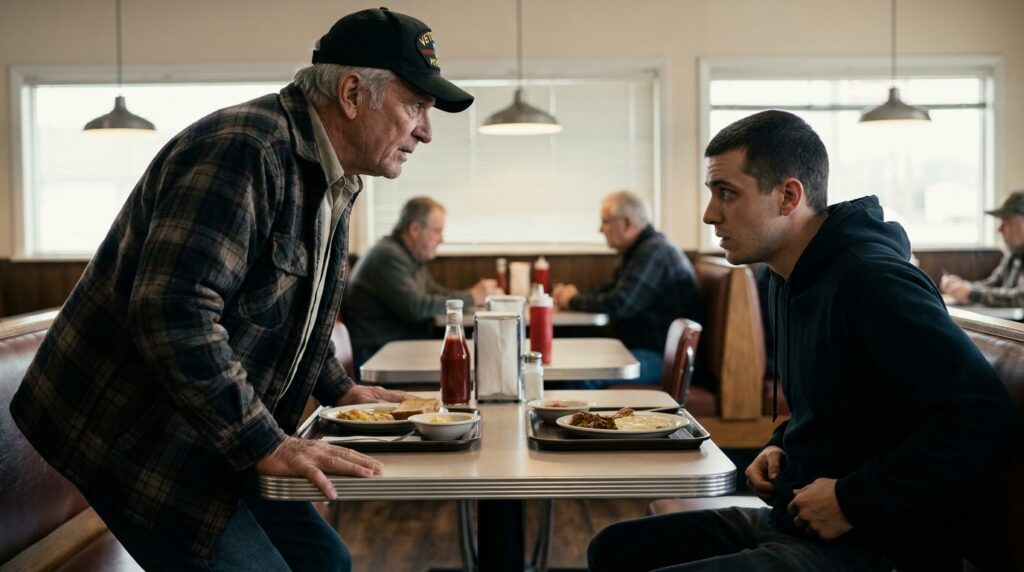
CHAPTER 8: THE GRAVEL AT THE HORIZON
The vibration didn’t start in the air; it came out of the limestone substructure of the yard, a deep, three-cycle diesel thrum that made the dust on the lip of the rusted iron shipping crate dance in uniform circles. The heavy transports from the Delaware fleet were arriving, three minutes ahead of the logistics board’s certified schedule.
Miller didn’t turn his head to look down the access lane. Time didn’t dilate because he was old; it dilated because forty years of regulatory precision had trained his mind to isolate every micro-action down to its friction points. He could hear the specific, dry click of the silver sedan’s radiator cooling fan cycling off, the soft hiss of the oxygen tank near Marcus’s rusted truck, and the sharp, shallow breath the man in the gray coat took as his roller pen finally slipped from his fingers, clattering against the concrete floor.
“The board didn’t send those rigs for the warehouse frames, Miller,” the gray coat said, his voice flat, stripped of its administrative arrogance, sounding like a dry bearing running on a bare shaft. He reached down to close the black oilcloth binder, but his hand stayed frozen over the yellowed plastic tab. “They have the federal clearance from the state capital. The liquidation field is closed.”
“The field is only closed when the iron is out of the vault,” Miller said. His voice was lower than the multi-axle rumble from the road, a dense, mechanical block of sound that occupied the entire central bay.
He didn’t look at the surveyor or the clean orange safety vest that was now retreating toward the concrete ramp. The veteran moved his wide frame two inches to the left, his heavy work boots grinding a track through forty years of accumulated foundry soot until his heel struck a raised seam in the floorboards. Beneath the gray grease and the limestone dust lay the corner of a heavy, galvanized cast-iron plate—the hatch cover that locked the old state guard asset reserve into the sub-grade rail spur.
The ring of iron keys in Miller’s hand felt cold, the heavy four-sided bitted steel carrying the specific chill of subterranean vaults that had never seen the noon light. He didn’t drop them into the latch hole. A sovereign protector doesn’t expose the core asset while the boundary remains breached by an active agent. He simply held them flat against his canvas-covered thigh, a visible, performable proof of his absolute command over the structural reality of the valley.
Marcus stepped forward, his breath rattling in his throat as his dirty hand gripped the edge of the shipping crate. The copper wire stitching on his jacket sleeve was gray with limestone dust, a crude repair job caught in the sharp glare of the noon sun. “You took the blame,” he whispered, his eyes wide as they tracked the outline of the cast-iron plate beneath Miller’s boot. “When the bank took my old man’s rigs… you let the whole town say you were a lazy clerk who didn’t check the scale manifests. You let him die thinking the system had just run over him.”
“If the system hadn’t run over him, Marcus,” Miller said, his gaze staying locked on the gray coat’s eyes, “it would have dug up this floor. Your father’s shop was the only independent line left with an easement over the spur. I signed the non-compliance orders because an administrative failure is a temporary block. A federal seizure is a permanent fence.”
The man in the gray coat took a step back, his field coat rustling as his heel caught on the edge of the surveyor’s plastic case. He looked at the heavy iron ring, then down at the smudged print on his oilcloth page where Miller’s grease-stained thumbprint had blotted out the regional trust’s liquidation stamp. The double-stamped date code from May of fourteen wasn’t a mistake; it was the exact record of a twenty-four-hour standoff between the river command and the corporate auditors—a standoff Miller had settled by locking the vault and carrying the key into thirty years of silent retirement.
“Some people mistake peace for weakness,” Miller said, his voice dropping into that deep, quiet center that made the entire loading dock seem to contract around his words. “Don’t make that mistake again.”
The sound of the approaching fleet transport reached the foot of the concrete ramp, the air brakes releasing with a massive, rhythmic hiss that shook the corrugated iron panels of the roof. The driver didn’t clear the gate post; he stopped the massive cab directly across the entrance lane, the chrome grille blotting out the view of the highway scale and Route 9 like a wall of polished tin.
The gray coat didn’t try to salvage the binder. He left the black oilcloth ledger sitting on the rusted shipping crate, its pages fluttering once in the hot draft from the diesel exhaust before he turned and walked down the concrete ramp toward the idling sedan. His movements were quick, short, and stripped of the professional smoothness he had carried into the diner an hour ago. He didn’t look back at the platform, nor did he look at the surveyor who was already climbing into the front passenger seat of the silver fleet vehicle.
Miller stood perfectly still in the center of the bay, his wide shoulders set against the gray glare of the midday sky. He didn’t adjust his navy cap. The tarnished brass anchor pin remained fixed three degrees off-center on his lined forehead, a quiet, unglamorous marker of a service that didn’t require an audience or a parade to maintain its boundary.
Marcus looked down at the cast-iron plate, then up at the veteran’s face, his fingers finally letting go of the dark jacket sleeve where the frayed copper wire had begun to unravel from the cuff. The valley was still hot, the smell of zinc oxide, old lard, and dry iron dust remaining heavy in the noon air, but the friction that had been building since nineteen-eighty-four had finally settled into the concrete floorboards, hard and unyielding as a level masonry line.
The silver sedan swung into the access road, its tires throwing up a final cloud of white limestone dust that blotted out the highway for three long seconds before the ticking of its unbalanced tie rod was completely swallowed by the heavy, multi-axle roar of the Delaware rigs. Miller didn’t move his boot from the hatch. He waited for the dust to clear from the horizon, his hand staying firm against the iron ring of keys as the afternoon heat settled over the valley like a sheet of old iron.








