
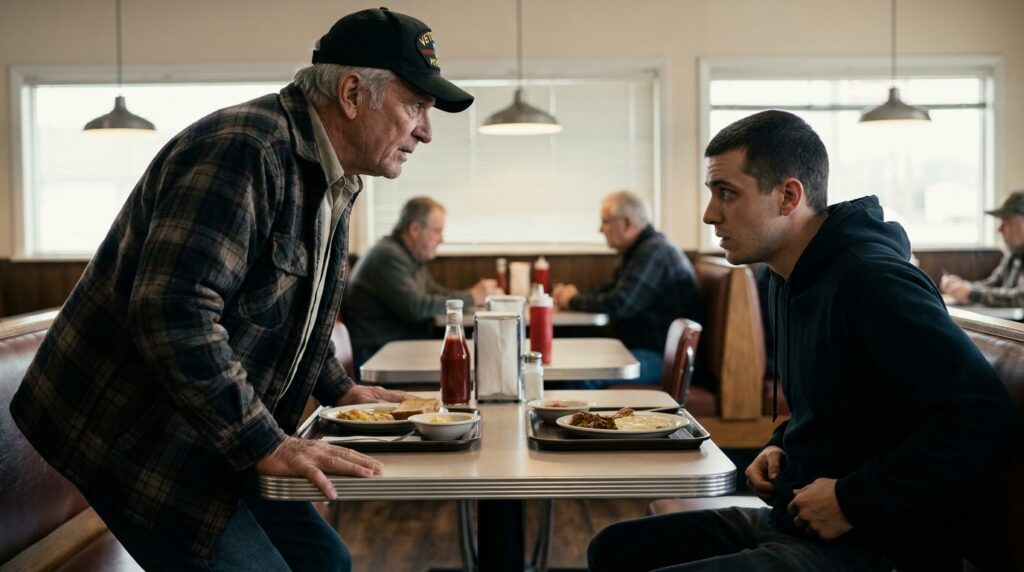
CHAPTER 3: THE GEOGRAPHY OF THE BOOTH
The words left the younger man like water draining through gravel—thin, carrying the silt of an old grievance that had finally run out of room to move. He stayed where he was for three full breaths, his forehead nearly touching the iron base of the table leg, before he dragged his right knee inward. The movement was small and heavy, the coarse denim of his jeans scraping a gray track through the salt crystals on the floor.
The veteran didn’t offer a hand to help him up. A sovereign protector handles an extraction by checking the perimeter first, not by altering the position of the individual who chose to breach the line. His eyes remained anchored to the envelope. The paper was stiff, the cheap wood-pulp stock used by regional administrative offices when the state wanted to minimize its footprint on a foreclosure. The oil smudge across the corner didn’t just blur the name; it formed a greasy lens over the red-ink circular stamp of the District Liquidation Board.
“Get off the floor, Marcus,” the veteran said. His voice was lower now, falling beneath the high-frequency rattle of the ventilation fan over the grill. He hadn’t used the name in ten years—not since the boy’s father had stopped bringing the flatbed trucks through the north gate for the monthly clearance checks.
The younger man—Marcus—flashed a look upward through a tangle of dark hair. His jaw was dark with two days of gray stubble that held the smell of diesel exhaust and stale tobacco. He didn’t look like an aggressor anymore; he looked like a machine that had been run past its service hours on a cold oil pan. He hauled his weight onto the edge of the vinyl bench, his boots dragging over the linoleum with a dull screech that made the waitress by the register flinch again.
“You remember my name,” Marcus said, spitting a grain of salt onto his lower lip. He reached down, his fingers hovering over the oil-stained envelope before he snatched it off the floor with a quick, defensive twitch. His thumb came down directly over the red stamp, hiding it, but his hand was shaking enough that the corner of the blue paper inside rattled against the tear. “I figured you’d have cleared that out with the rest of the ledger files when they handed you your pension.”
The veteran didn’t take his seat. He remained standing in the narrow space between the booth and the counter, his bulk blocking the natural light from the window. The smell of his own breakfast—the cold grease on the thick rim of the plate—was sour in the noon heat, but he didn’t move it aside. His calloused hand stayed near the edge of the Formica, his fingers flat against the fake wood grain, feeling the deep, longitudinal scratch where someone had carved an unreadable set of initials into the plastic decades ago.
“The files stay where they are put,” the veteran said. He looked at Marcus’s jacket sleeve, tracking the line of frayed copper wire that held the cuff together. It was utility wire from the old rail spur behind the grain elevators—the kind of copper people stripped when the scrap yard stopped asking for identification papers. “Your father’s rigs were pulling three tons over the axle limit every Tuesday for four winters. I didn’t need a ledger to see what that did to the concrete on Route 9. I didn’t need a file to see the bearings burning out in the yard.”
“They had to run over,” Marcus said, his voice rising, catching on the silence of the room. He leaned his forearms onto the table, his dark shirt absorbing a dark circle of spilled water from a glass that had tilted during the scramble. “They were under-cutting the state freight rate by forty percent just to keep the tires on the rims. The regional office knew it. The state inspectors knew it. They were letting the big fleets out of the valley carry the clean manifests while my old man took the scrap contracts that wouldn’t clear a county scale. And you signed the non-compliance orders.”
The veteran’s face didn’t change. The skin around his eyes was dry, lined like old harness leather that had spent too many seasons in the back of an unheated barn. He knew the argument. He had heard it from seven different independent drivers before the line was shut down in November of ninety-two. They all had the same logic—that a small violation was just a way of greasing a rusty hinge so the house wouldn’t fall down around them. They never looked at the hinge itself; they just looked at the oil can in their hand.
“The order was for a cracked frame on the number four flatbed,” the veteran said, his voice flat as a level-line across masonry. “It wasn’t about the manifests. It was about seven thousand pounds of scrap iron riding on an eight-inch weld that had a split through the center you could stick a nickel into. I told him to ground the rig. He ran it to the river anyway.”
Marcus shifted the white envelope from his left hand to his right, his fingers digging into the paper until the blue security sheet within deformed with a crisp snap. “He ran it because if he didn’t deliver the tonnage by five o’clock that Friday, the yard was going to cancel the contract and give it to the line out of Chicago. He was trying to save the shop, Miller.”
The name—the veteran’s surname, spoken without the rank he had worn for thirty-two years—sat between them on the greasy table like a dead battery.
Across the aisle, the man with the rye toast slowly lowered his fork, his eyes shifting toward the register where the waitress had finally taken her hand off the total key. She didn’t look at Marcus; she looked at the veteran’s faded navy cap, her face tight with the specific, small-town anxiety of someone who knew exactly whose name was on the mortgage of the building they were standing in.
The veteran didn’t look at her. He kept his eyes on Marcus’s hand, watching the way the oil smudge on the envelope was beginning to transfer onto the younger man’s skin, leaving a dark, slick mark that looked like an old bruise.
“Your father was an idealist, Marcus,” Miller said, his thumb tracking the edge of his coffee mug without lifting it. “He thought a contract was a promise between two men who had clean fingernails. He never looked at the small print at the bottom of the blue sheet.”
Marcus paused, his hand tightening around the paper until his knuckles went the color of lard. “The small print didn’t close the hub, Miller. This notice did. It came from the regional office three days ago. They’re selling the ground under the loading docks to a logistics firm out of Delaware. Every route left in this county is flagged for cancellation by the end of the month.”
He leaned forward again, but this time his shoulders didn’t hold the weight of a threat. They held the dry, brittle tension of someone who had discovered an empty oil reservoir at the bottom of a well. “They’re clearing the whole valley out. And the signature at the bottom of the authorization—the initial field-clearance file from ten years ago—it’s yours.”
The veteran’s thumb stopped moving against the earthenware handle. The low hum of the ice machine under the counter didn’t change its pitch, but to Miller, the sound grew thin, like a wire being pulled tight across an iron peg until the zinc coating began to peel away.








