
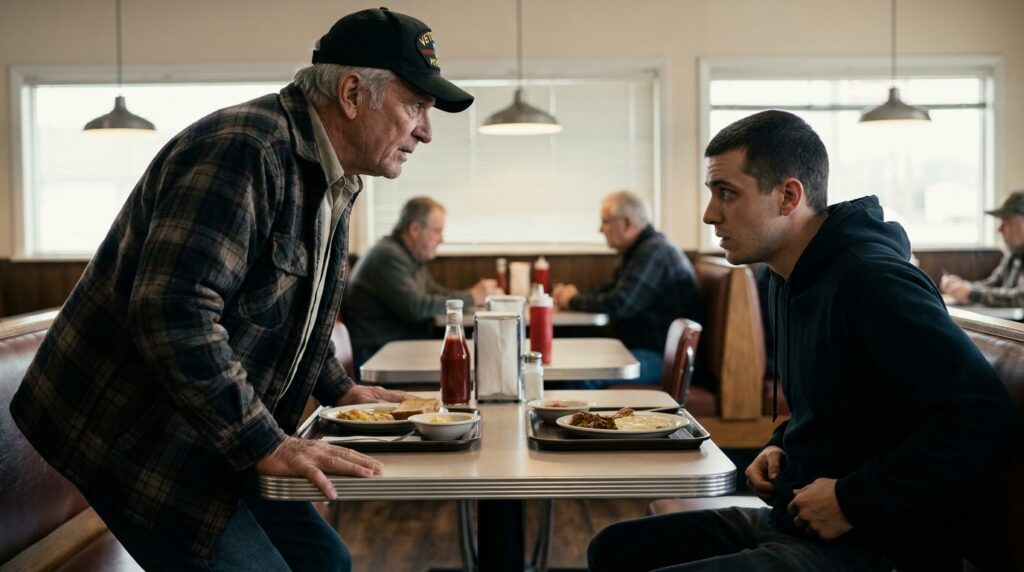
CHAPTER 2: THE GRAVITY OF THE FLOOR
The sleeve of the dark jacket never made contact with the navy cap. Instead, the air between them died, sucked out by the sudden, heavy pivot of the veteran’s left heel against the grease-filmed linoleum.
There was no theatrical display of agility—no polished, rapid-fire sequence from a training manual. It was simply the blunt physics of a mass that refused to be shifted, redirecting a smaller, looser object that had overextended its reach. As the younger man’s hand shot forward, his fingers clawing for the brim of the cap, the veteran’s right forearm rose like a rusted iron bar. It didn’t strike; it merely occupied the space the younger man’s wrist needed to travel through. The impact was dull, the sound of thick canvas meeting synthetic padding with a heavy thud.
The younger man’s momentum did the rest. With his center of gravity already tilted too far over the broken egg yolks, the sudden obstruction of his arm acted as a fulcrum. The veteran didn’t push. He simply closed his calloused fingers around the cuff of the dark jacket—noticing, in that micro-second of extreme proximity, a crude repair job done with a strand of frayed copper utility wire instead of thread—and twisted his hips three degrees back toward the center of the booth.
The movement was short, dense, and finished before the waitress could drop her pencil. The younger man’s boots lost their purchase on the worn floorboards. He spun half a turn, his hip striking the corner of the Formica table with a hollow groan from the bolted iron pedestal beneath the floor, and then he went down.
He didn’t tumble gracefully. He hit the floor with the unvarnished slap of dead weight, his shoulder checking the base of the neighboring booth before his ribs flattened against the gray, salt-pitted linoleum. The small salt mound he had been harassing earlier vibrated off the table edge, scattering like dry sand across the back of his dark shirt.
The diner fell into a type of silence that smelled of old lard and cold exhaust. Three booths down, a man holding a half-eaten slice of rye toast stayed perfectly still, his jaw locked mid-chew. The low, rhythmic clicking of the refrigerator compressor seemed to grow louder, filling the sudden vacuum between the counters.
The veteran didn’t slide back into his seat, nor did he look around to gauge the reaction of the remaining patrons. A sovereign protector doesn’t look for an audience; he checks the boundary. He rose from the bench with a slow, deliberate extension of his bad knee, the joint clicking once with the dry sound of a dry-turning bearing. His solid, late-70s frame seemed to occupy more of the diner’s narrow aisle than it had a minute ago. The brown work shirt remained tucked tightly into his jeans, the faded navy cap still sitting exactly where it had since six that morning—three degrees off-center, the tarnished anchor pin catching the yellowed noon light.
He stood over the younger man, his boots planted wide, anchoring his weight into the floorboards. His breath was steady, drawn through his nose in deep, mechanical expansions that showed no trace of adrenaline. He looked down at the dark jacket, watching the way the younger man’s shoulders heaved as the air returned to his lungs.
“Stay down,” the veteran said. The voice was neither angry nor triumphant. It had the flat, administrative tone of an inspector marking a defective crate on a loading dock. “And calm yourself.”
The younger man didn’t move immediately. His cheek was pressed against the coarse floor, his eyes wide and bloodshot, staring at the base of the table leg where the paint had flaked away to reveal the dark rust beneath. The arrogance had left his face, replaced by the confusion of a machine that had broken down after striking a immovable post. His hand twitched against the floor, his fingers curling into the dust motes that drifted through the light.
Beside his outstretched hand, a long, tri-fold envelope had slid free from the interior pocket of his dark jacket. It lay flat on the linoleum, its white surface smudged with a streak of old motor oil from the floor. The upper corner was torn, and through the gap, a glimpse of blue security paper showed—the heavy, official bond used only by regional liquidation authorities when closing a commercial hub.
The veteran’s eyes locked onto the edge of that blue paper. He didn’t bend to pick it up—not yet—but his gaze didn’t leave the smudged print. He knew that exact weight of paper. He had signed three hundred of them during the long winter of eighty-four, back when the valley’s veins were being systematically drained by men who wore suits instead of work shirts.
The younger man let out a ragged breath, his fingers scraping against the linoleum as he tried to find enough leverage to lift his chest. “You don’t know what they’re doing,” he muttered into the dust, his voice thin, stripped of its previous heat. “You think you cleared your desk and walked away clean.”
The veteran didn’t answer. He adjusted the brim of his navy cap with a single, thick thumb, his eyes staying fixed on the blue paper as a new, cold current of friction began to stir beneath the diner’s quiet floor.








