
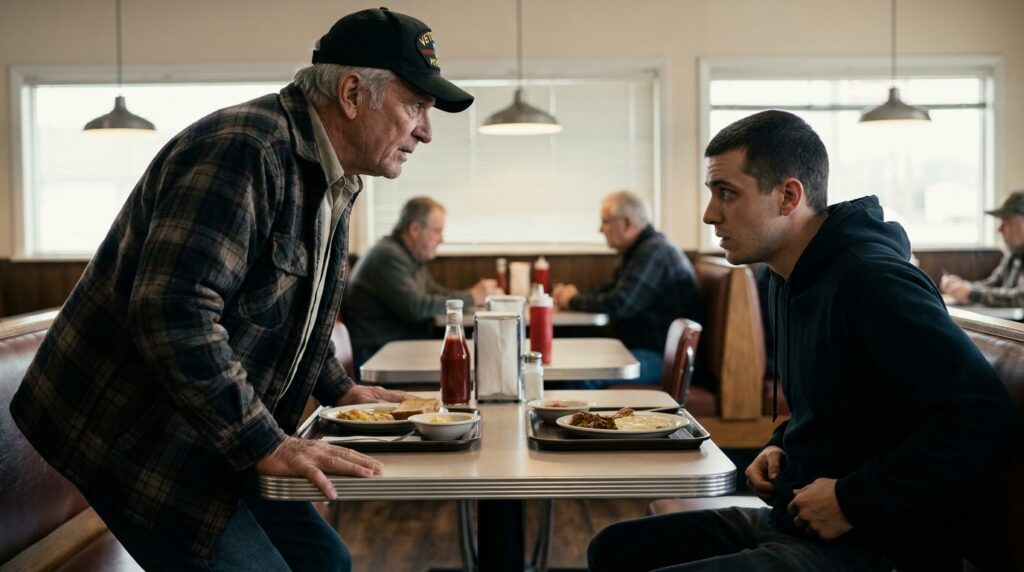
CHAPTER 5: THE DYNAMIC HOLD
The crunch of the boot on the gravel outside didn’t just vibrate through the screen door; it hit the soles of Miller’s feet through the joists of the floorboards. The rhythm was deliberate—the heavy, unhurried tread of a man who didn’t work for a living by the hour, but by the contract.
Miller didn’t drop his posture. His right hand shifted away from his coffee mug, his forearm resting flat on the Formica like an unpainted structural timber. Under his skin, the muscle fibers along his forearm pulled tight, his bones registering the low-frequency shudder of the sedan’s engine still idling outside near the kerosene tank. An unbalanced tie rod was ticking under the frame—a corporate fleet vehicle run hard on county gravel without an alignment.
“Don’t turn around, Marcus,” Miller said. The command didn’t carry weight because it was loud; it carried weight because it was flat, leaving no pocket of air for the younger man to negotiate with.
Marcus froze, his hand still clamped over the torn corner of the white envelope. The copper wire stitching on his dark jacket sleeve gave a tiny, metallic rasp against the edge of the bench as his fingers twitched. His jaw stayed open, his bloodshot eyes darting toward the reflection in the grease-filmed window pane where the silver sedan blotted out the view of the highway scale.
The screen door didn’t slam. It was held back by a thick, calloused palm that let the springs groan before clicking into the wooden frame. The man who entered didn’t smell like gas station coffee or diesel exhaust. He smelled of laundry starch and the chemical tang of new vinyl—the kind of scent that clings to a man who spends his mornings in an air-conditioned corporate branch office forty miles up the river. He wore a gray canvas field coat over a blue poplin shirt, the fabric crisp enough that the creases along the sleeves hadn’t dropped yet.
“Miller,” the newcomer said, his boots stopping exactly two paces inside the threshold, where the linoleum gave way to the unwashed grit near the door mat. He didn’t look at Marcus on the bench; his eyes locked directly onto the tarnished brass anchor pin on the veteran’s navy cap. “They told me I’d find you here before the noon manifest was posted. You’re a hard man to locate when the local office switches its phone relays.”
The veteran slowly rose from the bench, his bad knee clicking once with a dry, metallic pop that was lost in the hum of the ice machine. He didn’t offer a name. He didn’t need to. He recognized the type from thirty years of regulatory enforcement—the mid-level operators who carried leather binders and signed their names with fine-point rollers so the ink wouldn’t bleed through the cheap duplicate paper.
“The relays are right where they’ve been since eighty-four,” Miller said, his boots set wide, anchoring his frame across the narrow width of the aisle. His solid, late-70s build occupied the full distance between the high counter and the back of Marcus’s booth. “If you’re looking for the manifest, it’s tacked to the board by the county scale. If you’re looking for something else, you’re on the wrong side of the creek.”
The man in the gray coat smiled, but his eyes stayed small, tracking the way Miller’s thick, calloused thumb remained hooked into the pocket of his brown work shirt. He reached into his coat, his hand sliding behind the stiff canvas flap before pulling out a small, pocket-sized ledger bound in black oilcloth. The corners were frayed, the fabric showing gray threads where it had rubbed against the interior pocket of a desk drawer for a decade.
“The creek has a new owner, Miller,” the man said, his voice carrying the flat, professional rhythm of an auditor reading an estate settlement. He flipped the ledger open, his thumb stopping at a page marked with a yellowed plastic tab. “The regional logistics board cleared the north platform survey yesterday afternoon. The forty-eight-hour maintenance deferral you signed in May of fourteen? It expired forty-eight hours ago. The county trust doesn’t need to post a public auction if the abandonment file is certified by the original inspector.”
Marcus let out a sharp, ragged breath, his boots scraping the linoleum as he made a move to slide out of the booth. “He told you,” he muttered, his hand rising toward the gray coat. “The courier said you had the sign-off, Miller. You let them hold the file until the clock ran out.”
The veteran didn’t look back at the boy. He kept his steady, unwavering gaze fixed on the man by the door mat, tracking the subtle shift of the man’s weight from his heels to his toes. The decoy secret—the idea that a simple liquidation notice was just a routine corporate overreach—was collapsing into a larger, uglier reality. The forty-eight-hour mismatch on the double-stamped date code wasn’t an administrative error from ten years ago; it was a deliberate fuse, timed to explode the moment the local transport association tried to renew its fuel contracts at the hub.
“The file wasn’t certified, son,” Miller said, his voice dropping into that deep, mechanical center that made the waitress behind the counter stop cleaning the coffee machine. “Because the inspector who signed that deferral didn’t use a county stamp. He used a federal inventory clearance code from the river command.”
The man in the gray coat stopped flipping the pages of his black ledger. His fingers stayed flat against the oilcloth, the small smile vanishing from his lips like grease dissolving in gasoline. He looked from Miller’s face down to the thick, scarred hand that was now resting flat against the edge of the Formica table.
“The code was retired when they pulled the motor pools out of the valley,” the man in the gray coat said, his voice losing its professional smoothness, turning thin and sharp like a rusted tin edge. “The county records don’t recognize a federal allocation after twenty years of commercial transition. It’s just dead paper, Miller.”
“The paper isn’t dead until the equipment is out of the yard,” Miller said, taking one slow step forward, his boot heel coming down directly between Marcus’s envelope and the man by the door mat. “And the equipment on the north platform doesn’t belong to the regional trust. It belongs to the state guard asset reserve. I parked it there myself before they turned the keys over to your father’s association, Marcus.”
The revelation hit the aisle like a dropped tire iron. Across the room, the patron with the rye toast slowly slid his wallet out of his back pocket, his hand staying low against the vinyl cushion as he watched the space between the veteran and the door.
The man in the gray coat took a step back, his heel catching on the edge of the dry door mat with a small, coarse rasp. His hand stayed near the interior of his coat, but he didn’t reach for the ledger again. He looked past Miller’s shoulder toward the window, where the silver sedan’s engine suddenly kicked into a higher idle, the ticking of its unbalanced tie rod accelerating through the glass like a warning bell.
“You’re holding onto a ghost, Miller,” the man said, his hand dropping down to his side as he reached behind him for the latch of the screen door. “The company out of Delaware isn’t looking at the manifests. They’re looking at the ground. And the ground doesn’t care about a river command stamp.”
The latch clicked, the sound sharp as a pistol hammer in the quiet diner, and the veteran stood perfectly still as the screen door began to swing open into the hot, midday glare of the gravel lot.








