
CHAPTER 6: THE SHADOW OF THE LEDGER
The screen door swung wide, its rusted spring screaming with the dry, high-pitched scrape of iron filings grinding inside a tight sleeve. The midday glare hit the threshold like a physical blow, carrying the scent of baking asphalt and scorched rubber from the idling sedan.
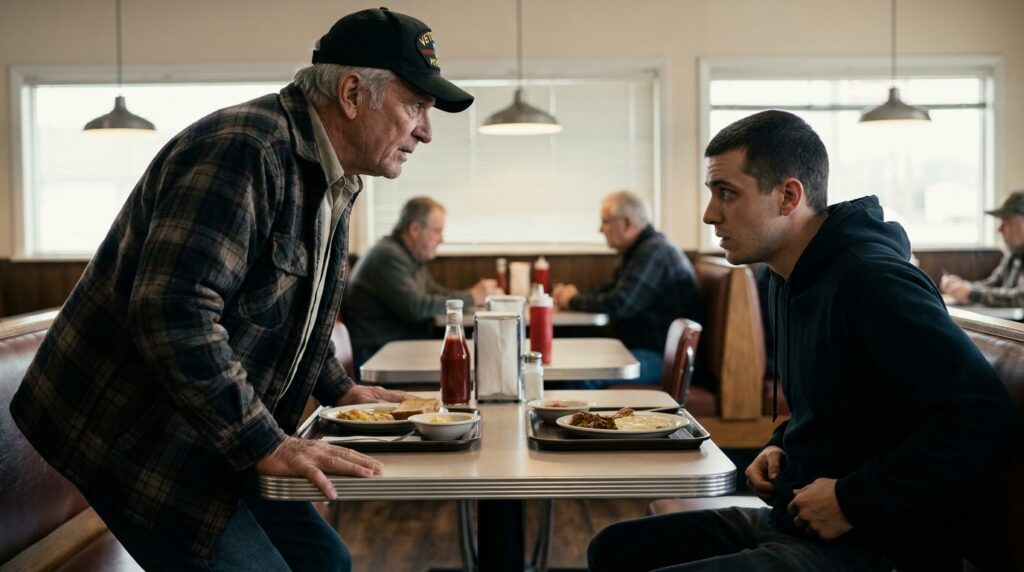
Miller didn’t take two paces to trail the man in the gray coat. A sovereign protector doesn’t leave his high ground to pursue an unverified target across an open sector. Instead, his thick, scarred hand went down flat on the torn corner of the blue paper Marcus had left on the table. The friction of his broad thumb against the bond paper was distinct—a solid, unyielding brake that pinned the document to the fake wood grain before the heat from the open door could lift it.
“Get your gear, Marcus,” Miller said. His voice was lower than the steady vibration of the sedan’s tie rod, dropping into that mechanical register used for sealing a leaky valve under head pressure. “We’re out of time on this bench.”
Marcus didn’t move for two full breaths. His fingers were still hooked into the gray vinyl of the seat cushion, his dark eyes wide, locked on the empty doorway where the man’s laundry-starnished scent was already being blotted out by the smell of diesel exhaust. The copper wire stitching on his cuff glinted once in the sharp noon light, a single strand of utility metal caught on the edge of a small, bright screw head beneath the table binding.
“The asset reserve,” Marcus muttered, his teeth clicking together as the adrenaline began to cool in his jaw. “You didn’t say anything about the guard trucks when the county inspectors pulled the scales out of the yard. You let my old man take the hit for the weight violations while you were sitting on fifty tons of federal steel.”
“Your father wanted the yard clean so the Delaware firm would write the commercial lease,” Miller said, his voice level as an unchipped masonry line. He picked up the blue document, folding it once with a heavy crease from his calloused palm before sliding it into the deep breast pocket of his brown canvas shirt. “He thought if he cleared the county ledgers, the rest of the track would lie flat. He didn’t know the regional board had already filed the liquidation notice before the first flatbed hit the river bridge.”
The veteran turned toward the register, his heavy work boots grinding the stray salt crystals into gray powder against the linoleum floor boards. The waitress hadn’t dropped her yellow pencil, but her hand had shaken enough that a thin line of graphite had tracked down across the margin of her pad. She looked at Miller, then at the navy cap sitting three degrees off-center on his lined forehead, her features tightening with the ancient, unexpressed fear of a valley that had been losing its blood to the interstate for thirty years.
“Put the specials on my tab, Clara,” Miller said, his face as unyielding as the cast-iron frame of the stove behind her. He didn’t wait for her to check the totals. He dropped a worn ten-dollar note onto the counter near the glass pie case, the paper old and soft enough that it didn’t rattle against the wood.
Across the aisle, the patron with the rye toast finally stood up, his hand staying tucked inside his denim jacket where the leather shape of an old utility knife showed against the seam. He didn’t speak to Miller, but he gave a short, transactional nod toward the door—the silent recognition of two men who had worked the same concrete shifts before the foundry had put the chains across the main gate.
Miller didn’t return the nod. He grabbed Marcus by the shoulder of his dark jacket, his grip closing over the frayed fabric with enough mechanical leverage to lift the younger man out of the vinyl booth without a struggle. The physics of the movement were short and efficient, calibrated to minimize the dry ache in Miller’s right knee before the joint could lock under the weight of his seventy-eight years.
They hit the screen door together, the metal mesh rattling against the wood frame as they stepped out onto the gravel lot. The heat was immense, rising from the gray stones in heavy, shimmering waves that blurred the shape of the highway scale two hundred yards down the access road.
The silver sedan wasn’t waiting near the kerosene tank anymore. It had swung around the diesel pump, its front tires kicking up a low cloud of white limestone dust as the driver aligned the bumper with the narrow exit lane that led back to Route 9. Through the rear window, the man in the gray coat was visible, his head turned toward the ledger where the black oilcloth cover lay flat against his knee. The frayed legal seal—a small, lead button that had held the records closed since the winter of ninety-two—was gone, leaving a ragged white scar across the fabric where the string had been cut with a clean blade.
“They’re going to the north platform,” Marcus said, his hand reaching for the latch of his own truck—an old, rusted three-quarter-ton with a split windshield and a left fender held in place by two lengths of baling twine. “The security keys are still in the office drawer, Miller. If they break the lock on the gate, the county association doesn’t have a legal standing to file the counter-injunction.”
“The keys aren’t in the drawer,” the veteran said, his boots stopping near the rear tire of Marcus’s truck, where the smell of leaking differential fluid was sharp in the heat. He reached into his pocket, his fingers closing around a heavy ring of unpolished iron keys—the old four-sided bitted ones that hadn’t been stamped by a commercial locker smith since the army had cleared the motor pools. “The keys stay where the inventory is marked. Get in the truck.”
The engine of the three-quarter-ton caught with a heavy, unbalanced roar, the manifold leaking gray smoke through the gap in the hood as Marcus slammed his weight onto the torn spring of the driver’s seat.
Miller didn’t climb into the passenger side immediately. He stood on the running board, his thick hand gripping the frame of the mirror, his eyes scanning the long, straight gray line of Route 9 where it disappeared into the pine scrub at the edge of the valley. The silver sedan had already cleared the gravel entrance, its brake lights flashing once before the driver accelerated into the heat, the low, rhythmic ticking of its tie rod fading into the general hum of the midday valley like a fuse burning down inside a concrete vault.
The veteran pulled himself into the cab, the rusted door closing with a dull, hollow clank that marked the boundary of the sector behind them, the absolute truth of the ledger still locked deep beneath the iron plates of the platform ahead.








