
CHAPTER 4: THE THRESHOLD OF THE EXTENSION
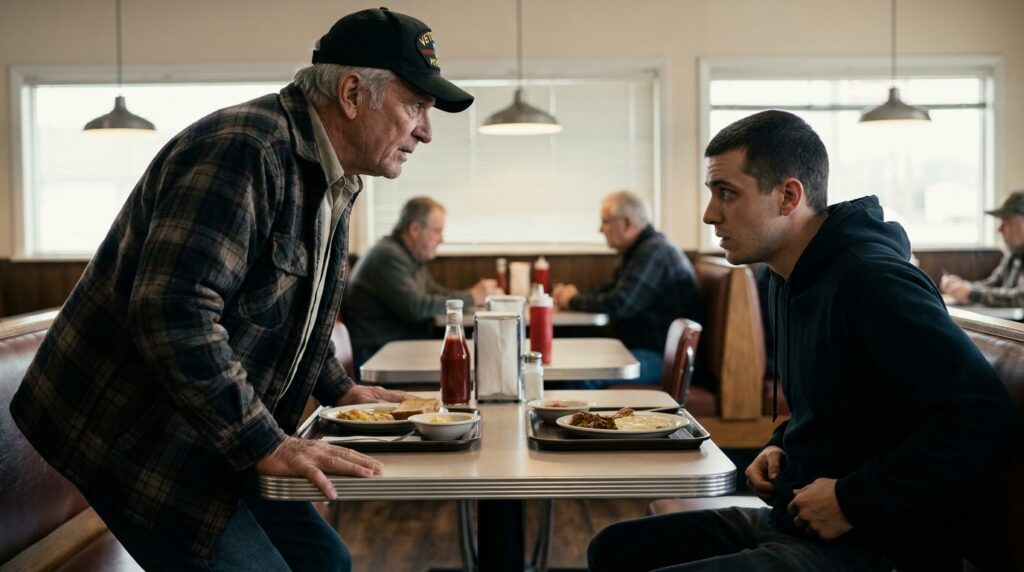
Miller did not take his hand off the thick white ceramic handle of his coffee mug. He didn’t blink. The noon light shifting through the grime of the diner window caught the tiny, jagged teeth of the brass anchor pin on his navy cap, casting a small, jagged shadow down across the bridge of his nose.
“A clearance file is just ink, Marcus,” Miller said. His voice was lower than the steady rattle of the ventilation slats, dropping into that flat, unyielding register he used when checking a high-clearance flatbed for hair-line cracks along the axle housing. “It doesn’t move a foot of dirt. It doesn’t pull down a loading dock.”
“It gave them the leverage,” Marcus spat, his thumb grinding into the blue security paper until the edge tore under the friction of his dirty nail. He pushed the document across the Formica, sliding it over the greasy boundary where the salt crystals lay scattered like dry bone shards. “Look at the third section. The regional logistics office didn’t use a standard municipal order. They pulled the old inspection clearance from May of fourteen. Your stamp is on the structural survey for the entire north platform. You called it non-compliant for commercial retention.”
The veteran didn’t reach for the paper. A sovereign protector doesn’t gather evidence from an unverified source while his position remains exposed. Instead, Miller leaned two inches forward, his wide shoulders dropping down into the grey light of the booth until his face was parallel with the young man’s tense jaw. His eyes scanned the blue paper where it lay flat against the imitation wood grain.
The print was crisp, but near the margin where the red ink circular stamp sat, there was a double-stamped date code. The first mark read May 12, 2014. The second, stamped heavily over the top with a machine-ink that had aged into a dark, greasy purple, read May 14, 2014. A forty-eight-hour mismatch. To a driver, it was nothing but a lazy clerk at the county scale; to Miller, it was the exact micro-second where the old system had been split open to hide a rotten ledger.
“The survey was for a shifting foundation on the grain spur,” Miller said, his thumb finally relaxing against the mug handle. “The concrete was splitting three feet deep because the drainage culverts were blocked with slag from the foundry. I didn’t condemn the hub, Marcus. I wrote the maintenance deferral so your father’s crews would have forty-eight hours to clear the yard before the state took the keys.”
“The maintenance deferral is what they used to prove abandonment,” Marcus whispered. His fingers hooked into the table edge, his knuckles turning the color of old tallow. “They’re using your forty-eight hours to claim the local association walked away from the infrastructure. If the association walked, the land reverts back to the regional trust. And the trust is already sold to Delaware.”
The room had gone entirely flat. Three booths down, the man with the rye toast had placed his piece back on the small ceramic plate, his hand staying frozen over his coffee cup. Even the low hiss of the grease trap behind the kitchen door seemed to have dropped an octave, leaving only the mechanical clicking of the ice machine under the counter.
The waitress didn’t move from her spot behind the register. Her face was gray in the shadow of the pie case, her fingers still holding the small yellow pencil she used to write out the totals for the morning specials. She knew what a liquidation notice meant for Route 9; it meant the fuel trucks wouldn’t stop here on their way to the interstate anymore. It meant the diner would be nothing but an empty shell by winter, its windows covered in plywood and its asphalt lot turning to weeds under the valley frost.
Miller shifted his weight from his left hip to his right, his boot heel making a dry, crunching sound as it ground a stray salt crystal into the floorboards. He knew the layout of the regional trust better than anyone still drawing a breath in this valley. He had spent three decades tracking the movement of every ton of iron, every bushel of grain, and every gallon of fuel that crossed the river. He knew that an allocation doesn’t move through Delaware unless someone on the county board had already cleared the tracks from the inside.
“Who handed you this envelope, Marcus?” Miller asked. The question was sharp, transactional, stripped of any grandfatherly softness.
Marcus looked down at his own hand, tracing the line of frayed copper wire that held his dark jacket sleeve together. The copper was dull, oxidized by the damp air of the river bottom where the independent drivers parked their rigs out of sight of the county inspectors. “A courier from the logistics office in the city. He was waiting by my truck when I pulled into the fuel dock at five this morning. He said if I wanted to save what was left of the old man’s shop, I’d bring this to you before the noon shift started.”
“A courier,” Miller repeated. He looked past Marcus’s shoulder, his eyes cutting through the glass pane of the window toward the gravel lot outside.
A silver sedan—a standard commercial fleet vehicle with no dealer plates and a light layer of gray highway dust along the rocker panels—was sitting idling near the diesel pump. The exhaust was thin, nearly invisible in the midday heat, but the vibration of the engine was distinct, a low, rhythmic thrum that caused the surface of the black coffee in Miller’s mug to ripple in concentric circles.
The validation of the threat was instantaneous. The younger man hadn’t come here to start a fight over an old grudge; he had been steered here like a blind mule carrying a heavy pack across a live range. The decoy secret—the idea that a ten-year-old structural survey had caused the collapse of the hub—was already cracking under the weight of the double-stamped date code on the blue sheet.
Miller slowly pulled his right hand away from the coffee mug, his thick, lined fingers flattening out against the cold surface of the table. He could feel the old rust in his joints, the dry ache that came from seventy years of laboring in a world that didn’t value a level-line, but his posture didn’t give an inch to the shadow outside the window.
“They didn’t give you a notice, Marcus,” the veteran said, his voice dropping into the deep, quiet center of the room. “They gave you a leash.”
The younger man started to answer, his mouth opening to press the argument, but the sound was cut short by the sharp, metallic click of a car door opening in the gravel lot outside, the noise traveling through the screen door like the snap of a dry branch.








