
CHAPTER 6: THE DUSTY HORIZON
“He didn’t tell you the whole thing because he couldn’t look at his own reflection in a basin of clean water,” George said. His fingers didn’t move toward the piece of silver Vance was holding out. The metal sat in the boy’s broad, greasy palm like a lead washer pulled from an old pump housing, its edges blackened by years of furnace soot and cellar air. “Put it away, son. A receipt don’t buy back forty years of limestone dust.”
Vance’s hand didn’t drop. His fingers stayed spread, the knuckles raw where they had scraped the safety tread of the concrete steps during his fall. The little blue ribbon attached to the silver star was stiff, rotten with the humidity of twenty different valley basements, the weave separation showing the coarse gray linen threads beneath the dye. “He said you were the only one who didn’t sign the ledger for the insurance payout,” Vance whispered. His chest was still hollowed out, his shoulders pulled forward into the shape of a man who had spent his shift leaning over a drill press. “He said if I didn’t find you, the estate wouldn’t clear the probate court.”
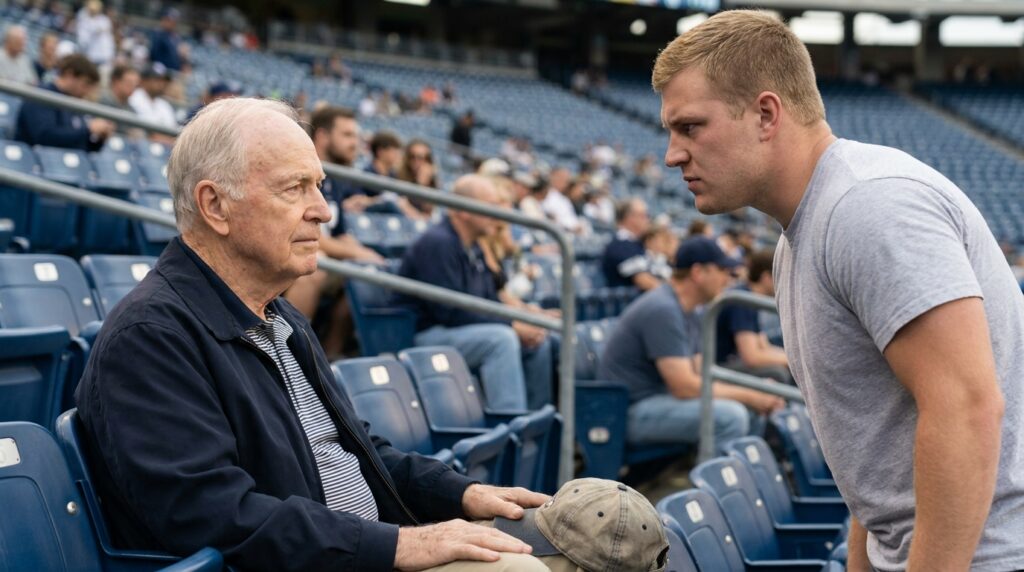
Miller took a heavy breath, his leather belt creaking as he finally turned his back to the playing field. The heat was beginning to drop behind the press box, casting long, purple bars across Section 114 that made the blue plastic seats look like iron plates sinking into a river bed. “The probate’s already cleared, Vance,” Miller said, his flat valley accent returning with the evening draft. “The court didn’t look at the ninety-ton registry because the logs were burned before the county line was moved. Your dad knew that. He just wanted the old man to see the metal before the ink went cold on the death certificate.”
George reached up and adjusted the peak of his cap. The buckram lining was dry against his skull, the shape settled into his forehead with the permanence of an old scar. He could feel the exact corner of the yellowed cardstock document resting against his temple—the non-judicial punishment record that had kept Colonel Vance’s name clean on the county courthouse roster while George spent forty years changing oil filters in a municipal garage behind the lime kilns. It wasn’t a burden anymore. It was just mass. The weight of things that didn’t rot when you left them out in the weeds.
“Your granddad was a weak man, Vance,” George said softly, his voice dropping into the low, mechanical rhythm of a man timing a diesel injector by ear. “But he had an eye for clearance. He knew exactly how much iron you could remove from a bridge before the center pin sheared off under a heavy load. He just didn’t calculate for the rain.”
The youth looked down at his own hand, his fingers slowly curling around the tarnished silver until the star was buried in his skin, the sharp points digging into the grease lines of his palm. He didn’t offer the provocation again. The entitlement had been wrung out of him by five inches of concrete and the flat, cold look of an old supply sergeant who had seen entire regiments reduced to a list of missing serial numbers on a carbon-copy sheet.
“What do I do with the truck?” Vance asked. The question was small, directed at the concrete floor between George’s boots where the salt dust had settled into a gray crust. “The one with the logistics mark on the door panel. My dad left it in the yard by the gravel pits.”
“You scrape the paint off,” George said, shifting his weight from his toes back to his heels, locking his frame against the structural girder one final time as the field lights flickered on with a dull, humming whistle. “And you drive it until the manifold cracks. You don’t leave old iron in the yard to collect the damp, son. It makes the neighbors ask about the invoice.”
Miller didn’t offer a hand to help the boy up. He simply stepped back into the portal aisle, his heavy flashlight bouncing against his thigh with a rhythmic, leaden click that told everyone in Section 114 the territory had been mapped and the boundaries were locked. “Come on, Vance,” the deputy said, his shadow stretching across three rows of blue plastic until it hit the edge of the dugout. “The game’s in the ninth, and the cars are already lining up at the county road gate.”
The boy rose slowly, his joints popping with the sound of cold iron clearing a latch. He didn’t look back at George. He tucked his hands into the pockets of his grease-stained cargo shorts, his broad shoulders slouched until he looked no larger than any other line-shift worker waiting for the whistle to blow at the end of the day. His boots made a short, heavy thud against the safety tread as he followed Miller up the concrete stairs, his silhouette disappearing into the yellow glare of the concourse portal.
George sat down. The blue polymer of Seat 12 was cold now, the sun having left the tier completely, leaving only the smell of roasted hulls and the dry, alkaline taste of the valley air. He reached down and picked up his worn baseball cap, his thumb finding the dark, cratered indent where the brass disk had been pried out forty summers ago. He pressed his finger into the groove, checking the alignment, then placed it back on the seat beside him.
The crowd around him lifted for the final out, their voices a single, watery roar that drifted over the rusted framework and out toward the gravel hills, but George didn’t look at the runner. He kept his eyes on the white line of the infield dirt, his posture upright and steady in the dark row, his space held tight by nothing but the iron stanchions and the quiet leverage of an unyielding frame.








