
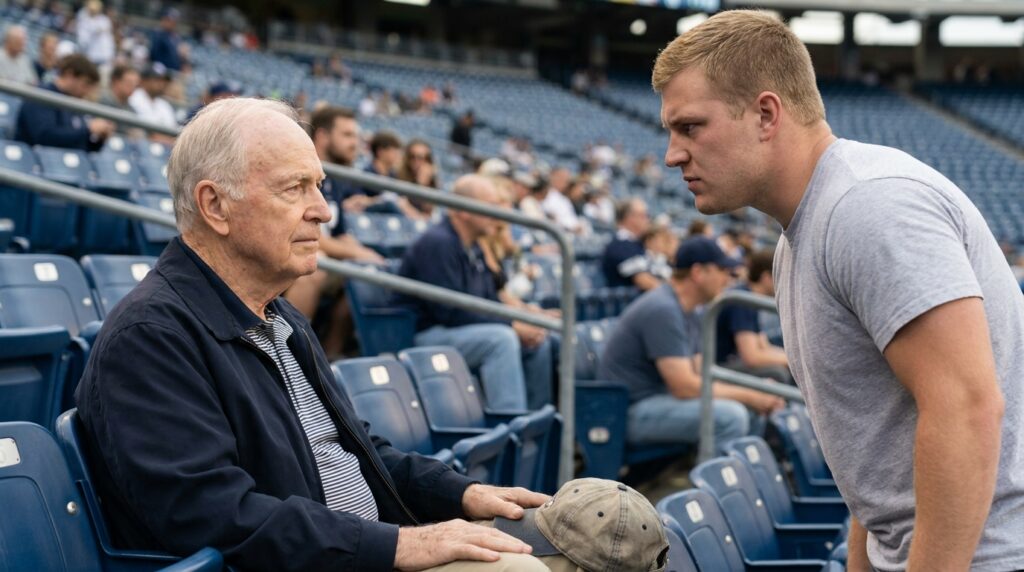
CHAPTER 5: THE WEIGHT OF CONCRETE SILENCE
The collective roar of the lower tier didn’t penetre the three-foot radius around Seat 12. It stayed out there, a distant, watery rattle against the corrugated steel roofing, while the concrete floor under George’s boots seemed to draw all the ambient sound into its gray, porous mass. The grit beneath his soles was fine, white like crushed bone, ground down by decades of heavy spectator traffic until it filled every micro-fissure in the structural slab.
Miller didn’t take his hand off the aisle railing. His leather glove creaked against the salt-crusted iron, the sound distinct and small, like a dry twig snapping in an empty cellar. He looked at the yellowed paper extending from the torn buckram, then down at Vance, whose ribs were still hitching in short, erratic jerks against the floor plates.
“Get up, Vance,” Miller said. The gravel was gone from his throat, replaced by a hollow, flat cadence that sounded like an old man reading a register of deeds in a county basement. “Get your heels under you and get out of the row.”
The boy didn’t move immediately. His left hand was flat against the concrete, his fingers gray with the graphite dust that collected near the drainage bolts. The impact had left a broad, white smear across the back of his light t-shirt where he had struck the polymer frame, the fabric frayed into small, fuzzy nests that caught the midday lint. When he finally lifted his chin, his skin was the color of skimmed milk, his teeth dry and flecked with gray foam near the corners.
“The signature,” Vance said. The words didn’t come out as an accusation; they were heavy, weighted down by a sudden, immense mass that had nothing to do with the physical shove. He stared at the looping, military script that George was slowly, methodically tucking back into the sweatband. “That’s my granddad’s handwriting. He didn’t write waivers. He was the logistics lead for the entire valley infrastructure. He didn’t sign off on field losses.”
“He did when the loss wasn’t fuel, son,” George said. He didn’t look down at the boy’s face. He kept his thumbs inside the rim of the cap, smoothing the linen backing until the cardstock lay flat against the crown’s contour, invisible once more to anyone standing more than twelve inches away. “He signed it because three hundred tons of cold-rolled plating went out through the eastern gate without an entry log, and the clerk who held the clipboard was nineteen years old and didn’t know how to lie to an audit team.”
Vance reached out, his hand gripping the lower flange of Seat 13 to steady his frame. The iron was orange with scale, the flakes coming away under his nails like dried scabs. “My dad told me it was a theft. He told me an old supply sergeant cleaned out the storage sheds before the battalion relocated. He said that’s why the name was pulled from the regional commission.”
“Your father wasn’t in the office when the sun went down on the fourteenth,” George said. His voice was low, rhythmic, balanced against the steady thwack of the ball hitting the catcher’s leather down on the dirt. “He was seven years old, playing with wooden blocks on the rug in the commander’s quarters. I know because I carried the coal for the stove in that house. I watched him through the window while your granddad sat at the kitchen table with a bottle of solvent and an eraser, trying to change the serial numbers on four manifests before the convoy cleared the state line.”
The silence came back down over the row, thicker this time, smelling of old paper and the rancid tallow that lined the underside of the iron stanchions. Miller didn’t look at either of them. He turned his heavy shoulders back toward the field, his gray head tilted as if he were trying to follow the trajectory of a foul ball that had already cleared the press box.
“Miller,” Vance croaked, his knees scraping the raised safety tread as he dragged his weight back into a seated posture on the gray floor. “You knew. You were at the gate house.”
“I was at the gate house,” Miller said without turning around. His hand remained locked on the iron rail, his massive thumb tracing the contour of a rusted hex nut. “And I logged the trucks out exactly the way the Colonel told me to log them. The old man here took the paper because if he didn’t, the registry would have gone to the federal marshal in Omaha before the week was out. Your dad would’ve grown up in a house with a rented roof, Vance.”
George placed the cap back onto his head. The peak was cold against his forehead, the stiff cardstock inside pressing against the small, deep ridge above his eyebrow like an unyielding iron plate. The weight was exactly where it had been for forty years—not a burden to be cleared, but a structural support that kept the rest of the frame from collapsing into the dirt.
The youth looked at George’s boots, then up at the dark windbreaker with its torn button hanging by a single, dirty white thread. His broad shoulders dropped, the entitled posture completely gone, leaving nothing but an awkward, oversized boy sitting in a pile of discarded peanut hulls and salt dust. His hand went to his cargo pocket, his fingers closing around a small, square object that didn’t have the weight of an invoice or a file. It was a silver citation, tarnished to the color of wet lead, its small blue ribbon frayed at the pin.
“He told me to give it back,” Vance whispered, his head dropping until his forehead almost touched the iron stanchion. “My dad. Before he went into the hospital last month. He said to find the man who took the twelve-dash-four log from Section 114 and give him the metal. He didn’t tell me it was a waiver. He told me it was a receipt.”
George didn’t look at the medal. He didn’t reach down to help the boy lift his weight from the concrete floor. He simply turned his face back toward the left fielder, his thumbs finding the denim of his pockets, his posture locking back into the vertical line of the girder as the umpire’s voice lifted through the heat to call the second out.








