
CHAPTER 2: THE ENCROACHING SHADOW
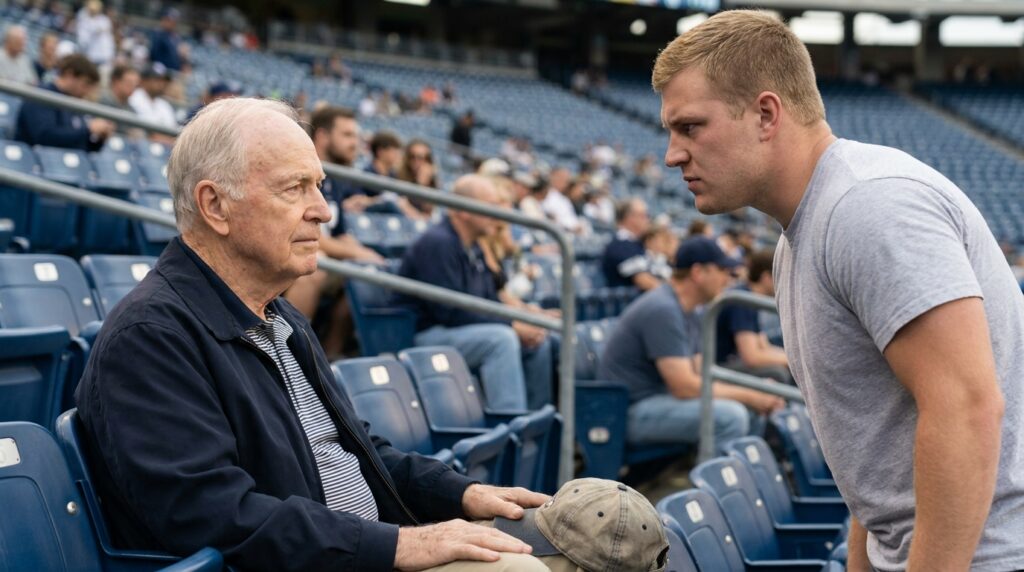
The iron bracket of Seat 13 didn’t yield; it groaned. When the younger man’s weight hit the molded plastic backrest, the flaking red primer on the frame sheared off in thin, brittle wafers that smelled of zinc and seventy years of rain. The boy’s boots didn’t slide on the concrete. They caught on the raised safety tread, his ankles twisting as his center of mass drifted three inches behind his heels—the exact distance required to turn an aggressive posture into a frantic scramble for balance.
George didn’t follow the push. He remained anchored to the vertical line of the girder, his knees slightly flexed, his palms returning to the rough denim of his thighs before the sound of the impact had even cleared the row. His breath came through his nose, slow and cold, a steady draft that didn’t disturb the salt dust on his upper lip. In the service, they called it checking the gauge—knowing exactly how much fuel remained in the tank before the manifold caught fire.
The broad-built youth was up within a second, his light t-shirt caught on a rusted hex-head bolt that secured the row’s drainage channel. The fabric tore with a short, wet pop, exposing a patch of skin near his ribs that was already mottling into a dull, congested purple. His eyes weren’t bright with anger anymore; they were wide, the pupils dilated until the blue of his irises looked like a thin rim of oil on a dark puddle. He didn’t rush back into the space. His fingers remained wrapped around the iron armrest of the row behind him, his knuckles white, testing the concrete anchors as if he expected the stadium itself to tilt into the playing field.
“You’re done,” the boy hissed. The words were thin, pushed through a throat that had gone dry from shock. “You don’t know who’s coming down that concourse. You don’t know what’s in my pocket.”
“I know the weight of a three-quarter-inch socket,” George said. His gaze didn’t leave the small, red-rimmed notch on the boy’s collarbone where an old chain had left a green copper stain against his skin. “And I know when an engine’s running on three cylinders. Your friends aren’t coming down the stairs, son. They’re still at the gate because they don’t have the stubs for this section.”
The boy’s hand twitched toward the right pocket of his cargo shorts, the fabric stiff with grease from some local machine shop—the specific black tallow that comes off the undercarriages of older tractors. But his fingers didn’t go in. He was looking past George now, his focus shifting toward the upper portal where the shadow of a stadium marshal—a retired county deputy with a heavy flashlight and an unhurried gait—was slowly cutting through the glare of the midday sun.
George reached down and picked up the cap from Seat 11. The movement was slow, deliberate, designed to show the marshal nothing but an old man adjusting his sunscreen. But as his fingers compressed the crown, his thumb caught on something that hadn’t been there when he bought the ticket at the window. The inner lining—the cheap buckram that held the front panels stiff—had split along the lower seam. Inside the gap, instead of the standard gray plastic stiffener, his nail scraped against the fibrous edge of heavy cardstock. It was the specific grade of paper used by the department of the army before they went to the digital registries—stiff, sulfurous, and backed with a thin layer of linen that didn’t dissolve when it got wet in a footlocker.
He didn’t pull it out. He tucked the cap under his arm, the split seam pressed tight against his ribs, feeling the rigid corner of the hidden document dig into his lower lung with every breath. The paper was old, but it had a density that didn’t belong in a sports venue. It felt like an anchor, or a knife.
The boy saw the movement. His eyes dropped to the cap, then to the unstitched seam near George’s thumb. The aggression left his shoulders all at once, replaced by a strange, sharp curiosity that looked too old for his face. It was the look a collector gives a piece of iron buried in a field—not angry, but hungry for the rust.
“That’s his,” the boy muttered, his voice dropping below the ambient roar of the vendors selling ice from the lower walkway. He took a half-step back, his boots grinding a stray copper rivet into the concrete floor. “That’s the one from the drawer in the den. The one with the grease pencil mark across the seal.”
George didn’t answer. He turned his face back toward the shortstop, his eyes tracking the white lines of the diamond until the glare made his cataracts ache. The silence between them grew, heavy and filled with the smell of old grease and dry earth, while above them, the marshal’s boots began their steady, rhythmic thud down the concrete stairs.








