
CHAPTER 1: THE FRICTION OF MIDDAY SUN
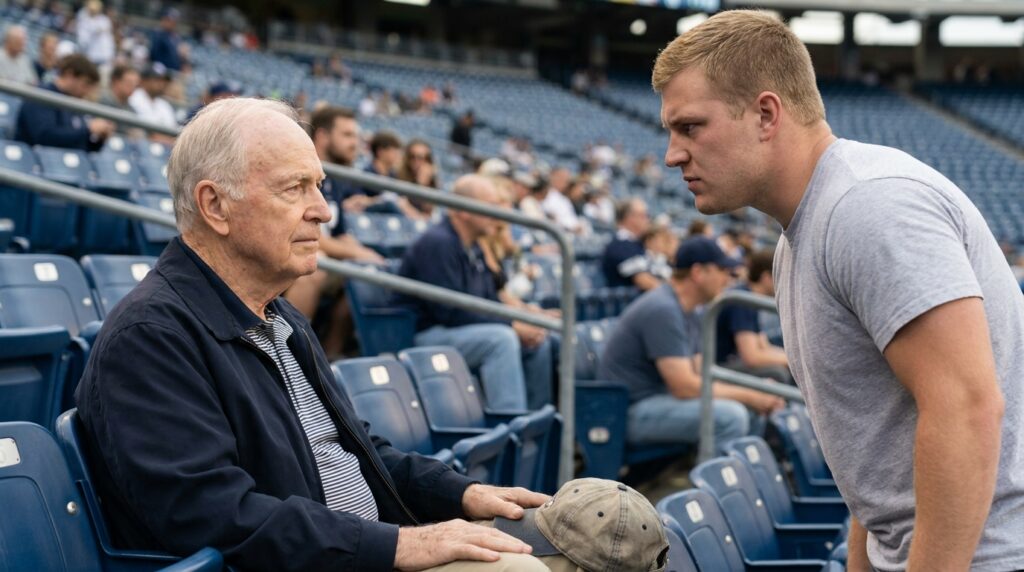
The blue plastic of Section 114 was pitted by years of salt air and spilled soda, the surface rough against the palms like coarse emery cloth. George didn’t look at the field. He didn’t need to. The crack of the bat had its own weight, a dry, splintering sound that told him exactly where the ball would drop long before the left fielder even cleared his heels from the warning track.
His thumb stayed inside the sweatband of the cap resting on Seat 12. There was a small, circular depression in the leather there—the ghost of a brass disk that had been pried out with a pocketknife forty summers ago. The metal was gone, but the oil from his skin had filled the hole, turning it into a dark, greasy crater that matched the size of his right index finger. To anyone passing down the concrete aisle, he was just another late-innings shadow, a thin frame in an unzipped windbreaker that smelled slightly of motor oil and stale laundry detergent.
The heat came off the concrete steps in waves, tasting of roasted peanuts and dust. A group of four had stopped at the portal three rows up, their shadows stretching long and sharp across the blue plastic backrests. One of them was wider than the others, his light t-shirt damp across the shoulder blades where the seam met the sleeve. He wasn’t looking at the scorecard. He was looking at the empty space between George’s hip and the iron aisle stanchion.
George felt the air shift first. It was the specific drop in pressure that happens when someone moves into a narrow space without intending to pass through it. The younger man’s boots—heavy, synthetic work shoes with thick rubber lugs—snapped a dry peanut shell into three distinct pieces against the gray floor.
“You’re in twelve,” the younger man said. His voice had the flat, hard edge of the local valley, the rhythm too fast, driven by a internal clock that hadn’t been timed against anything older than a shift whistle. “The cap’s in eleven. We need the row.”
George didn’t lift his head from the line of the shortstop’s shoulders. “Ticket says twelve,” he murmured. His tongue felt thick, dry from the heat. “The hat stays where it is.”
The younger man took a step down, his thigh crowding the rusted armrest of Seat 13. He smelled of sun-baked iron and a specific brand of liniment George hadn’t seen since the motor pools outside of Da Nang. It was a heavy, camphorated stench that clung to the wool of winter uniforms. Up close, the boy’s light hair was cropped close enough to show the pink skin of his scalp, but the skin was twitching near the earlobe, a small, rhythmic pulse that beat against the grain of his stubble.
“I’m not asking you about the ticket,” the boy said, leaning down until his shadow covered the worn peak of George’s cap. His fingers hooked into the top edge of the blue seat directly in front of them, the knuckles turning the color of tallow against the plastic. “I’m telling you to clear the space. My people are at the top of the stairs, and they aren’t walking down to the lower tier.”
George let his thumb slip out of the leather groove. He didn’t reach for the cap. Instead, he placed both palms flat against his own knees, feeling the dry, hard contour of his kneecaps through the thin fabric of his trousers. The bones were old, but they were square, aligned by thousands of miles of gravel road and iron decks.
“Experience beats pride,” George said, his voice dropping below the roar of a strikeout call from the home plate umpire three hundred feet away. “When the moment finally arrives.”
The younger man sneered, his chest expanding as he took a full breath of the hot, metallic air. “You still think you can handle this?”
He reached down, his heavy, square hand descending toward the peak of the cap like an iron clamp closing on a dead engine part.
George didn’t wait for the fingers to touch the cloth. He shifted his weight six inches to the left, his spine finding the exact vertical alignment of the stadium’s load-bearing concrete girder behind his shoulder blades.








