
CHAPTER 4: THE LEVERAGE OF MOVING MASS
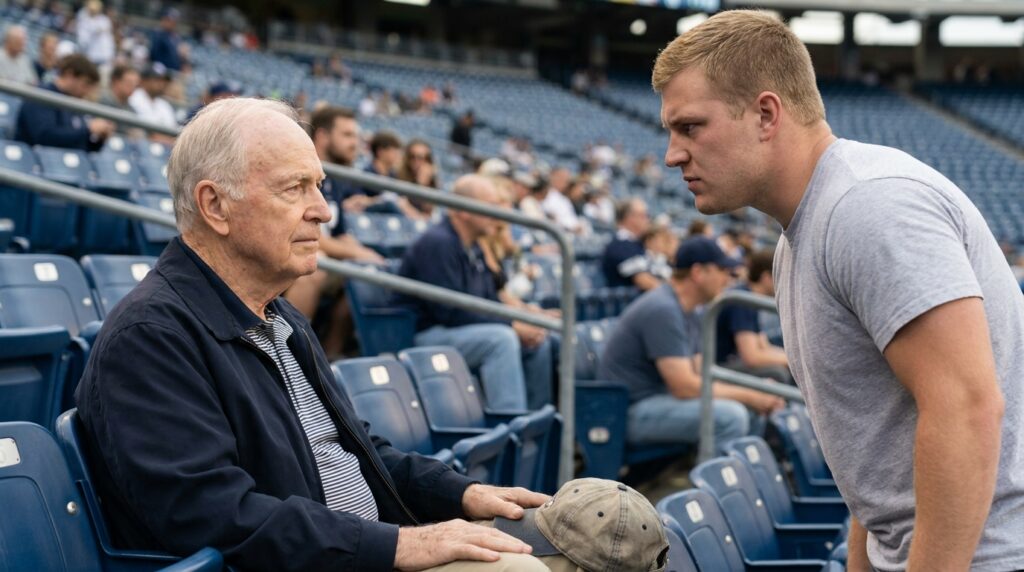
The boy didn’t take the walk to the concourse. His weight stayed centered over his thick rubber soles, his knees dropping two inches into a standard low-tier tackle stance that George had seen used on muddy base fields fifty years ago. To a civilian spectator five rows back, it looked like a careless stumble over a discarded soda cup. To George, it was thirty pounds of kinetic advantage moving at eight feet per second across a narrow concrete drop-off.
The first point of contact wasn’t a hand or a fist. It was the broad, wet seam of Vance’s t-shirt striking the iron stanchion of Seat 12. The blue polymer frame flexed until the lower mounting washers sheared through the lime crust on the gray floor, a dry, sharp snap that sounded like a pistol shot behind George’s left ear. Vance’s fingers hooked into the dark windbreaker fabric near George’s collarbone, his knuckles hot and greasy against the old man’s throat.
George didn’t try to pull back against the iron girder. He let his ribs take the initial impact of the younger man’s shoulder, his breath leaving his lungs in a single, unhurried whistle that tasted of iron filings and salt. He didn’t reach for Vance’s neck. Instead, his right heel locked against the raised safety tread behind Seat 11, his center of mass dropping into the small, three-inch pocket of space where the concrete row met the structural support weld. He used the boy’s momentum against the iron bracket itself.
The lever was short, but it was solid. George’s left hand came down onto Vance’s forearm—not with a grip, but with a flat, rigid palm strike that forced the boy’s elbow into the rusted edge of the seat-back hinge. The joint didn’t break, but the mechanical leverage was absolute. The sudden change in direction caught the youth off-balance, his broad chest rising as his heels cleared the floor grid entirely.
“Get off him!” Miller’s voice didn’t carry the authority of a badge anymore; it was the raw bark of a man trying to catch a falling transmission before it hit the floor plates. His heavy leather belt snarled against the iron armrest as he lunged down the row, his fingers claws against Vance’s shoulder blade.
But the mass was already in motion. George didn’t use strength; he used the three inches of clearance he had saved when he locked his heel. He twisted his hips toward the empty space of Seat 13, his right hand driving a single, straight push into the center of Vance’s chest where the cotton fabric was already soaked through with sweat. It was a short, unadorned movement—the old motor-pool shove used to break the seal on a rusted hatch cover.
The boy went back. He didn’t fall cleanly; his thighs caught the low-profile iron frame of the row behind him, his broad back striking the blue molded plastic with a heavy, hollow thud that vibrated through the entire floor plates of Section 114. A shower of dry peanut shells and gray paper cups scattered across the concrete aisle like salt thrown onto ice. Vance lay there for a fraction of a second, his light hair dark with grease from the floor bolts, his chest heaving as he tried to find the air that had been knocked out of his lungs by seventy pounds of unyielding bone and leverage.
George stayed upright. His dark jacket was torn near the third button, showing the fraying edge of his gray polo shirt underneath, but his boots hadn’t cleared their eighteen-inch alignment. He didn’t look down at the boy. His focus was entirely on his cap, which had dropped onto the concrete step between his feet.
The split buckram lining had completely separated during the struggle. The stiff, yellowed cardstock paper inside had slipped half an inch out of the crown, its fibrous edge curling under the midday heat. Across the top line of the document, visible under the harsh glare of the stadium lights, the heavy red grease pencil mark had begun to smudge against the sweat on George’s palm, but the signature beneath it remained legible—a bold, looping script that ended in a sharp, military cross-hatch.
Miller stopped his descent, his hand still clamped onto the iron rail of the aisle. His gray eyes drifted from Vance’s heaving chest down to the paper between George’s boots. The old deputy didn’t reach for his flashlight. His face had gone entirely flat, the color draining from his heavy cheeks until his weathered skin looked like wet sand under an old pier.
“George,” Miller said, his voice dropping into a low, ragged whisper that was instantly swallowed by the roar of a line drive down the third-base line. “That’s not an inventory log. That’s the court-martial waiver from the third depot division. The one they sealed when the commander went into the ground.”
The boy, Vance, rolled onto his side, his knuckles scraping the iron bolts as he tried to lift his head. His eyes were wide, fixed on the yellowed paper that had spent forty years hidden inside the old man’s cap. He didn’t look at George with anger now; he looked at him with the raw, sick realization of a man who has spent his entire life digging in the wrong grave.
George reached down and picked up the paper, his fingers steady as he smoothed the curling edge back into the torn lining of the crown. “The commander didn’t sign it to save the fuel, son,” George murmured, his gaze finally dropping to the youth on the floor. “He signed it to save his name. And you just broke the seal.”








