
CHAPTER 3: THE INTRUSIVE THRESHOLD
“Is there a problem down this row, George?”
The marshal’s voice was like gravel shifting under a heavy boot. He had stopped two steps up, his massive frame blocking the glare from the stadium lights behind him, throwing a broad, dark wedge of shade over Seat 12. His name was Miller, and his leather belt creaked with the specific weight of thirty years of carrying iron keys and a heavy mag-lite that had never been used for illumination alone. His hand didn’t rest on his hip, but his thumb was hooked firmly into his pocket, right beside the brass rivets that held the denim together.
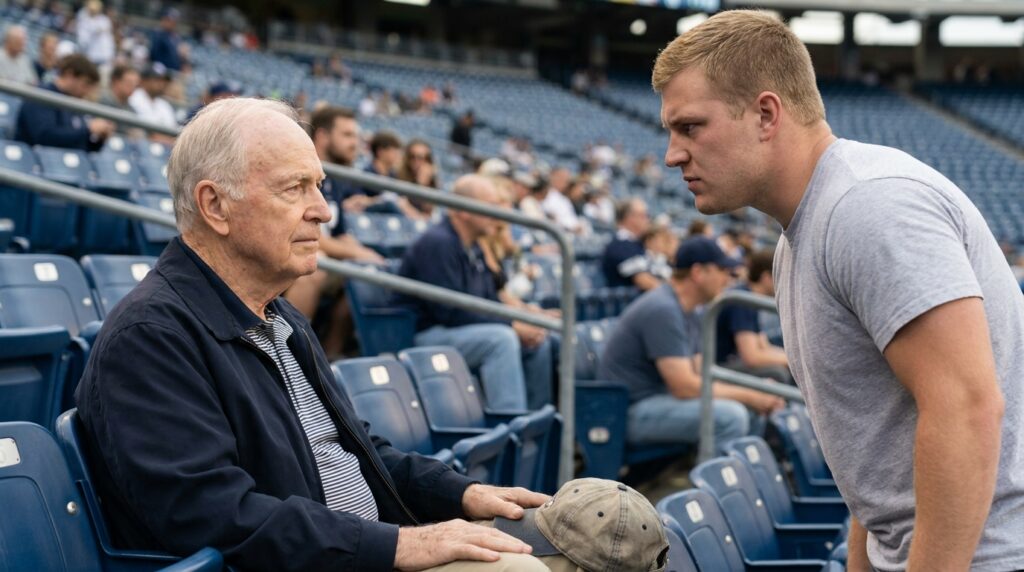
George didn’t look up immediately. He waited until the shortstop finished his warm-up throw to first base, watching the ball leave the glove with a dull, rhythmic thwack that vibrated through the iron framework of the stands. “No problem, Miller,” George said. His voice was flat, dry as the concrete dust under his feet. “Just sorting out the boundaries on eleven and twelve. The boy here was just leaving.”
The broad-built youth didn’t move. His heels were still locked against the concrete lip of the drainage trough, his shoulders held tight, but the sudden arrival of the law had pulled the frantic look back into his eyes. He looked at Miller’s heavy, sun-scorched face, then down at the cap George held pinned under his arm.
“He pushed me,” the boy said. The accusation was raw, but it lacked the weight of a man who believed his own words would be carried out of the section. He pointed a thick, grease-darkened index finger at George’s chest. “Old man’s got something that belongs to my family. He’s sitting on a ticket he didn’t buy with his own money.”
Miller took one slow step down. The iron stanchion beside his thigh rattled against its bolts. He didn’t look at the boy; he looked down at George’s cap, his small, gray eyes narrowing until they looked like two lead shot pellets embedded in old oak. Miller had been around long enough to know the smell of a motor pool, and he knew the specific way George carried himself—shoulders locked, chin level, feet split exactly eighteen inches apart to balance weight on a moving surface.
“The boy’s name is Vance, George,” Miller said softly, his voice dropping into a low register that didn’t carry past the three closest rows. “His granddad was Colonel Vance over at the depot before they pulled the tracking logs back in eighty-four. You remember the Colonel.”
The corner of George’s jaw tightened. The fiber of the old paper cardstock inside his cap lining seemed to grow cold against his ribs, a heavy, dead mass that felt like an unexploded shell buried in the mud of a ditch. The grease pencil mark the boy had mentioned—the heavy red line across the official seal—was something George hadn’t looked at since the night he signed the waiver in the small, windowless office behind the fuel tanks.
“I remember the rank,” George said. He didn’t use the name. He kept his eyes fixed on the field where the first batter was stepping into the box, the dirt kicking up around his cleats like dry smoke. “The rank doesn’t change the seat assignment, Miller. The row is clear.”
The youth, Vance, let out a sharp, wet breath through his teeth. He took a half-step forward, his broad chest tightening under his torn t-shirt, his hand twitching back toward his pocket. “He’s got the file, Miller. My dad spent ten years looking through the warehouse for that specific tracking log. The one that cleared the inventory before the third division moved out. It’s inside that cap.”
George didn’t flinch. He leaned back against the concrete girder, his hand coming down onto the armrest with a deliberate, slow pressure that allowed his knuckles to find the rusted edge of the iron bolt. He could feel the dynamic shifting now—the decoy secret, the old paperwork they all thought was a matter of missing machine parts or stolen fuel, was sitting right under his thumb. They thought it was an invoice. They thought it was money.
Miller didn’t move his hand from his pocket. He looked at Vance, then back at George, his heavy brow furrowing as he calculated the risk of an old man and a hot-headed boy in a public tier filled with five thousand pairs of eyes.
“Vance,” Miller said, his tone carrying the flat authority of a man who had cleared bars from the river to the highway. “Take a walk up to the concourse. Get yourself a drink. I’m going to have a word with George about his belongings.”
“He’s not leaving the stadium with that,” Vance hissed. His face had gone from red to a dull, ash-gray, his broad shoulders hunched as if he were ready to drop his weight and drive through the old man’s position regardless of the badge standing between them. “If that seal is broken, my dad’s name goes off the memorial wall at the depot. You know what he did.”
George looked up then, his weathered eyes meeting the boy’s with a cold, clear clarity that made the youth halt mid-breath. “Your granddad didn’t leave anything in the warehouse, son,” George murmured, his thumb feeling the edge of the stiff paper through the torn buckram. “He left it with me. And I’ve been holding the weight of it since before your father had a driver’s license.”
The boy froze, his fingers curling into tight, blunt fists against his thighs as the ambient crowd noise seemed to rise around them like a wall of dry sand.








