
CHAPTER 8: THE RESET ON THE CONCRETE GRID
The tail-lights of the city bus didn’t blink so much as they bled through the rising exhaust smoke, two oblong smears of wet crimson that stained the gravel path before the chassis dropped behind the warehouse wall on Fourth. The low, heavy rumble of the diesel engine flattened out, bouncing twice off the corrugated siding of the old wire mill, then unraveled into the regular, distant hiss of the belt line.
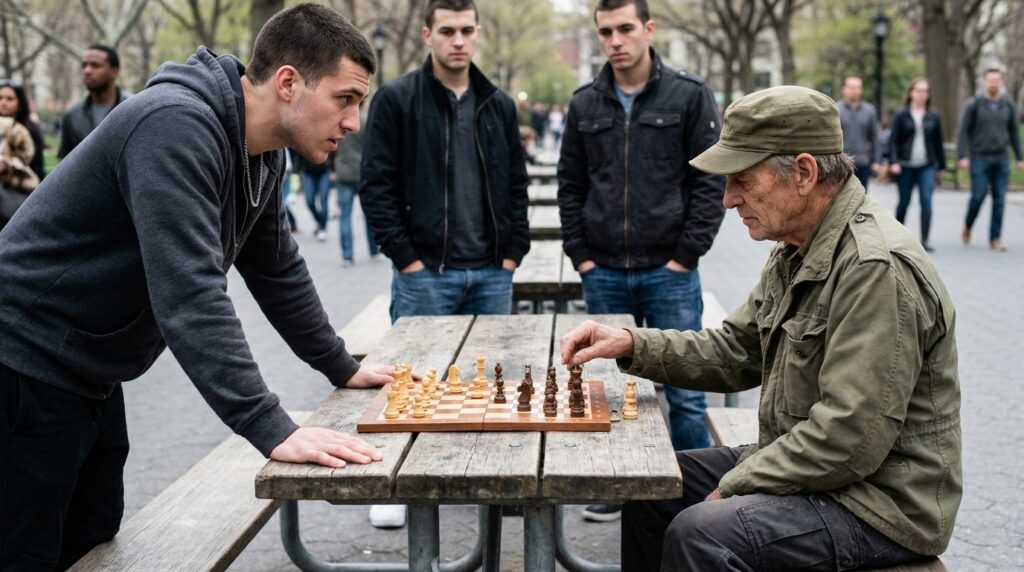
Marcus didn’t sit back down immediately. His knees remained straight, his posture anchored beside the concrete picnic table with the stiff, unhurried rigidity of an iron switch-stand left out in the weeds. The wind coming off the river basin had shifted toward the north, carrying a sharp, salt-crusted tang of early frost that turned his breath into short, white tufts against the collar of his jacket.
He looked down at his left hand. The thumb was still resting over the head of the pearwood knight, his gnarled joints white from the pressure of holding the piece against the painted aggregate square. Slowly, one knuckle at a time, he uncurled his fingers. The wood didn’t tip. The circle of green work-shirt flannel beneath the base held the grain perfectly balanced between the black line and the pitted stone, but when he lifted his palm, the internal lead cylinder inside the piece shifted against the wall with that dull, unmistakable clink.
The silence of the terrace was absolute now. The boy in the sports jersey was gone from the water fountain; the basketball behind the maintenance shed remained stranded in the high weeds where the chain-link met the dirt. Even the crow had cleared the rim, leaving nothing on the iron hook but a tiny streak of gray down. The park had pulled its corners in, the vast, fast-moving city outside the fence lines running on its own slick grease while the three feet of concrete between the benches stayed cold.
Marcus reached out with his right hand, his thumb and forefinger catching the greasy edge of the canvas-bound box. He slid it back three inches across the painted grid, covering the sliver of black oilcloth ledger that had been exposed during Trey’s demand. The movement was small, a quiet, administrative gesture that closed the gate on the names hidden inside the wrapper.
He didn’t open the book to check page sixteen. He didn’t need to see the blue ink strokes that spelled out David’s name, nor did he need to trace the forty-one other entries that filled the lined spaces between the old rail-yard logs. To the people at the terminal office, those boys had been manifests—numbers on a voucher sheet that could be cross-indexed against a missing crate of lard or a shipment of unrefined tallow. To Marcus, they were the ones who had sat on the steps of the shed while the late shift was blowing its whistle, the ones whose mothers had waited on the porch until the streetlamps turned from violet to gray.
He let his hips settle back onto the cracked aggregate of the bench, his old work shoes making a soft, scraping protest on the grit as his weight found the stone. The olive fabric of his field jacket rustled against his ribs, the faded unit patch over his pocket catching the last pale, lukewarm glint of the sky before the horizon turned the color of an iron pipe.
He picked up the box of paper matches from the black square of A1. It had that same leaden, surrogate weight against his palm—the anchor he used to keep the sheets from drifting when the wind came through the broken panes of the yard shack. He tucked it deep into his side pocket, past the brass screws and the blue carpenter’s chalk, until it rested flat against the seam.
The world didn’t move on Trey’s clock, and it didn’t move on Marcus’s either. It simply ran down, one afternoon at a time, like a clockwork hoist that had lost its spring in the middle of a long winter.
Marcus reached into his pocket and pulled out his pocket-knife—the one with the stag-horn handle that had been ground down until the rivets showed through the bone. He didn’t open the blade. He used the flat, smooth brass bolster to press a tiny flake of dried sycamore bark off the white square of E4. The wood of his white king’s pawn was split near the base, a small, silver-thin line where the winter damp had gotten into the grain after the strike of ’79, but it was still standing.
He took the black knight from C3. He didn’t place it in the cardboard box; he held it between his palm and his third finger, letting the loose lead weight slide back and forth in its cavity as he looked at the open squares of the king’s side. The game wasn’t finished. The pieces were still scattered across the concrete grid in the same asymmetrical row they had held before Trey’s shadow fell across the board—a patient, silent calculation that didn’t require an audience or a voucher to preserve its logic.
He placed the knight back on its square, ensuring the circle of green flannel was aligned perfectly with the white border. The metal clinked once inside the wood, then went still.
Marcus pulled the brim of his army cap down until the violet reflection of the streetlamps was blocked out by the dark canvas. He leaned his elbows on the rough edge of the concrete table, his eyes tracing the gray lines of the painted grid as the dusk turned into a solid, unblinking slate-gray across the ward.








