
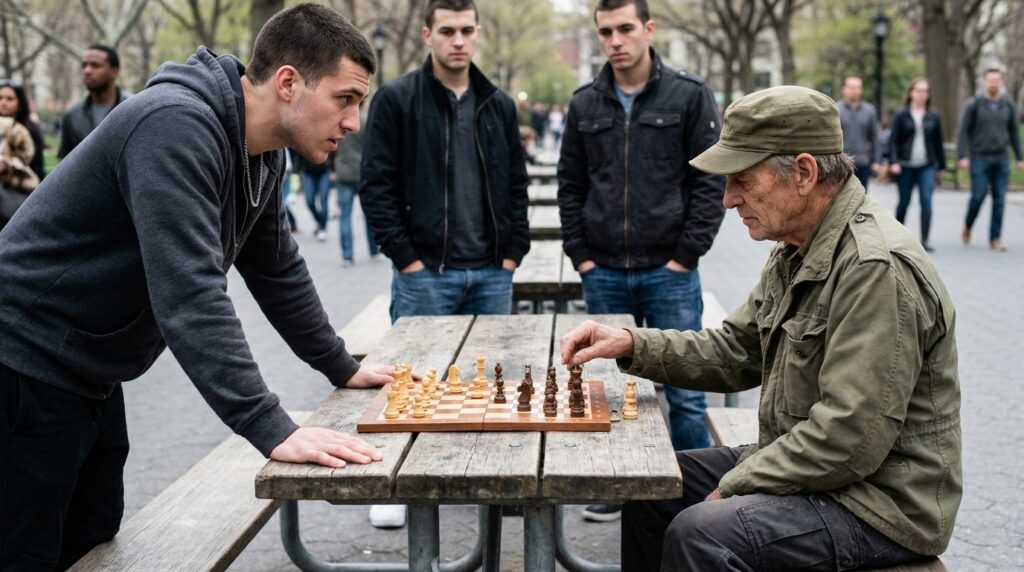
CHAPTER 4: THE BREAKING EDGE OF THE SQUARES
“Trey,” the second companion repeated, his voice dropping into that wet-plank flat rhythm. He moved his foot back an inch, his boot heel scraping against a discarded plastic bottle cap. “That’s the yard book. The old one with the heavy linen back. My uncle had one just like it before they sold the spur line to the shipping company.”
Trey didn’t look back at him. He didn’t let his hand fall away from Marcus’s white king’s pawn either, but the small zinc turnstile token suspended from his drawstring hit the head of the piece with a tiny, dead clink. The arrogance hadn’t left his shoulders, but it had stiffened, turning from the loose, swaying weight of a boy walking a fence into the hard, rigid brace of someone who had just found a crack in the foundation he was standing on.
“Leon said your name was Marcus,” Trey murmured. He leaned lower, his athletic frame casting a cold, dark wedge across the entire center of the concrete board, completely extinguishing the last pale yellow glint of the sun on the wood. “My brother told me about you. Said you used to sit by the old weighing platform when the grain trucks were still line-backed up to Twelfth Street. He said you kept a list of every plate that came through the gate.”
Marcus didn’t give him an inch of movement. His left hand remained anchored over the circle of green flannel at C3, his thumb resting lightly against the grain of the pearwood knight. The concrete underneath was drawing the heat right out of his skin, a steady, old-iron cold that he’d known in every motor pool from Fort Dix to the central lowlands.
“Your brother was named David,” Marcus said. His throat felt dry, like he’d been swallowing dust from a grain silo all afternoon. “He wore a silver ring with a square face he’d ground down from a brass union nut. He used to sit on the third step of the maintenance shed when the late shift was blowing its whistle. He didn’t talk much either.”
Trey’s fingers went dead still. The small cross tattooed on the soft flesh of his inner wrist twitched as the tendon in his forearm tightened. “He didn’t need to talk,” Trey snapped, his voice gaining that thin, high-friction rattle again. “He got five years in the state farm because someone handed a ledger to the transit office on Fifth. A ledger with blue pencil marks all over the margins.”
The tallest companion, the one with the salt-stained denim cuffs, took his hands out of his pockets entirely. His right hand was short two fingers at the knuckles—old machinery work from the wire mill down by the canal—and he used the stump to nudge Trey’s shoulder. “The bus is at the curb, Trey,” he said, his eyes scanning the long shadow of the sycamore tree where it reached across the gray gravel path. “The doors aren’t opening. The driver’s just sitting there looking at his wheel. That’s three minutes now.”
The silence that followed was different from the normal lull of the park. It wasn’t the absence of sound; it was the gathering of it. The thunk-thunk of the basketball behind the maintenance shed had stopped completely, replaced by the low, regular rattle of a diesel engine idling three blocks away near the old warehouse terminal. The neighborhood was holding its breath, the way a horse holds its ears back when it smells grease on a hot axle.
Trey ignored the nudge. He looked down at the matchbox Marcus had laid on the black square of A1, then his eyes traveled back to the corner of the black oilcloth ledger protruding from beneath the canvas-bound box. To a boy like Trey, that ledger was a map—a physical record of every delivery route, every unregistered truck, and every small-scale shipment that had passed through the rail-yards before the county chained the fences. It was the only thing that could show who had been moving the tallow crates before the transit police cleared the loading bays.
“Give me the book, old head,” Trey said. It wasn’t a shout; it was the heavy, low demand of a collector at a service window. He reached his hand out, his palm turning flat-up across the white squares, his fingers hooked slightly as if he were waiting for a tool to be dropped into his grip. “My brother’s still doing his time, and that book doesn’t belong to the park department. You don’t have a license to keep state property in a cigar wrapper.”
Marcus let his gaze stay on the boy’s open palm. The skin was pale in the fading light, the lines across the center deep and clean, unmodified by twenty winters of grease or iron. He thought of the ledger hidden beneath his box—the blue-lined pages that didn’t contain transit routes or shipping weights at all, but rather the names of forty-two local boys who had crossed the gravel path of this park between the winter of ’68 and the spring of ’72, names that the city had never bothered to cast into bronze or carve into the limestone walls of the courthouse downtown.
“The ledger stays where it’s bedded,” Marcus said softly. His voice had the flat, unyielding weight of an iron sleeper laid under a main line.
He didn’t move his hand from the knight, but he shifted his boots against the gravel under the bench. The gnarled, thick soles of his old work shoes planted themselves firmly into the gray dust, his shoulders squaring under the worn olive-drab field jacket as he prepared to break the stillness of the table.








