
CHAPTER 1: THE WEIGHT OF A KNIGHT
The wood was old pearwood, seasoned until the grain turned the color of dried liver, and the lead weights inside the bases had broken their glue ten winters ago. Every time Marcus lifted the black knight, he could feel the dull, internal metallic thud against the palm of his hand—a small, loose clink that smelled of linseed oil and forty years of pocket lint.
He didn’t look up at the courts. He didn’t need to. The rhythm of the afternoon was already etched into the soles of his boots through the cold concrete of the park bench: the heavy, syncopated thunk-thunk of an under-inflated basketball against rusted chain-link, the smell of sweet tobacco smoke drifting from the bus stop on Fourth, and the dry, scraping sound of sycamore leaves rolling down the asphalt like old currency.
To his right, the cardboard box that held his pieces sat propped against a water stain on the concrete table. It was an old military-issue ledger wrapper, its corners bound in frayed canvas tape that had turned grey from grease. A young man with a shaved head and a bright white sports jersey passed the table, his sneakers making a sharp, squeaking protest on the pavement. The boy didn’t look down. People in the ward rarely looked down at the tables unless they were looking for something someone had dropped. Marcus preferred it that way. The invisibility was a form of weather he had learned to navigate; it was thick, it was reliable, and it kept the wind off his neck.
He placed the knight on C3. The felt on the bottom was gone, replaced by a circle of green flannel he’d cut from an old work shirt during the first year of the strike. The wood hit the painted square with a soft, flat sound.
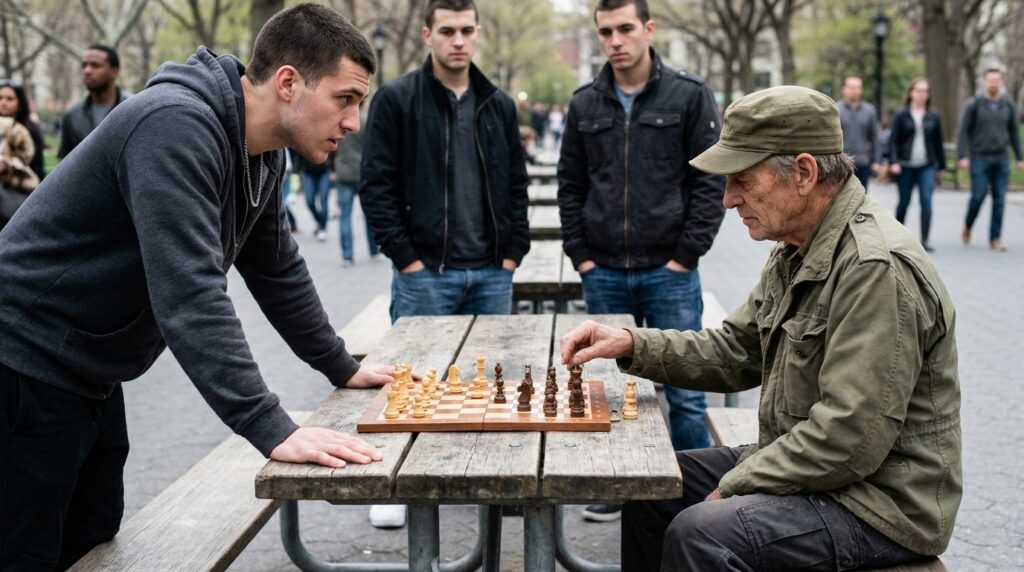
A shadow fell across the board then, not with the slow, drifting logic of the afternoon clouds, but with a sharp, heavy drop that smelled of cheap laundry detergent and synthetic winter jackets. The shadow didn’t move. It stayed fixed over the white squares on the king’s side, blocking the thin, late-October sun that had been warming Marcus’s left wrist.
“Hey old man, move faster, you’re wasting everyone’s time.”
The voice was too loud for the park’s four o’clock lull. It had that thin, metallic edge of an engine running without enough oil—an unearned velocity that wanted everyone within thirty yards to stop and check their pockets.
Marcus kept his fingers on the head of the knight. He didn’t look up at the silver chain swinging two inches above his pawns, nor did he look at the dark fabric of the hoodie crowding the edge of the concrete grid. He watched the shadow of the chain instead. It looked like a small, iron pendulum swinging across the white paint of the table, regular and small. Behind the boy, two sets of larger, wider boots shifted on the gravel, their soles grinding the small stones into gray powder. The chorus was waiting.
Marcus let his thumb trace the small, circular brass blemish where the lead had been resealed into the wood. The metal was cold. The park around them seemed to pull its breath in, the basketball on the court hitting the rim once, twice, then rolling out into the grass where nobody went to fetch it.








