
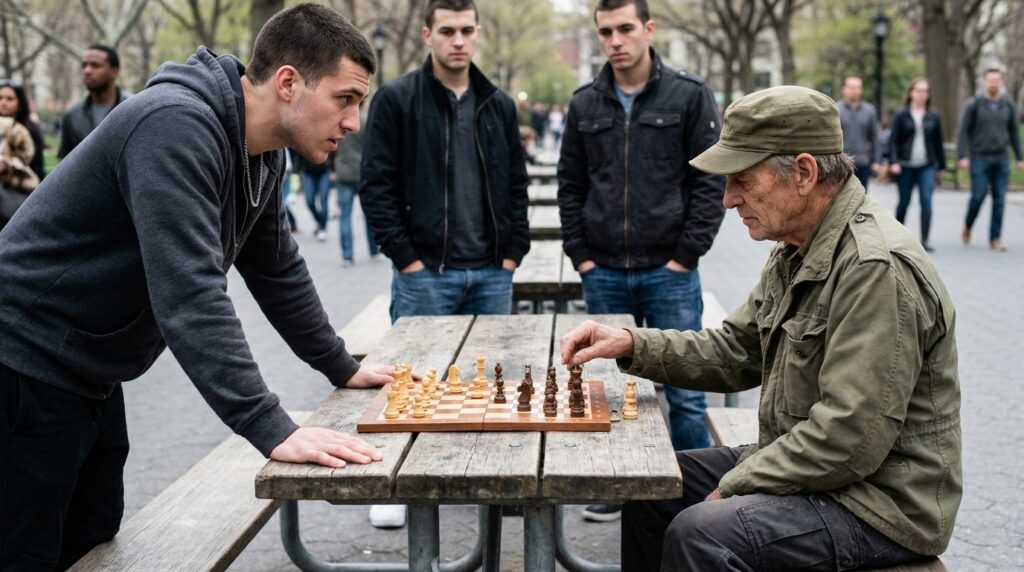
CHAPTER 3: THE COLD CORNER OF THE GRID
Trey’s fingers hovered, casting a small, dual-pronged shadow over Marcus’s white king’s pawn. The kid didn’t drop his hand into a grab, but the distance between his skin and the old lacquer was less than an inch. A man could build an entire life out of less space than that, Marcus knew; he’d seen squads partition a clay trench with nothing but two sandbags and an unuttered agreement not to look each other in the eye while eating lard.
“You’re an old head who doesn’t hear so good,” Trey said. His knuckles were gray-white against the charcoal fleece of his cuffs, the salt-rimed denim jacket he wore over his hoodie rustling like dry corn husks. When he leaned, the blue wool of his sleeve turned up slightly, exposing a pale square of skin near the inner wrist where someone had scratched a tiny circle crossed with an asymmetrical lines—a crude chalk marker or an old tattoo done with a sewing needle and ink from a ballpoint pen. It matched the three notches on his zinc token.
Marcus let his gaze stay dead on that small, ink-bitten cross. It wasn’t the signature of the local gangs on Fourth, nor was it the tagging he saw sprayed along the side of the warehouse docks near the river. It was an older type of shorthand—the kind of ledger mark the city rail workers used to scribble on the sides of grain cars to show a brake line was weeping oil.
“I hear the court,” Marcus said, his throat clicking on the dry air. He didn’t lift his fingers from the pearwood knight. “The ball is still hitting the iron. Nobody’s playing for forty dollars on a rim that’s missing half its hooks.”
Behind Trey, the tallest of the two companions let out a dry, rattling cough that ended in a throat-clearing grunt. His hands remained deep inside his oversized work-pants pockets, his shoulders hitching against the autumn draft that came off the river basin. “Trey, look at the block,” he muttered, his eyes shifting toward the far corner of the park where the old iron flagpole stood without a rope. “The bus is turning around early. The regular driver isn’t on the three-fifteen.”
The boy didn’t look back, but his chin twitched. The forward lean stayed fixed, his center of gravity hung over the concrete painted squares like an unexploded mortar shell caught in a low branch. He wanted the table because the table was the only piece of the terrace that didn’t have a direct line of sight from the street corner where the transit cops parked their cruisers. It was a pocket—a blind spot created by the gnarled trunk of a ninety-year-old sycamore and the cracked brick wall of the old city maintenance shed.
“The bus isn’t our business, Leon,” Trey said, though his voice dropped a fraction of an octave, losing some of its gloss. He looked back at Marcus, his jaw shifting as if he were chewing on a piece of tobacco he’d found in his pocket. “The old head knows the rules. You want to sit here, you pay the rental or you play the house. That’s how Mr. Miller set it up before they boarded up the clinic across the way.”
Marcus didn’t answer. He took his hand off the black knight, leaving the piece precisely between the C3 square and the faded white boundary line. He reached slowly into the side pocket of his olive-drab jacket, his fingers brushing past three spare brass screws, a stub of blue carpenter’s chalk, and a small strip of emery cloth. He pulled out a box of paper matches—the cheap, sulfury ones given away with tobacco pouches at the corner grocery before the windows were sheeted with plywood.
He laid the matchbox on his side of the concrete table, right on the black square of A1.
The box wasn’t empty. It had a weight to it that didn’t match twenty wooden splints. When it hit the aggregate, it gave off a heavy, leaden thump that made the box of chess pieces shift an eighth of an inch to the left. The grease-stained canvas tape on the corner of the box scraped against the stone, revealing just a sliver of the oilcloth book hidden underneath.
Trey’s eyes dropped to the matchbox. He didn’t touch it, but his mouth went tight at the corners. He recognized the sound of dead weight. In the ward, a lead-lined matchbox meant one of two things: it was either a scale-weight for balancing portions of unrefined tallow from the butcher’s yard, or it was the kind of anchor an old merchant marine used to keep his tally sheets from blowing into the bilge water when the hatches were cleared.
“Mr. Miller’s been in the home on Grand since the frost came two years ago,” Marcus said softly, his thumb resting on the matchbox’s striking strip. “And he didn’t leave any receipts for this corner. I know because I helped him pack his trunk when the county van came for his mattress.”
The second companion, the one who hadn’t spoken since they crossed the gravel path, took his hands out of his hoodie pocket. He wasn’t looking at Marcus; he was looking down at the small oilcloth corner that had appeared under the chess box. His forehead bunched into three thick ridges above his nose. “Trey,” he said, his voice flat as a wet plank. “That’s the book from the yard office. The one with the green strings.”
Trey didn’t move his hand away from the bishop, but his fingers uncurled. The athletic posture—the wide-stanced, forward-tilting loom that had dominated the picnic table for five minutes—seemed to lose its spring, the fabric of his hoodie settling heavily against his ribs. The silence between the four of them grew thick, smelling of coal dust and old river water, while behind the maintenance shed, a crow came down onto the rusted rim of the basketball hoop with a solitary, dry snap of its wings.








