
CHAPTER 5: THE RISE OF THE ANCHOR
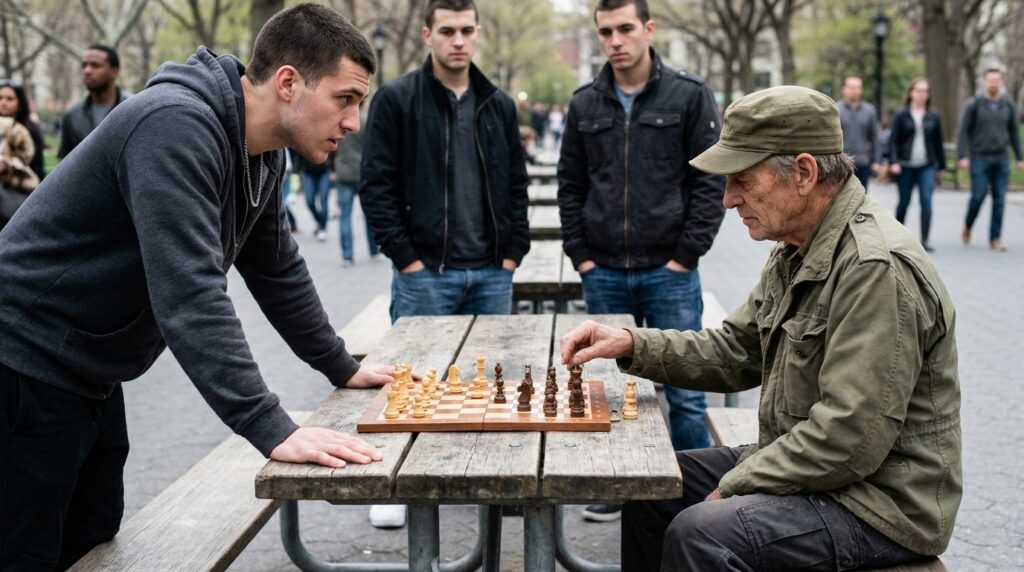
The shift didn’t begin with a shout. It began in the gnarled rubber of Marcus’s soles, the deep, cross-hatched treads of his old work shoes biting into the gray park grit until the small stones flattened under his ballast. His knees, which usually gave off a dry, wooden crack when he rose before noon, moved in absolute silence.
He didn’t pull his hand back from the pearwood knight. Instead, he kept his fingers curved over the smooth lacquer of the piece, using the slight, front-weighted tilt of his torso to press the green flannel circle deeper into the C3 square. Then he stood.
He didn’t jump or spring like the boys who played the baseline behind the brick shed. He went up with the slow, unhurried mechanics of an old warehouse hoist—one link of the chain settling into the tooth of the sprocket at a time, loud and heavy and thick. His shoulders, hidden beneath the grease-softened seams of the olive-drab field jacket, squared themselves against the cold draft coming off the river basin until the fabric drew tight across his shoulder blades.
Trey didn’t step back immediately, but his open palm, which had been extended over the white squares to receive the ledger, tilted upward by two inches. His fingers curled back toward his wrist like dry leaves reacting to a sudden frost. The boy was athletic, built out of clean lines and quick muscle, but his clearance was gone. Standing eye-to-eye with Marcus, the top of Trey’s army-style cap was level with the youth’s forehead, but the mass was different. Marcus had forty years of salt-bacon, boiler smoke, and iron-piling under his skin; he didn’t sway when the transit bus shifted its gears three blocks away.
“Your brother David didn’t know how to finish a row either,” Marcus said. His voice was lower now, falling into that rhythmic, low-frequency hum that old mechanics used when they were talking over the rattle of a loose belt line. “He’d get three boxes into the spur car and then he’d sit down on the step to look at his knuckles. He thought the train would wait because he was young and his shoes were clean.”
Trey’s mouth opened, then snapped shut so hard his silver chain gave off a tiny, metallic ring against the zipper of his hoodie. The small zinc turnstile token suspended from his drawstring swung wildly, nicking the edge of the cardboard chess box. “You don’t talk about David,” Trey muttered. The skin around his nose had gone a pale, chalky gray, the tiny ink cross on his inner wrist shaking against the cuff of his sleeve. “You don’t know nothing about what he was doing with those marking sheets.”
“I know he didn’t read the bottom line,” Marcus said softly, his gaze remaining locked on Trey’s eyes. He didn’t look down at the board, nor did he look at the two companions who had gone completely still on the gravel path. “He thought the blue marks were for the shipping office. He thought he was tracking crates of lard for Mr. Miller’s store.”
To Marcus’s left, the tallest companion—the one with the two missing fingers on his right hand—let out a short, blowing breath through his teeth. He didn’t nudge Trey this time. His arm stayed glued to his side, his thumb twitching against the salt-rimed denim of his thigh. “Trey,” he whispered, his eyes fixed entirely on the faded unit patch sewn above Marcus’s left pocket—a small, dark shield with three olive leaves that had been scrubbed so many times the green thread had turned the color of river moss. “Trey, leave the head alone. That’s the jacket from the terminal gate. The one from the old yard guard.”
The park around them had dropped its regular sounds one by one. The basketball behind the shed didn’t bounce; the boy in the white sports jersey was standing near the water fountain, his hands dangling at his sides as he watched the picnic table from twenty yards out. Even the crow on the rim had stopped its wing-snapping, its head tilted toward the concrete grid like an old clerk waiting for a voucher to be stamped.
Marcus didn’t use the silence to push. He simply held his position beside the table, his hand resting on the pearwood knight with the light, unthinking pressure of a driver holding a loose steering wheel on a straight road. He could feel the cold of the concrete bench radiating through the air between them, a pale, fraying winter chill that smelled of dead grass and wet gravel.
“The book doesn’t have any names you want to find, son,” Marcus murmured, his eyes unblinking under the shadow of his cap brim. “And if you touch the binding, you’re going to have to carry the weight of every line that’s written in it. You haven’t got the shoulders for that kind of ledger.”
Trey’s hand stayed caught in the air between them, his fingers hovering above the king’s pawn like a bird that had forgotten how to land on a wire. The arrogance was still there, stamped into the sharp curve of his jaw and the tight draw of his dark hoodie, but the momentum had broken. The spatial logic of the terrace had turned over; the boy was no longer crowding an old man at a public bench—he was standing in front of an iron gate that hadn’t been oiled in thirty years, and the keys were in the old man’s pocket.








