
CHAPTER 6: THE RETREAT OF THE CHORUS
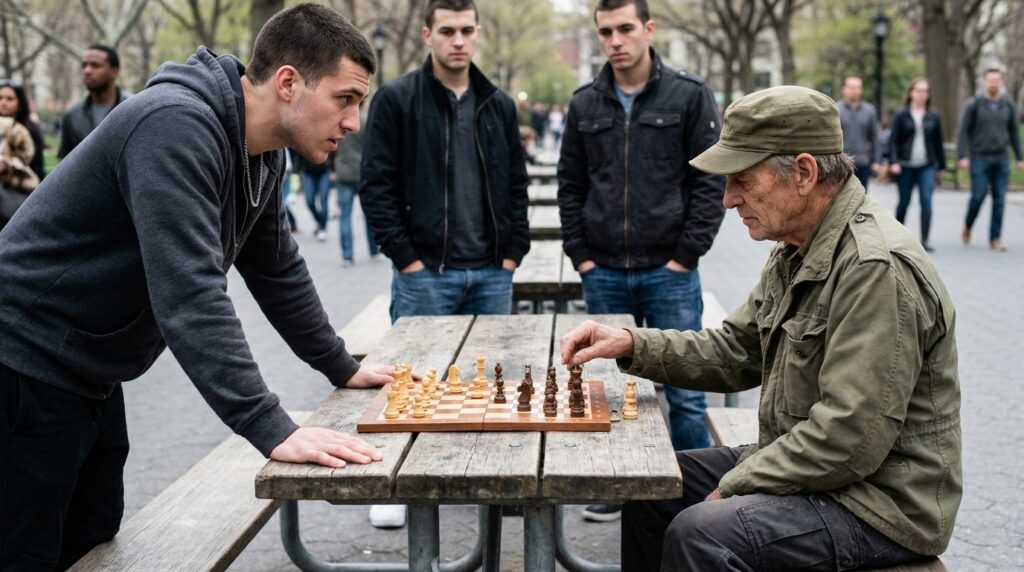
Leon took his hand out of his jacket pocket, and for the first time since they had crossed the gravel path, his three good fingers didn’t form a fist. They hung loose, gray-skinned and thick from winter moisture, the stub of his middle knuckle twitching against the seam of his thigh. He didn’t look at Trey’s profile. He didn’t look at Marcus’s eyes either. He looked strictly at the dark shield of the unit patch sewn over Marcus’s left pocket, his chest dropping as he let out a slow, unhurried whistle through his teeth.
“Trey,” Leon said. His voice had lost that dry, rattling snap it carried when they were standing near the basketball benches. It sounded wet now, softened by the cold river draft until it was thin as tissue paper. “Trey, we’re off the line. My uncle told me about the gate guards from the north terminal. They didn’t work for the transit authority. They worked for the federal yard office before the rails went under.”
The second companion didn’t wait for Trey to turn his head. He took a long, flat step backward, his high-top sneaker grinding a piece of yellowed sycamore bark into the gray grit. His hands stayed tucked into his waistband, his elbows pinned tightly against his ribs as if he were trying to make his athletic frame fit into the narrow shadow of the maintenance shed behind them.
The circle was breaking. It wasn’t an explosion; it was a slow, systemic erosion of leverage, like a stack of loose cedar shingles sliding off the back of a flatbed when the handbrake drops.
Trey didn’t move his hand away from Marcus’s white pawn, but his fingers had gone completely rigid, the tips turning the color of dry salt against the dark wood. The small zinc turnstile token suspended from his drawstring had stopped its wild swinging, hanging perfectly straight over the painted concrete grid. The boy was isolated now—not by distance, but by the sudden, heavy silence of his own crowd.
“Leon, shut your mouth,” Trey muttered, though his jaw didn’t move with the same wide, loose swagger it had five minutes ago. His chin remained tucked into the collar of his fleece hoodie, his breath coming in short, foggy bursts that clouded the surface of the black pieces on the king’s side. “The old head’s just talking. He’s trying to pass a bluff because he knows he can’t clear the table before the streetlights come on.”
Marcus didn’t break his stance. He stood with his hands resting lightly on the corners of his cardboard chess box, his old work shoes planted so deeply into the dust under the bench that he looked like an iron mooring post left behind after the wharf had rotted away. The faded olive fabric of his jacket gave off the faint, sour smell of damp cotton and ancient wool—the scent of blankets that had spent three years in an army locker before being dragged out to face a county winter.
“It’s no bluff, son,” Marcus said softly. His voice didn’t carry past the sycamore trunk, but within the three feet of concrete separating them, it had the density of a lead sinker dropped into a bucket of grease. “Your brother thought he was moving lard because the manifests were printed on the back of the grocery warehouse sheets. He didn’t check the serials on the crates. If he’d looked at the zinc plates under the latches, he’d have seen the department seals.”
Trey’s eyes flicked down to the corner of the black oilcloth ledger. His brow split into two sharp vertical ridges between his eyebrows, his nostrils widening as he tried to find the thread of his original demand. He wanted the book because the people behind the three-on-three game—the ones who had put up the forty dollars on the rusted rim—had told him that the old man’s ledger was the only thing that could clear David’s name at the transit station on Fifth. They’d told him it was a tracking log, a record of the trucks that had cleared the loading bays before the gates were chained.
“If the seals were on the crates, then the gate guard knew,” Trey said, his voice dropping into a tight, transactional rasp that sounded like iron filings sliding down a tin chute. “The guard let them load. He took the vouchers and he didn’t log the plates.”
Marcus let his gaze rest on the tiny ink cross scratched into the skin of Trey’s inner wrist. The lines were jagged, the blue ink fading into a sickly shade of slate-gray under the pale evening light. “The guard logged every name that went through that turnstile, Trey,” Marcus murmured. “But he didn’t log them for the transit company. He logged them so their mothers wouldn’t have to go down to the river morgue to identify a jacket by the lining.”
Leon took another step back, his boot heel hitting the rusted iron base of the old maintenance shed wall with a dull, hollow clank. He didn’t say another word. He simply turned his shoulder away from the table, his eyes fixed on the city bus that was still idling at the far curb, its red brake lights casting a long, bloody smear across the wet asphalt of Fourth Street.
Trey stayed caught in the space between his companions’ retreat and the unyielding mass of the old man across the grid. The arrogance had stiffened into something brittle, a thin crust of pride that was cracking under the weight of an old war patch and a story about a brother who hadn’t checked the latches on his crates.








